Sunday 22nd February 2026

  • One of its moons (Ganymede) will come out from behind the planet.
    o
  • It looks like a tiny dot of light slowly appearing beside Jupiter.
    o
  • With a small telescope or big binoculars, you can see it slowly moving.
    o

Posted in Homepage (Posts) | Comments Off on Sunday 22nd February 2026

Friday 20th February 2026

  • Mercury reaches its highest altitude in the evening sky.
    o
  • This makes tonight one of the best evenings for UK observers to catch Mercury in twilight.
    o
  • Just after sunset, look west – Mercury will be at its easiest to spot for this apparition, low in the western sky.
    o
  • BSL Version

o


Posted in Homepage (Posts) | Comments Off on Friday 20th February 2026

Friday 20th February 2026

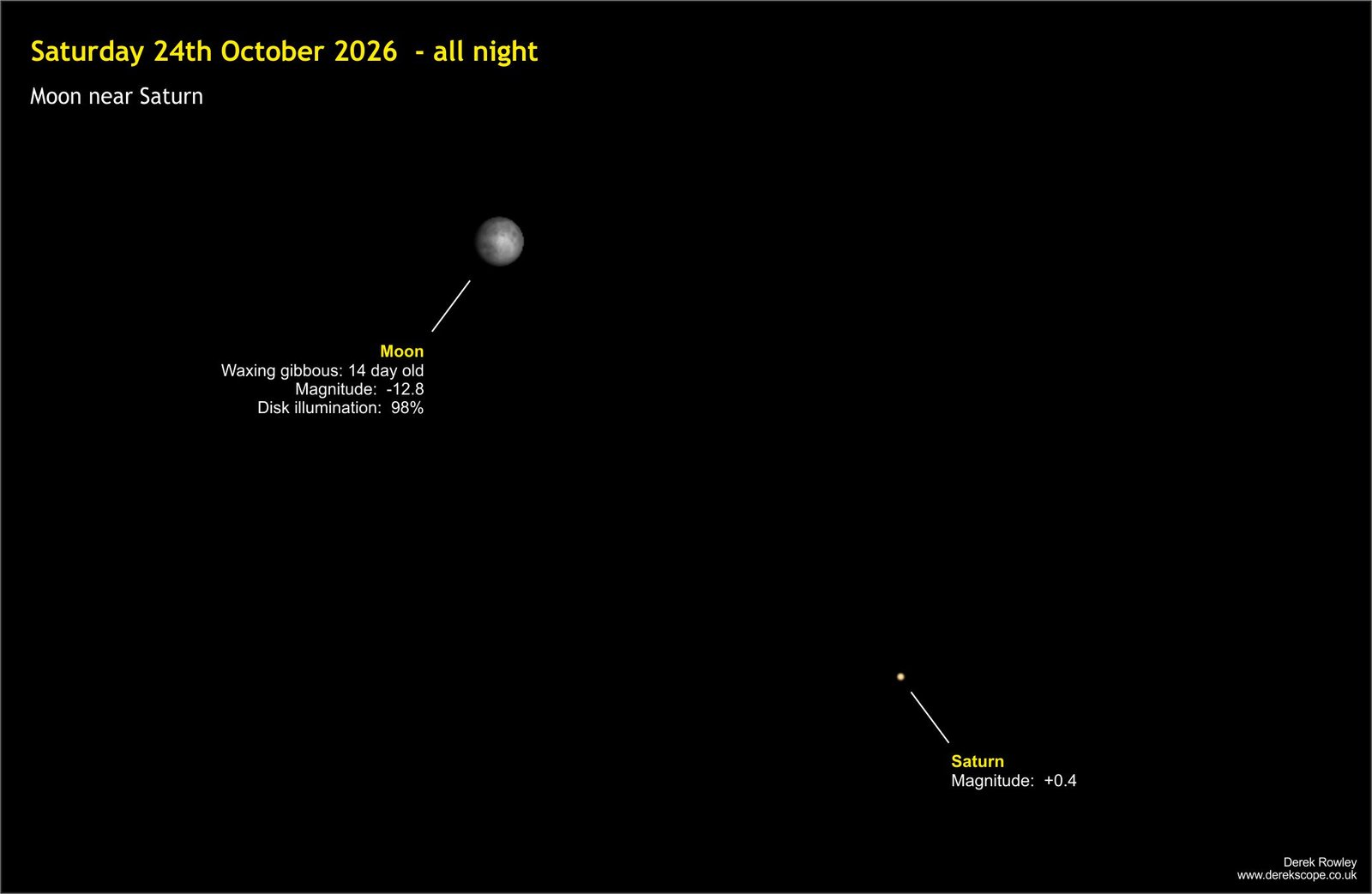
  • Conjunction of the Moon and Saturn – both will be relatively low in the sky, so clear horizon to the west will help.
    o
  • Binoculars will enhance the view, but Saturn’s rings won’t be visible without a telescope.
    o

Posted in Homepage (Posts) | Comments Off on Friday 20th February 2026

Thursday 19th February 2026

  • A 3‑day crescent next to Saturn makes a lovely, gentle pairing – a conjunction.
    o
  • They’re low in the west (Clear horizon, binocular recommended.)
    o

Posted in Homepage (Posts) | Comments Off on Thursday 19th February 2026

Thursday 19th February 2026

  • Mercury will reach its greatest eastern elongation today, appearing 18° east of the Sun in the evening sky.
    o
  • This will be the best evening apparition of Mercury for the Northern Hemisphere in 2026.
    o

Posted in Homepage (Posts) | Comments Off on Thursday 19th February 2026

Wednesday 18th February 2026

  • Both planets will be visible low in the western sky after sunset.
    o
  • Venus will shine brilliantly as the “Evening Star,” while Mercury will be fainter but still noticeable nearby.
    o
  • Mercury lower down, and the crescent Moon between them – a perfect outreach opportunity.
    o
  • Use binoculars to help after the sky fades.
    o
  • BSL Version

oooo


Posted in Homepage (Posts) | Comments Off on Wednesday 18th February 2026

Tuesday 17th February 2026

  • Annual Solar Eclipse today
    Not visible from the UK but worth saving the date in August this year.
    o
  • Although today’s annual solar eclipse can’t be seen from Britain, our next UK visible solar eclipse is on Wednesday 12 August 2026.
    o
  • It will be a large partial eclipse across the UK, with the Sun taking a dramatic bite in the evening.
    o
  • BSL Version

oooo


Posted in Homepage (Posts) | Comments Off on Tuesday 17th February 2026

Thursday 12th February 2026

  • A vertical straight‑line alignment occurs when three of the Galilean moons — usually Io, Europa, Ganymede, or Callisto — appear in a single straight line.
    o

Posted in Homepage (Posts) | Comments Off on Thursday 12th February 2026

Thursday 12th February 2026

  • Callisto and Europa both produce visible shadow transits.
    o

Posted in Homepage (Posts) | Comments Off on Thursday 12th February 2026

Wednesday 11th February 2026

  • The Moon will indeed appear close to Antares in the early morning of 11th February.
    o
  • Antares is the brightest star in the constellation Scorpius, a red supergiant often called the “heart of the scorpion.”
    o

Posted in Homepage (Posts) | Comments Off on Wednesday 11th February 2026