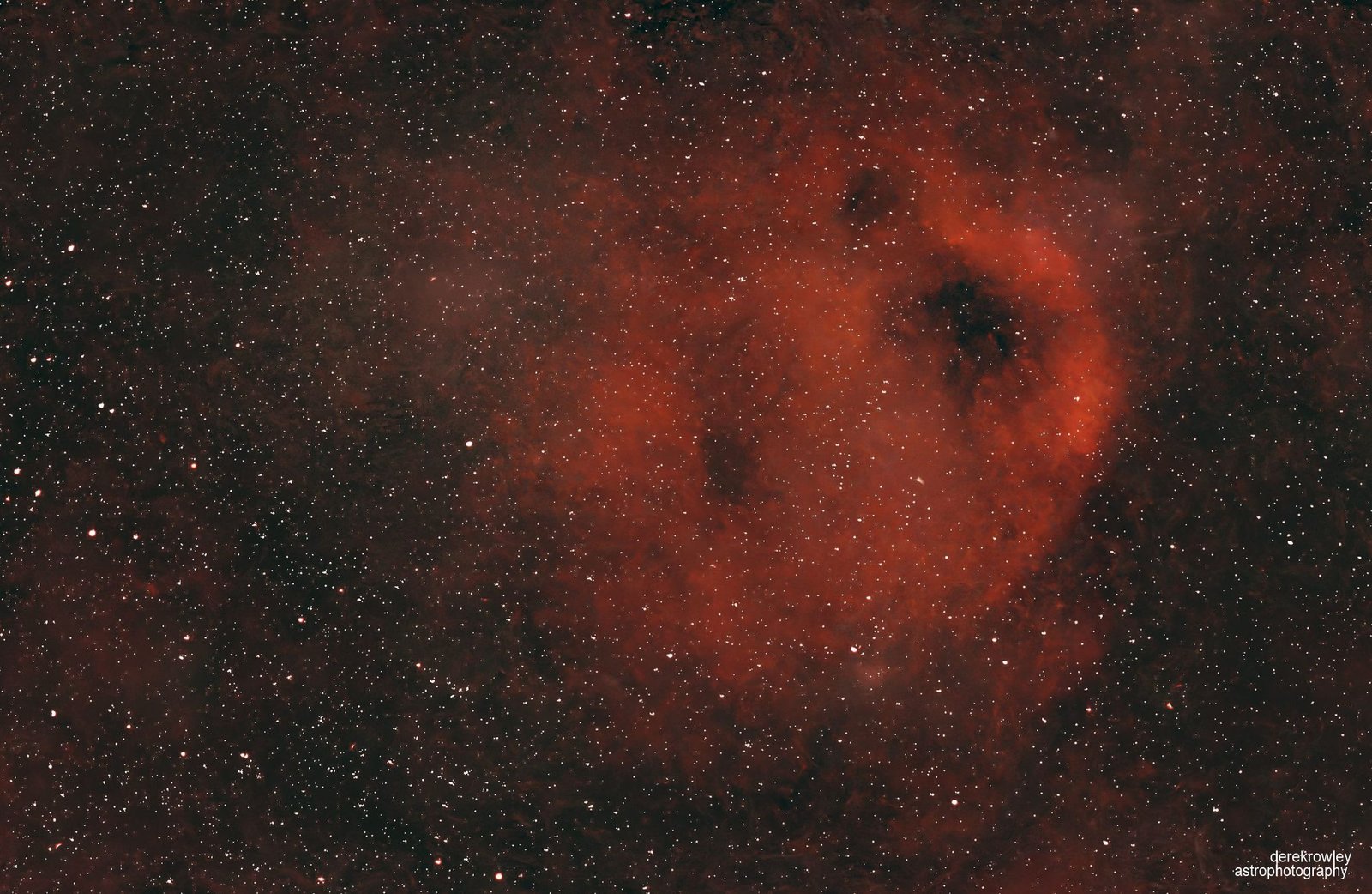
Sh2-173 (The Phantom of Opera Nebula)
oooo
- Located in Perseus Arm of the Milky Way ~ a young nebula glowing on the edge of Cassiopeia.
o - The nebula’s shape resembles the Phantom’s mask:
– a curved bright rim
– a pale interior “face”
– dark dust lanes crossing the front.
This appearance is consistent across deep narrowband images (see image above).
o
- Object Name
Sh2-173
- Object Type
Emission Nebula
- Constellation
Cassiopeia
- Magnitude
n/a
- Distance
8,800 light-years
oooo
oooo
Equipment
Telescope:
Mount:
Accessory:
Sky-Watcher Esprint 80ED Triplet
Sky-Watcher AZ-EQ6 GT
ZWO ASIair Plus / PixInsight
Camera:
Guiding:
Filter:
ZWO ASI585MC Pro cooling
ZWO ASI1200MM
2″ Optolong eNhance
oooo
Bortle Scale: Kelling Heath, Weybourne, North Norfolk (Bortle 4.1)
oooo
oooo
Integration
- Date:
Tuesday 13th October 2026
- Moonlit:
Waning gibbous – 23 days old
Magnitude: -10.4
Moonlit: 39%
- Total:
180’s x 50 subs = 2 hour 30 minutes
oooo
oooo
Constellation :- Vulpecula (The Fox)
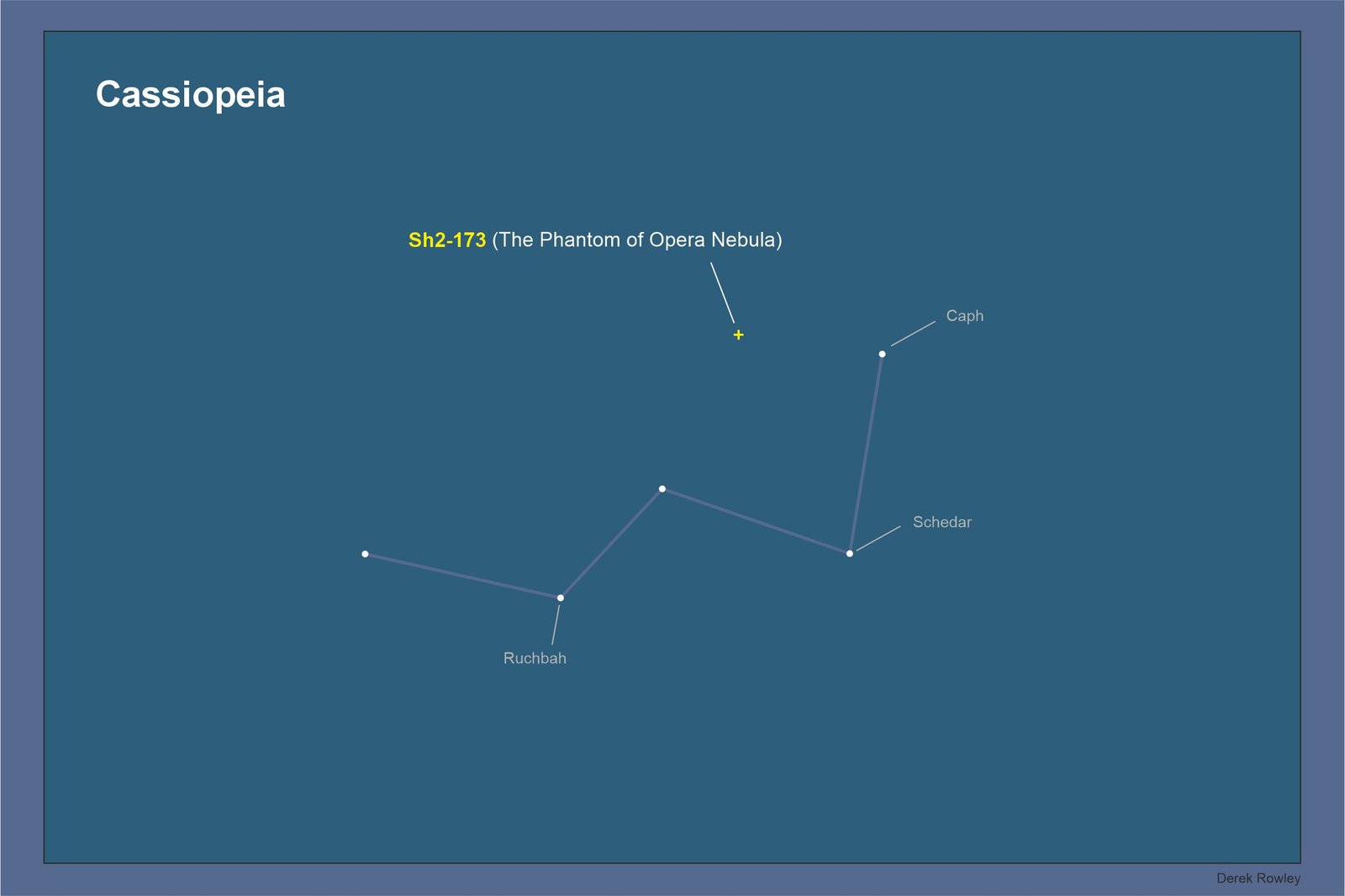
Object :-
oooo
Object :-
Other name :-
Type :–
Magnitude :–
Distance :-
Constellation :-
Right Ascension :-
Declination :-
oooo
oooo
Sh2-173
Phantom of Opera Nebula
Emission Nebula
n/a
8,800 light years / 77 light years across
Cas (Cassiopeia / The Queen)
00h 21m 16s
+61° 43′ 30″
Enlarge on click the map.

(Click the map above for a large view.)
oooo
oooo
More Information
| Abbreviation: Cas (Cassiopeia) |
| English Name: The Cassiopeia Queen |
| Genitive: Schedar, sometimes spelt Shedar or Shedir. |
| Hemisphere: Northern Hemisphere |
| Location: Between the constellations of Andromeda and Cephus. |
| Visible between latitudes: +90 and -20 degrees |
| Best season: Autumn |
| Seen in three seasons: Summer, Autumn and Winter |
| Best seen in: November |
| Seen between: Circumpolar (This constellation of Cassiopeia stays in the sky all the year.) |
| Right Ascension (RA): 01 hour |
| Declination (DEC): +60 degrees |
| Area (square degrees): 598 (25th) |
oooo
oooo
oooo
oooo
oooo
oooo
oooo
oooo
oooo