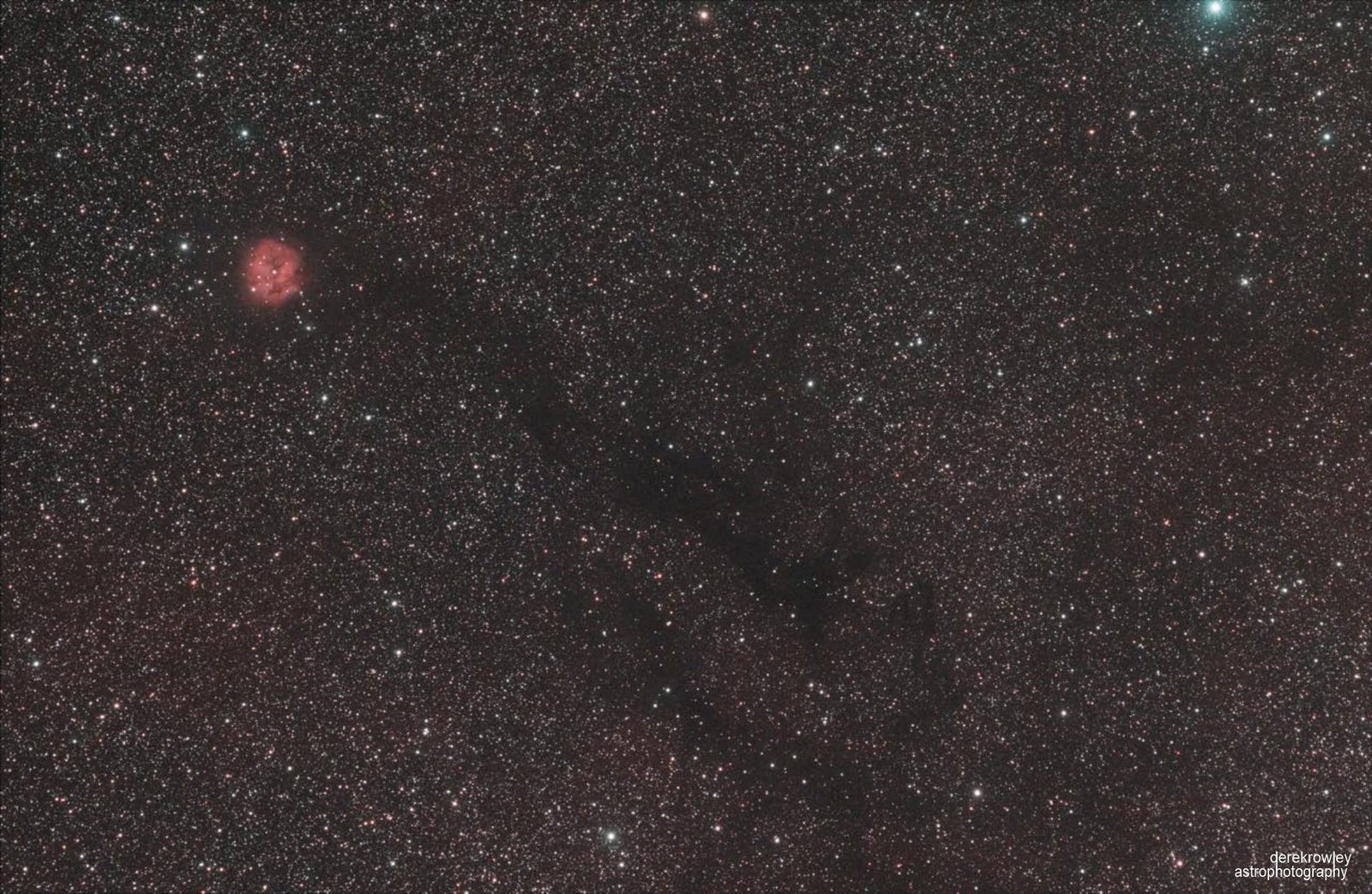
Barnard 168
- Barnard 168 is a long, dark, snake‑like dust cloud in the constellation Cygnus, famous for containing the Cocoon Nebula (IC 5146) at its eastern end.
o - It is one of the most striking dark nebula “lanes” in the northern Milky Way.
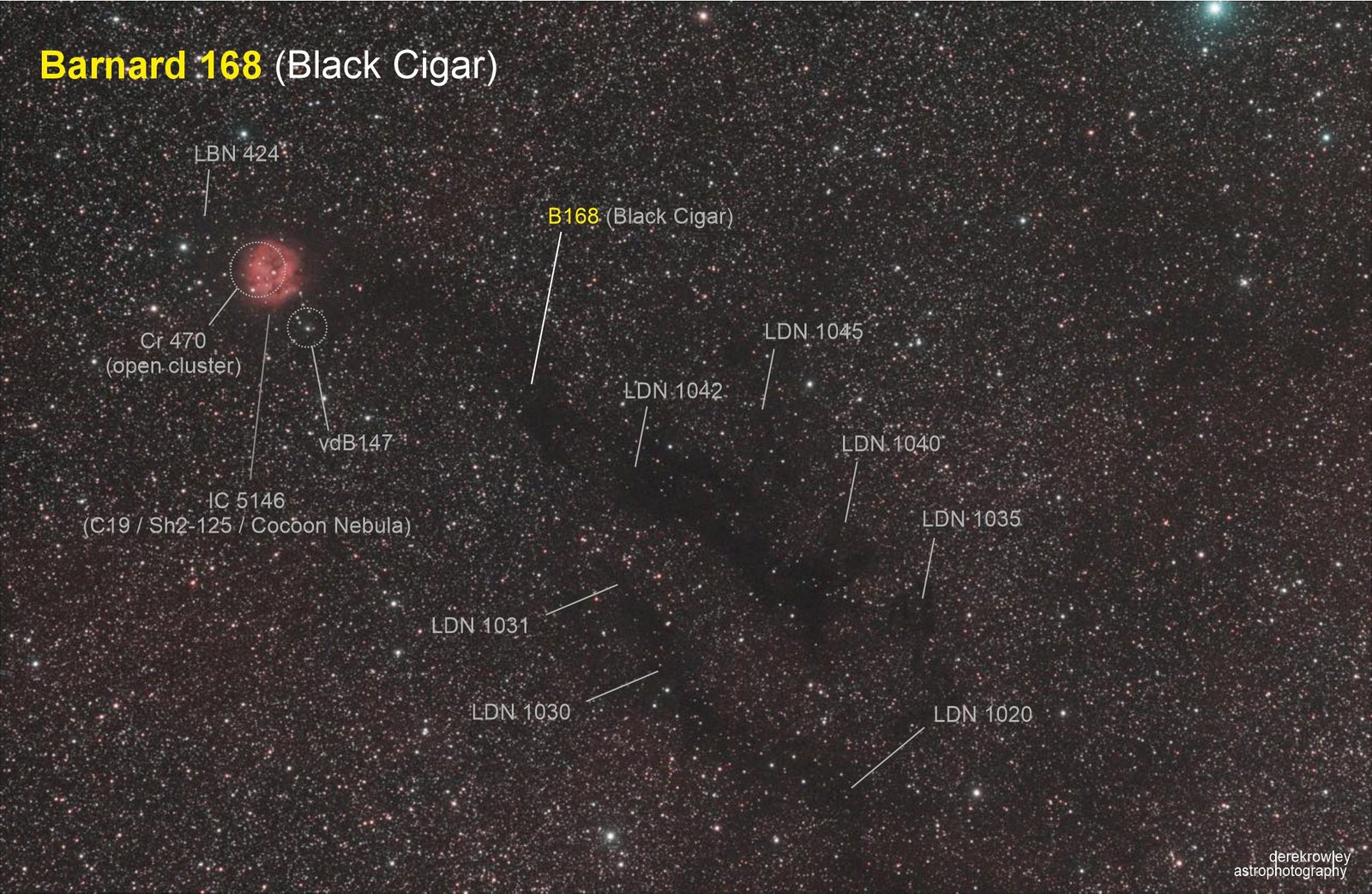
o - The Cocoon Nebula (IC 5146) is an active star‑forming region associated with the young open cluster Collinder 470 ~ contains an open cluster of 20 stars – see the annotated version.
o
- Object Name
B168
- Object Type
Dark Nebula
- Constellation
Cygnus
- Magnitude
n/a
- Distance
2,700 ly
- Annotated
oooo
Equipment
Telescope:
Mount:
Accessories:
Sky-Watcher Esprint 80ED Triplet
Sky-Watcher AZ-EQ6 GT
ZWO ASIair Plus / PixInsight
Camera:
Guiding:
Filter:
ZWO ASI2600MC Pro cooling
ZWO ASI1200MM
2″ Optolong eNchance
oooo
Bortle Scale: Kelling Heath, North Norfolk (Bortle 4.2)
oooo
oooo
Integration
- Date:
Saturday 14th October 2023
o - Time:
01: 30 / 1.30 am (BST)
- Moonlit:
Waxing Crescent 0.8 days old
Magnitude: -3.0
Moonlit: 5%
- Total:
180’s x 21 = 1 hour 5 minutes
oooo
oooo
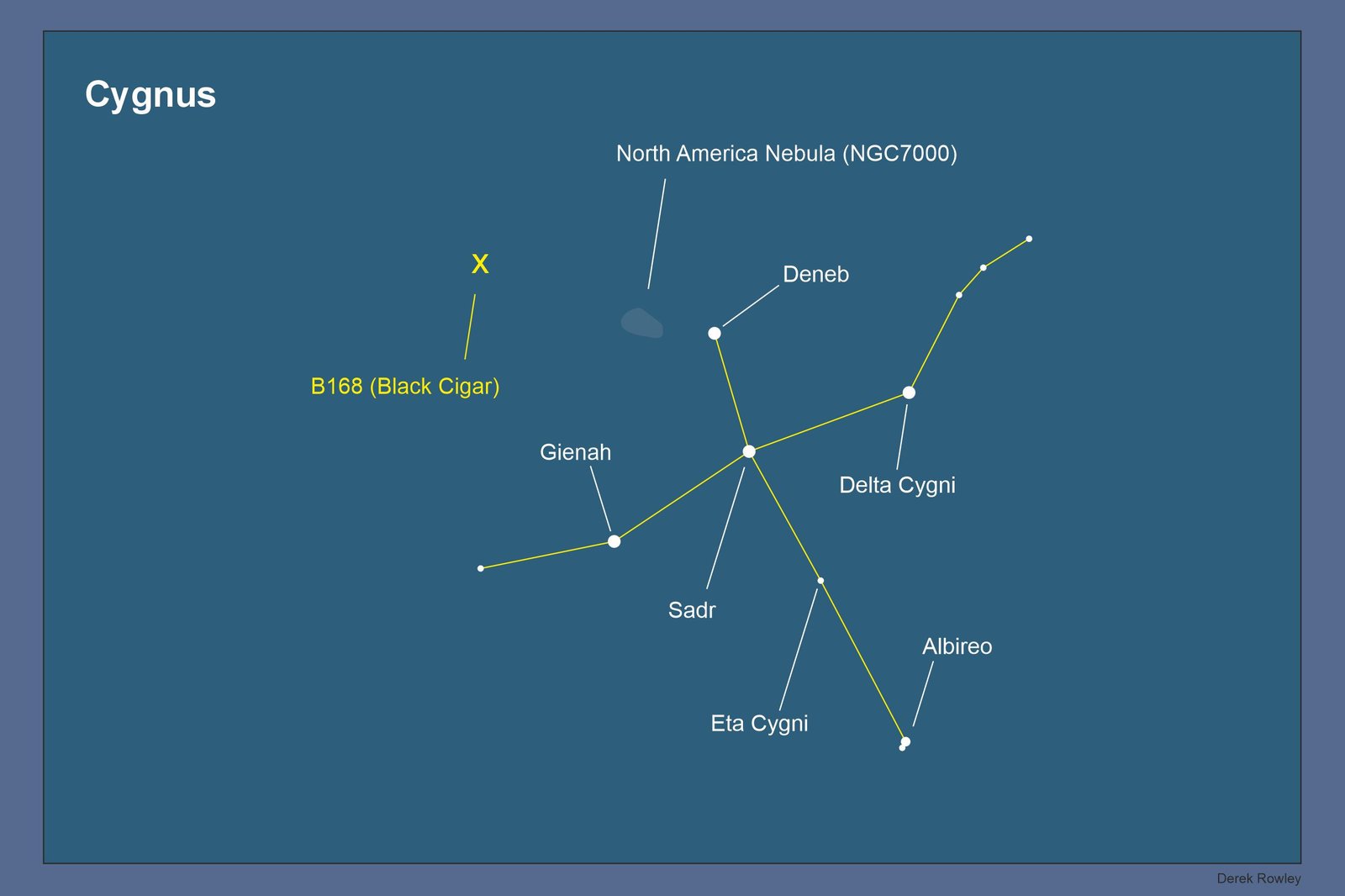
Constellation :- Cygnus (The Swan)
Object :-
oooo
Object :-
Other name :-
Type :-
Magnitude :–
Distance :-
Constellation :-
Right Ascension :-
Declination :-
oooo
oooo
B168
LDN 1610 / Black Cigar
Dark Nebula
n/a
2,700 light years / 23 light years across
Mon (Monoceros / The Unicorn)
06h 38m 27s
+10° 19′ 12″
Enlarge on click the map.

(Click the map above for a large view.)
| Abbreviation: Cyg |
| English Name: The Swan |
| Genitive: Deneb |
| Hemisphere: Northern Hemisphere |
| Location: Between the constellations of Cephus and Draco. |
| Visible between latitudes: +90 and -40 degrees |
| Best season: Autumn |
| Seen in three seasons: Summer, Autumn & Winter |
| Best seen in: August (map) and September (map) |
| Seen between: May and November |
| Right Ascension (RA): 21 hour |
| Declination (DEC): +40 degrees |
| Area (square degrees): 804 (16th) |
oooo
oooo
Facts about B168
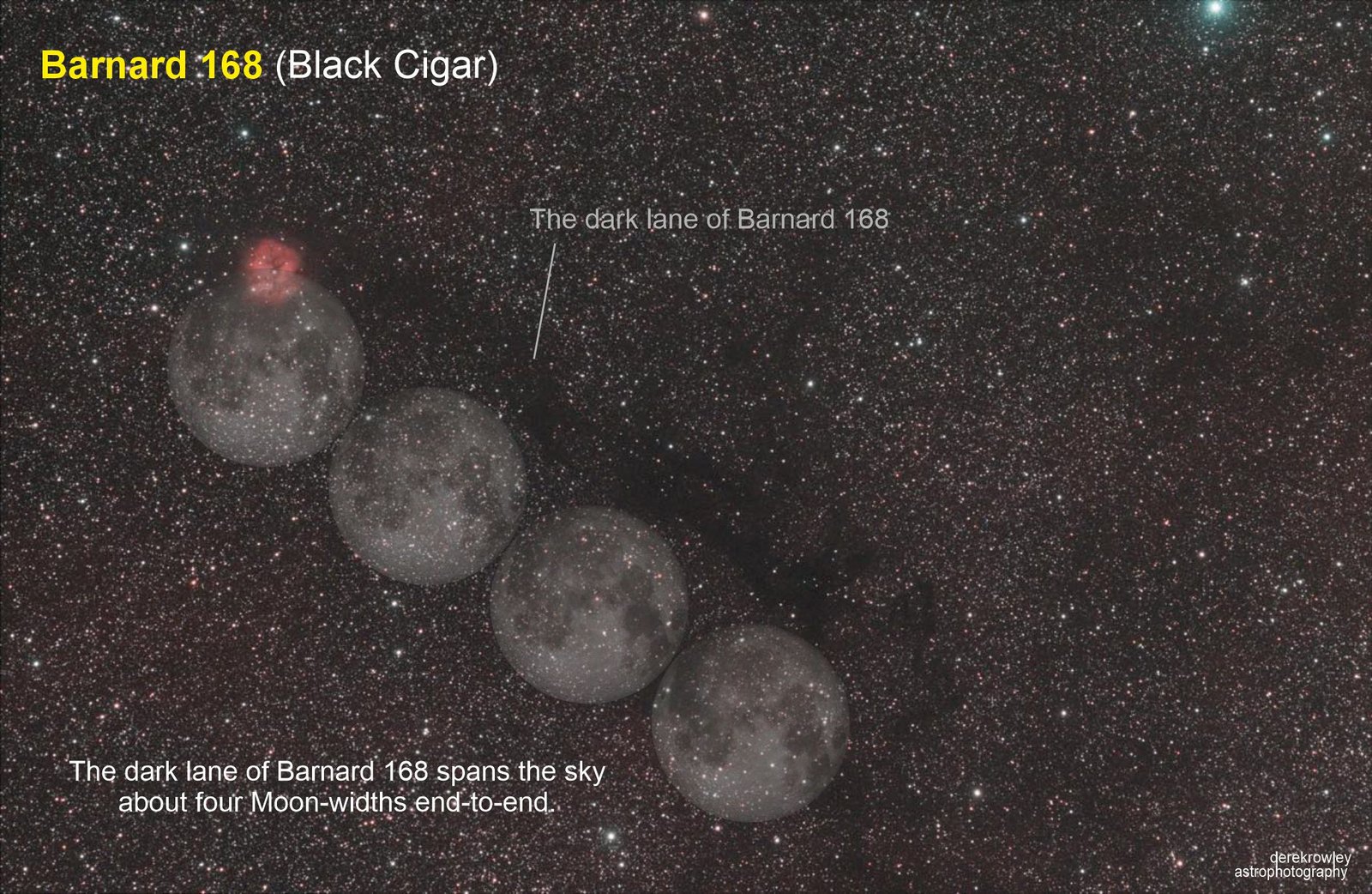
- Distance from Earth:
1,300 light‑years (same as IC 5146), so the dark lane of Barnard 168 spans the sky about four Moon‑widths end‑to‑end.
o - A long, narrow, sinuous dust lane
Often called the “Cocoon Nebula dark lane.”
o - Barnard 168
This makes B168 a large, filamentary molecular cloud, similar in nature to B68 but stretched into a long lane rather than a compact Bok globule.
o - In deep images, it looks like a smoke trail leading directly into the glowing Cocoon Nebula.
o
oooo
oooo
oooo
oooo
oooo
oooo