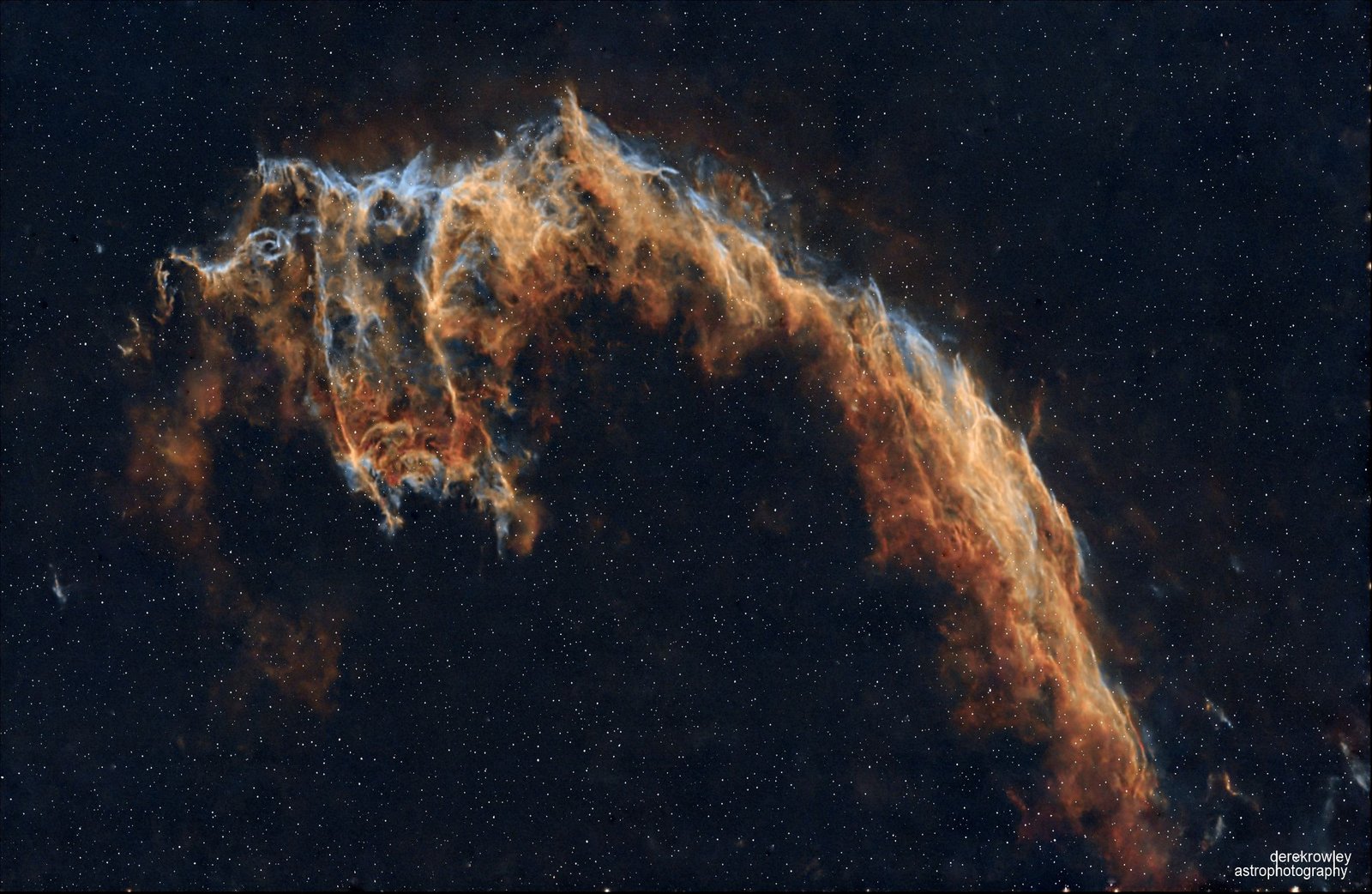
Caldwell 33 (NGC6992 / The Eastern Veil Nebula)
- Caldwell 33 is the Eastern Veil Nebula ~ the bright, filamentary arc of the Cygnus Loop supernova remnant, catalogued mainly as NGC 6992 and NGC 6995.
o - It’s one of the most spectacular supernova remnants in the northern sky.
o - Without filters in eyepiece, Caldwell 33 is extremely faint ~ often invisible even in medium telescopes (With the right filter, it becomes one of the most rewarding nebulae to observe).
o
o
- Object Name
C33
- Object Type
Emission Nebula
- Constellation
Cygnus
- Magnitude
+7.1
- Distance
2,400 light-years
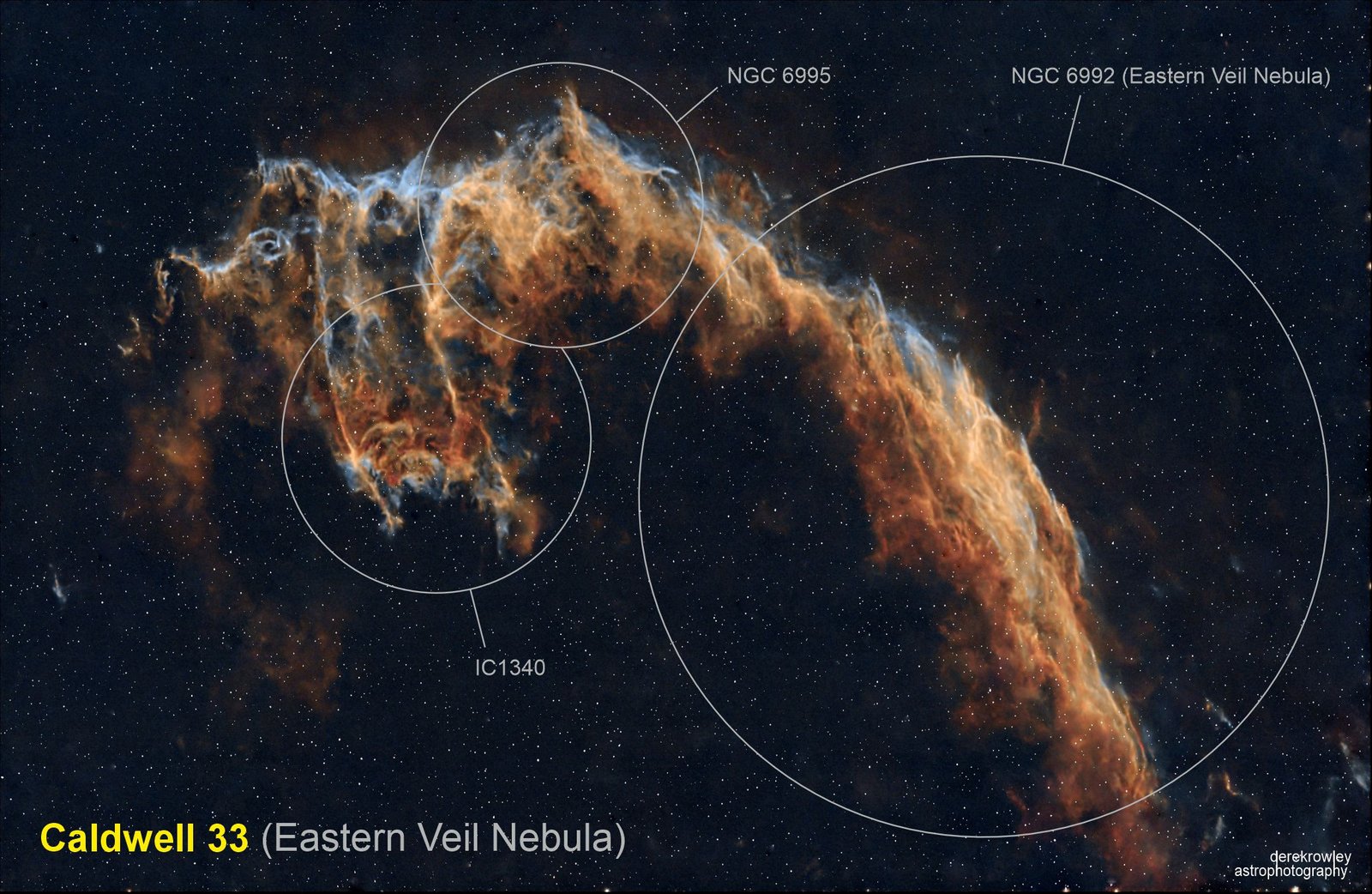
- Annotated
oooo
Equipment
Telescope:
Mount:
Accessories:
Sky-Watcher Esprint 80ED Triplet
Sky-Watcher AZ-EQ6 GT
ZWO ASIair Plus / PixInsight
Camera:
Guiding:
Filter:
ZWO ASI2600MC Pro cooling
ZWO ASI1200MM
2″ Optolong L-eNhance
Bortle Scale: Kelling Heath, Weybourne, North Norfolk (Bortle 4.1)
oooo
Integration
- Date:
Tuesday 22nd October 2024
- Moonlit:
Waxing Crescent 20 days old
Magnitude: -12.4
Moonlit: 70%
- Total:
60’s x 200 subs = 3 hours 20 minutes
oooo
oooo
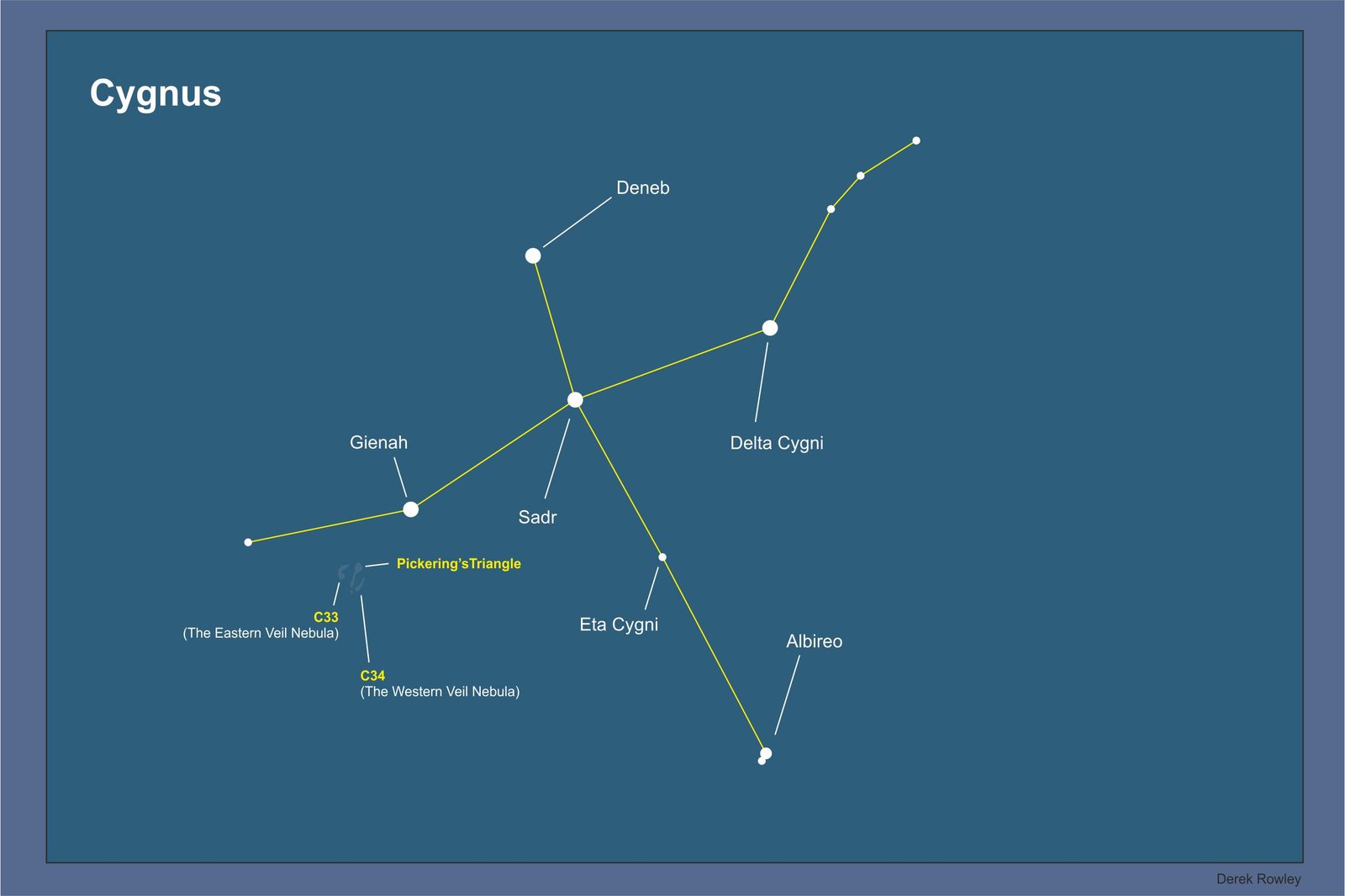
Constellation :- Cygnus (The Swan)
Object :-
oooo
Object :-
Other name :-
o
Type :-
Magnitude :–
Distance :-
Constellation :-
Right Ascension :-
Declination :-
oooo
oooo
C33
NGC6692 / The Eastern Veil Nebula /
Network Nebula
Emission Nebula
7.1
2,400 light years / 8 light years across
Cyg (Cygnus / The Swan)
20h 45m 31s
+30° 42′ 30″
Enlarge on click the map.

(Click the map above for a large view.)
| Abbreviation: Cyg |
| English Name: The Swan |
| Genitive: Deneb |
| Hemisphere: Northern Hemisphere |
| Location: Between the constellations of Cephus and Draco. |
| Visible between latitudes: +90 and -40 degrees |
| Best season: Autumn |
| Seen in three seasons: Summer, Autumn & Winter |
| Best seen in: August (map) and September (map) |
| Seen between: May and November |
| Right Ascension (RA): 21 hour |
| Declination (DEC): +40 degrees |
| Area (square degrees): 804 (16th) |
oooo
oooo
Facts about C33
- The names Veil Nebula, Cirrus Nebula, and Filamentary Nebula generally refer to the brightest part of the visible structure of the remnant, or even to the entire loop itself. The structure is so large that several NGC numbers were assigned to various arcs of the nebula
o - There are three main visual components;
o
– The Western Veil (also known as Caldwell 34), consisting of NGC 6960 (the “Witch’s Broom”, Lacework Nebula, “Filamentary Nebula”) near the foreground star 52 Cygni.
o
– The Eastern Veil (also known as Caldwell 33), whose brightest area is NGC 6992, trailing off farther south into NGC 6995 (together with NGC 6992 also known as “Network Nebula”) and IC 1340.
o
– Pickering’s Triangle (or Pickering’s Triangular Wisp), brightest at the north central edge of the loop, but visible in photographs continuing toward the central area of the loop.
o

oooo
oooo
oooo
oooo
oooo