Clouds into two main types:
Lynds Bright Nebulae (LBN) and Lynds Dark Nebulae (LDN).
oooo
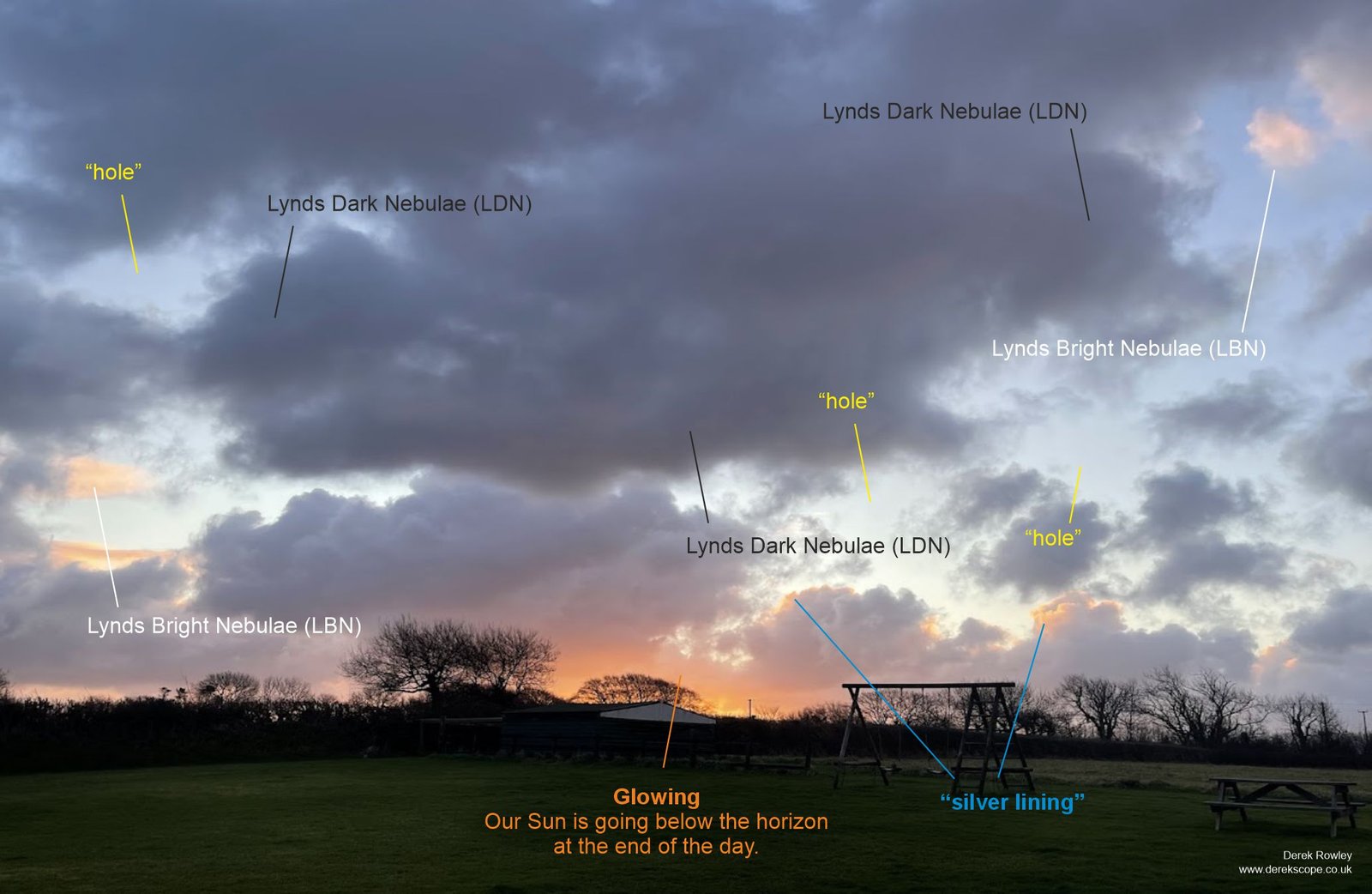
Here is how your star (Sun) as sunset view directly explains them:
oooo
oooo
Bright Nebulae (LBN) vs. Sunset Highlights
0000
- The Sunset Phenomenon (Bright)
When the sun dips low, you see brilliant, glowing white, pink, or orange/golden edges on the rims of clouds – this is called a “silver lining“.
o
o - The Space Connection (Bright)
This is exactly how a Lynds Bright Nebula works.
o
It does not create its own light. Instead, cosmic dust particles scatter and reflect the light coming from nearby hidden stars.
o
o - The Mechanism (Bright)
Water droplets in the UK sky bounce sunlight toward your eyes, just as interstellar dust clouds scatter starlight across the galaxy.
Dark Nebulae (LDN) vs. Sunset Shadows
oooo
- The Sunset Phenomenon (Dark)
In the exact same sky, the thick cores of heavy rain clouds appear completely black, bruised, and silhouetted against the bright horizon.
o
o
o - The Space Connection (Dark)
This is a direct analogue to a Lynds Dark Nebula (like the famous Horsehead Nebula).
o
These cosmic clouds are so incredibly dense with gas and dust that they block 100% of the starlight behind them.
o
o - The Mechanism (Dark)
The dark patches in a UK sunset are not devoid of light; they are simply blocking the light from reaching you.
o
In space, dark nebulae hide thousands of background stars, appearing as empty “holes” in the night sky.
oooo
oooo
oooo
oooo
oooo