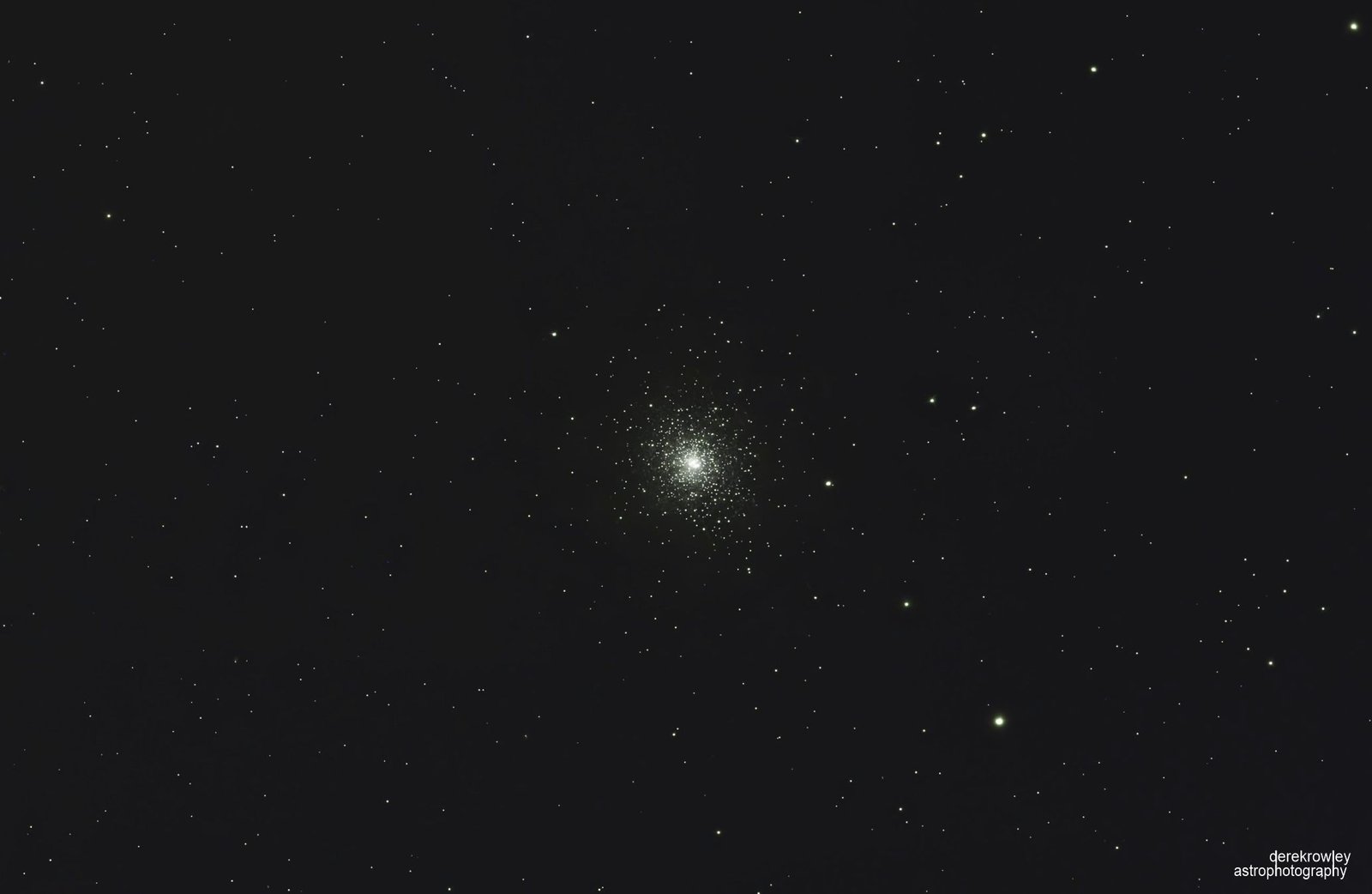
Messier 92 (Globular Cluster)
- Messier 92 is approximately 14.2 billion years old, making it one of the oldest globular clusters in the Milky Way.
o - It contains more than 330,000 stars tightly bound together by gravity.
o - While it is exceptionally brilliant, it is often called a “forgotten” cosmic showpiece because it sits in the shadow of its larger and more famous neighbour, the Great Hercules Cluster (Messier 13).
- Object Name
M92
- Object Type
Globular Cluster
- Constellation
Hercules
- Magnitude
+6.5
- Distance
28,000 light-years
- Age
14.2 million years old
oooo
Equipment
Telescope:
Mount:
Accessories:
Sky-Watcher Esprint 80ED Triplet
Sky-Watcher AZ-EQ6 GT
ZWO ASIair Plus
Camera:
Guiding:
Filter:
ZWO ASI2600MC Pro cooling
ZWO ASI1200MM
Optolong L-eXtreme
oooo
Bortle Scale: Milton Keynes, Buckinghamshire (Bortle 6.3)
oooo
oooo
Integration
- Date:
Monday 31st August 2026
- Moonlit:
Waning Gibbous 19 days old
Magnitude: -12.6
Moonlit: 84%
- Total:
180’s x 7 subs = 21 minutes
Stopped at 21 minutes due the clouds interrupted.
oooo
oooo
Constellation :- Hercules (The Hercules)
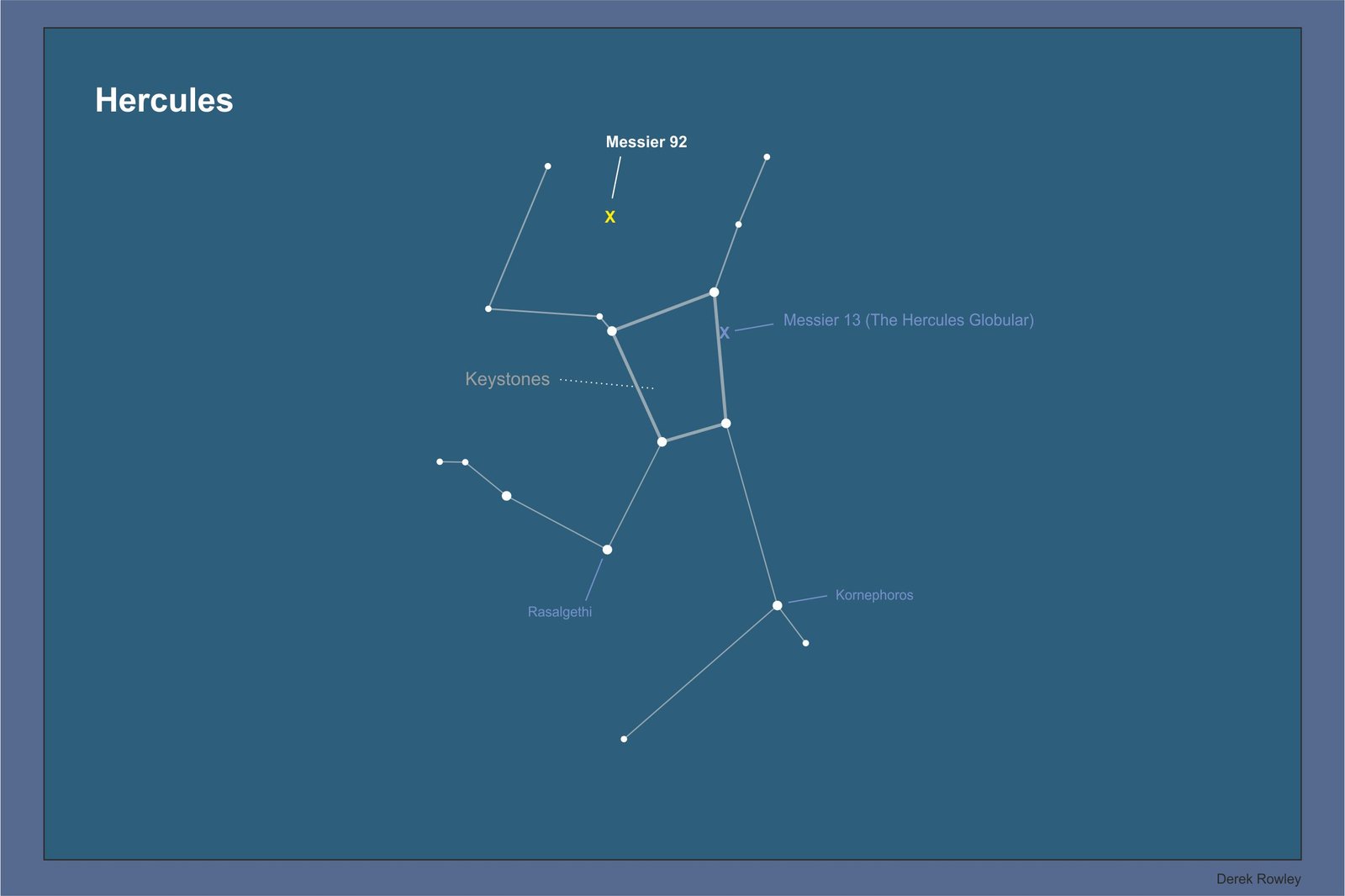
Object :-
oooo
Object :-
Other name :-
Type :-
Magnitude :–
Distance :-
Constellation :-
Right Ascension :-
Declination :-
oooo
oooo
M92
NGC 6341
Globular Cluster
+6.5
28,000 light years / 110 light years across
Her (Hercules / The Hercules)
17h 17m 10s
+43° 08′ 23″
Enlarge on click the map.
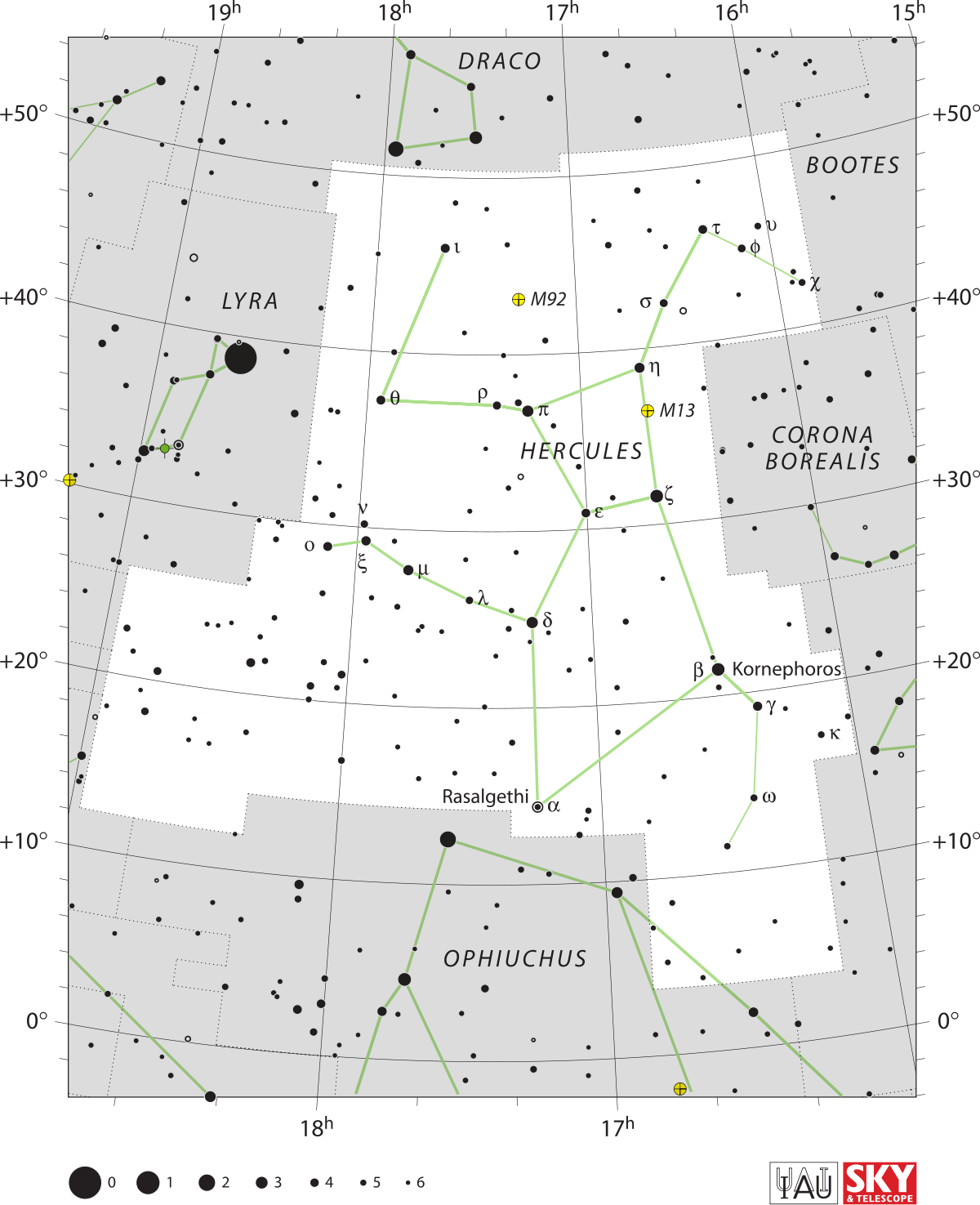
(Click the map above for a large view.)
| Abbreviation: Her (Hercules) |
| English Name: The Hercules |
| Genitive: Rassalgethi |
| Hemisphere: Northern Hemisphere |
| Location: Between the constellations of Lyra and Corona Borealis. |
| Visible between latitudes: +90 and -50 degrees |
| Best season: Summer |
| Seen in three seasons: Spring, Summer, and Autumn |
| Best seen in: Early July (map) |
| Seen between: April and December |
| Right Ascension (RA): 17 hour |
| Declination (DEC): +30 degrees |
| Area (square degrees): 1,225 square degrees (5th) |
oooo
Visibility to the Naked Eye
- Boasting an apparent visual magnitude of 6.3, M92 is so bright that it can actually be glimpsed with the unaided human eye under exceptionally dark, pristine sky conditions.
o
oooo
oooo
oooo
oooo
oooo
oooo