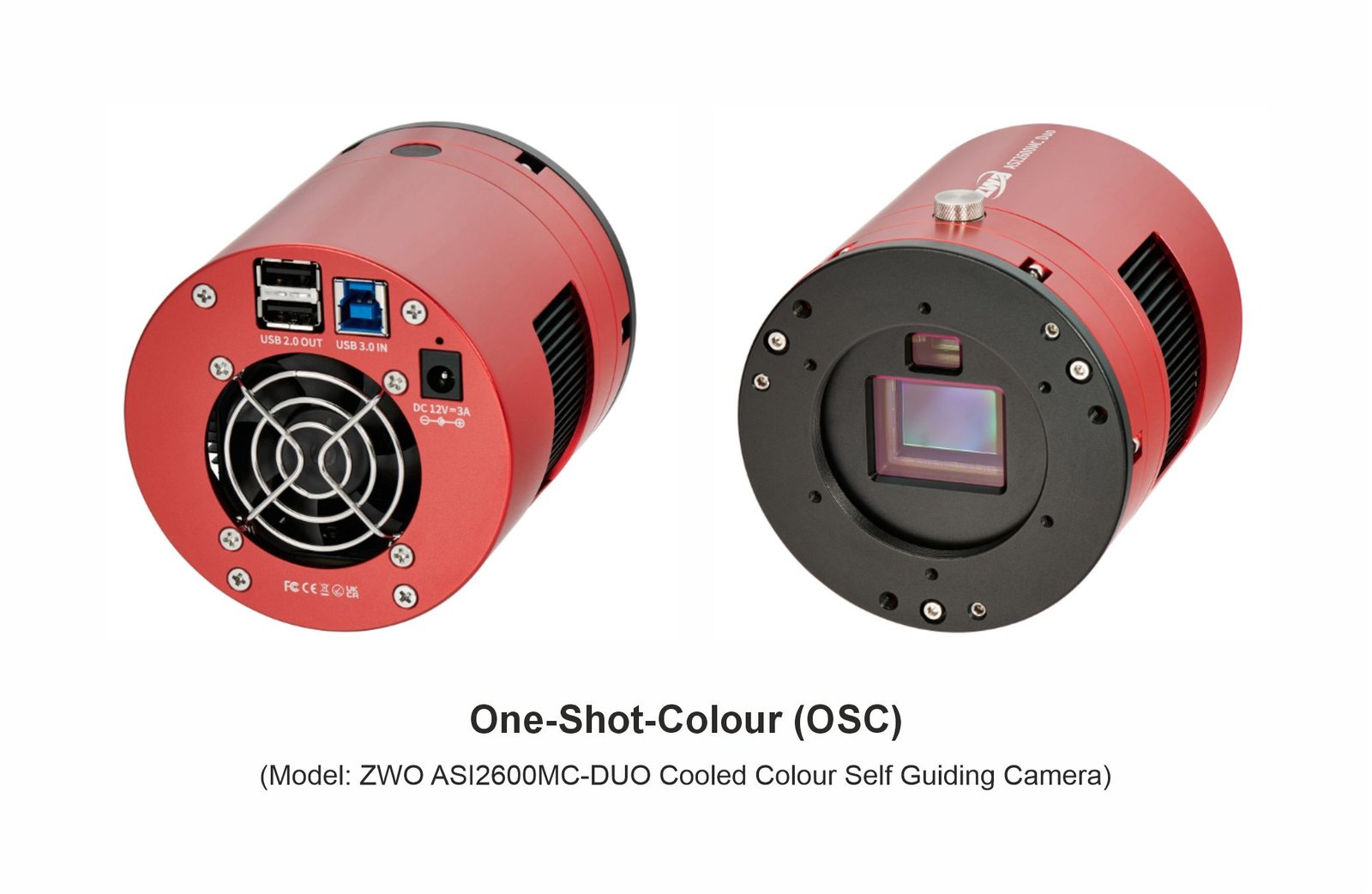
One-Shot Colour (OSC) cameras are astronomical imaging sensors designed to capture full-colour images in a single exposure.
o
Unlike standard monochrome astronomy cameras, which capture grayscale data through individual red, green, and blue (RGB) filters ~ OSC cameras record colour data instantly across the entire sensor grid.
oooo
oooo
One-Shot-Camera
oooo
oooo
How They Work:
OSC cameras
It feature a microscopic grid of colour filters, known as a Bayer Matrix, laid directly over the pixels.
o
The Bayer Pattern
The filter array typically uses an RGGB pattern (25% Red, 50% Green, 25% Blue).
o
Debayering (Demosaicing)
During image processing, software interpolates data from neighbouring pixels to produce a full RGB colour value for every single point in the image.
o
o
o

BSL Version

oooo
oooo
Advantages of OSC Cameras:
oooo
oooo
OOOO
1. Simplicity & Convenience
o
Every sub-exposure contains full colour data.
o
You don’t need to swap filters mid-session or manage individual R (red), G (green), B (blue), and L (luminance) files.
o
oooo
oooo
oooo
2. Lower Initial Cost
o
OSC cameras eliminate the need for an Electronic Filter Wheel (EFW) and expensive multi-filter sets (LRGB + Narrowband).
o
oooo
oooo
oooo
oooo
3. Faster Setup & Field Efficiency
o
Ideal for mobile astrophotographers, short window sessions, or unpredictable weather where you might only get 30 – 60 minutes of clear sky to capture a complete target.
o
oooo
oooo
oooo
oooo
4. Compatibility with Dual-Band Filters
o
Paired with modern dual-band or tri-band narrowband filters (for example, H\alpha and OIII filter passbands), OSC cameras can shoot emission nebulae efficiently even under light-polluted urban skies.
o
oooo
oooo
Key Trade-Offs (vs. Monochrome)
oooo
Reduced Resolution/Efficiency per Pixel
Because pixels are dedicated to specific colours, individual channels only use a fraction of the total sensor resolution per shot.
o
Less Sensitivity
The permanent Bayer matrix reduces overall quantum efficiency compared to a bare monochrome sensor.
o
Narrowband Filtering Constraints
While dual-band filters work exceptionally well on OSC, capturing full Hubble Palette (SHO) imaging is less efficient compared to a dedicated monochrome setup.
o
oooo
oooo
oooo
oooo
oooo
Back to
oooo
Back to page 3
Next to page 5
oooo
Page 4 – One-Shot Colour Cameras  Derek Rowley – Derekscope’s BSL Guide to Deep-Sky Imaging