oooo
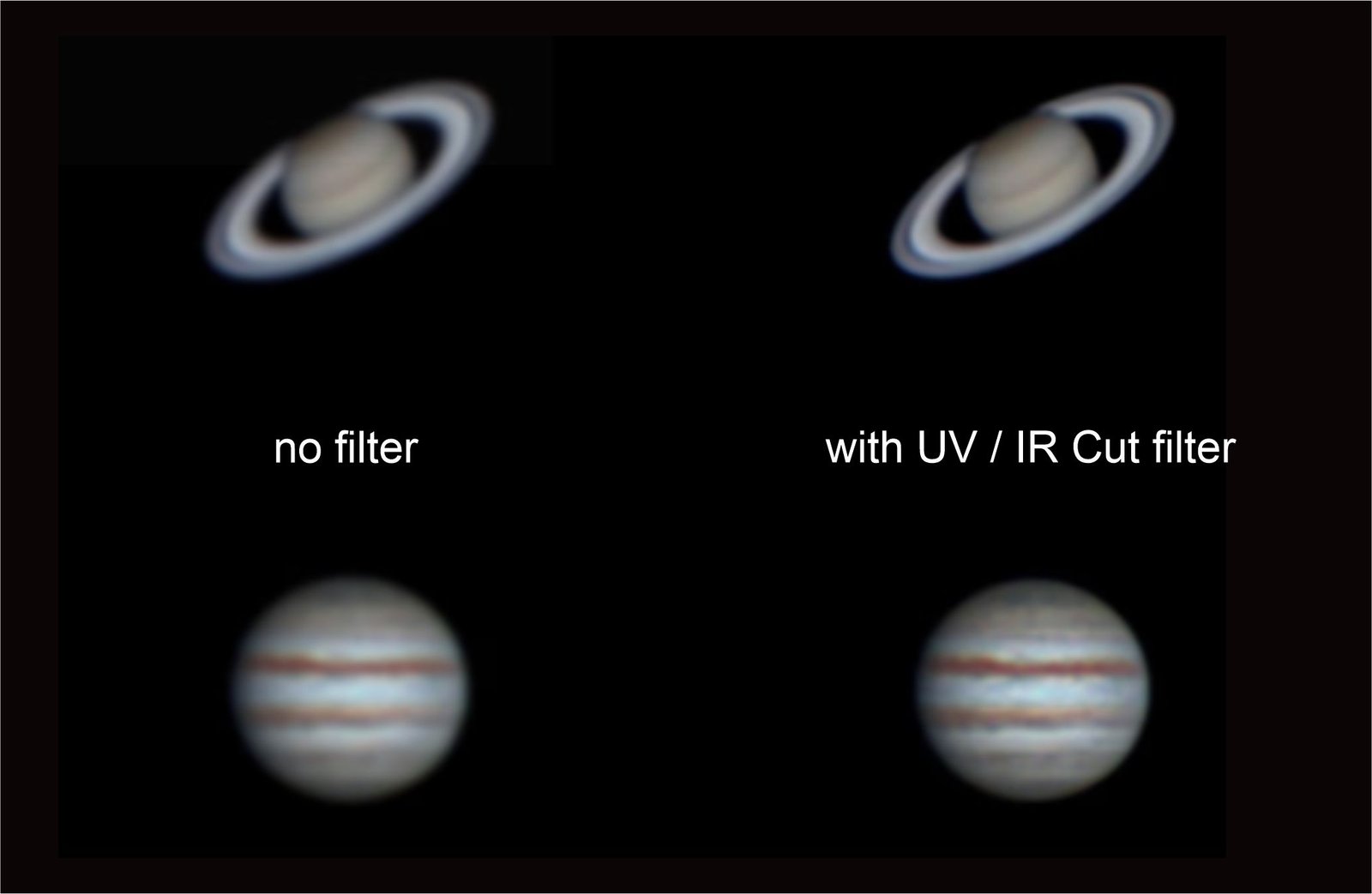
Lunar and planetary images become even sharper
Blocks the light in the UV and IR waveband and thus improves image sharpness in lunar and planetary photography.
o
Understanding UV/IR Cut Filters in Astrophotography
A UV/IR Cut Filter (sometimes called a Luminance or IR/UV blocking filter) is an essential optical accessory used to block ultraviolet (UV) and infrared (IR) light waves while letting visible light pass through cleanly.
oooo
oooo
Why you need a UV/IR Cut filter
oooo
oooo
oooo
oooo
Human Vision vs. Digital Sensors
o
Human eyes are only sensitive to wavelengths of light roughly between 400 nm and 700 nm.
O
However, silicon-based digital camera sensors (both DSLR/mirrorless and dedicated astronomy cameras) are sensitive to a much broader spectrum, extending deep into the invisible UV and IR ranges.
o
o

BSL Version

oooo
oooo
oooo
oooo
The Problem with Refracting Optics
o
Standard photographic lenses and refractive telescopes (dioptric optics) are designed and optically corrected to focus visible light at a single focal plane.
o
They are not designed to focus invisible UV and IR wavelengths.
o
o
oooo
oooo
oooo
oooo
oooo
The Result (Bloated Stars and Blurred Detail)
o
If UV and IR light are allowed to reach the sensor alongside visible light, they focus at different points.
o
This causes haloes around bright stars, bloated star profiles, a loss of crisp sharpness, and distorted colour balance.
o
o
oooo
oooo
oooo
When Should You Use a UV/IR Cut Filter?
oooo
oooo
oooo
oooo
1) Using Colour (OSC) Cameras with Refractors or Lenses
o
If you are using a One-Shot Colour camera (or an unmodified DSLR/mirrorless) with lenses or a refracting telescope, a UV/IR cut filter is crucial to maintain sharp stellar details and natural colour reproduction.
oooo
oooo
oooo
oooo
2) Reflecting Telescopes (Newtonians)
o
Reflectors use mirrors instead of lenses to focus light.
o
Mirrors reflect all wavelengths (visible, UV, and IR) equally to the exact same focal point.
o
Therefore, Newtonians do not inherently suffer from chromatic aberration caused by UV/IR light.
o
However, many imagers still use a UV/IR cut filter to protect the optical train or tighten up star profiles if their corrector lenses introduce dispersion.
oooo
oooo
oooo
oooo
oooo
oooo
oooo
3) Dedicated Monochrome Cameras
(Luminance Channel)
o
When shooting with a monochrome camera through an LRGB filter set, the Luminance (L) filter is almost always a specialized UV/IR blocking filter to ensure crisp broadband detail.
o
o
o
oooo
oooo
oooo
oooo
oooo
oooo
Back to
oooo
Back to page 5
Next to page 7
oooo
Page 6 – UV/IR Filter Derek Rowley – Derekscope’s BSL Guide to Deep-Sky Imaging
oooo
oooo