ooo
oooo
Pixel Binning
In astrophotography, pixel binning is the process of combining adjacent pixels on a camera sensor.
oooo
oooo
OOOO
Modern CMOS Recommendation
oooo
oooo
CMOS Astronomy Camera:
If you use a modern cooled CMOS astronomy camera (like an ASI2600, ASI533, or ASI6200), shoot unbinned 1×1) during acquisition in almost all cases.
o
Because CMOS read noise is extremely low, you can capture full resolution at night and simply apply software binning later in post-processing software (like PixInsight or Siril) if your focal length calls for it.
oooo

oooo
oooo
Why Astronomers do this with telescopes
oooo
oooo
oooo
oooo
oooo
Pixel Binning:
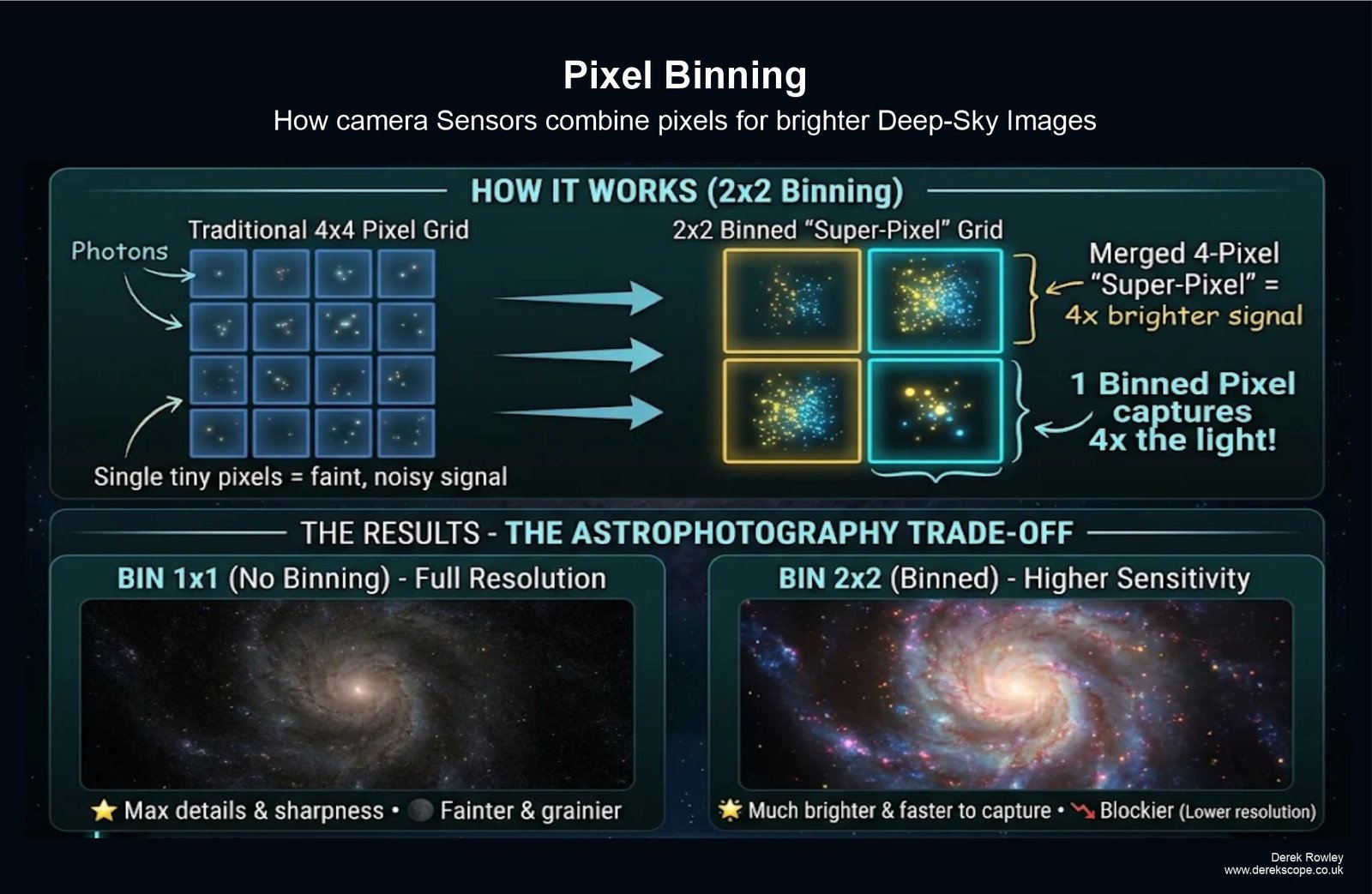
In deep-sky astrophotography is a camera setting (or software process) that combines clusters of adjacent physical pixels into one single, larger “super-pixel.”
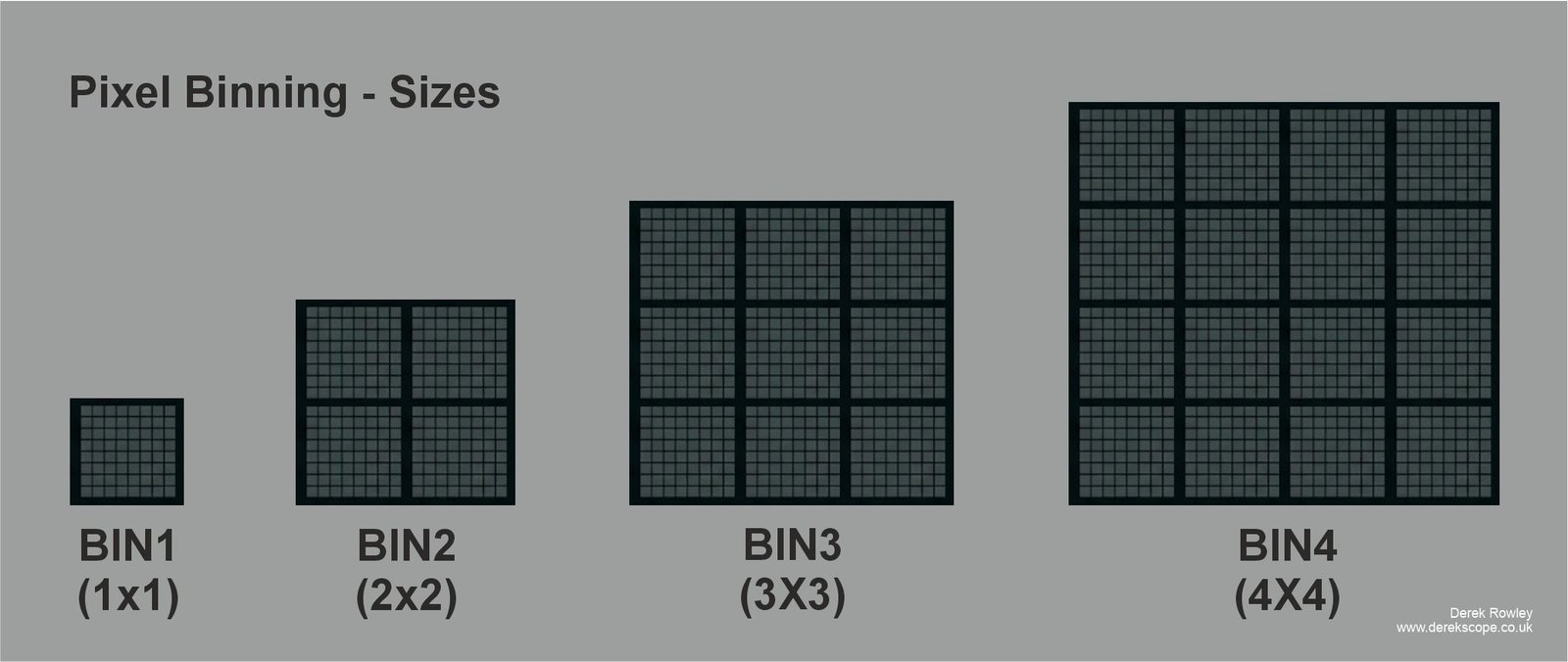
Instead of saving every pixel individually (for example: 1×1 binning), a 2×2 binning combines a 2×2 grid of 4 small pixels to act as 1 large pixel.
o
How binning works(for example: 2×2)
| Property | Unbinned (1×1) | Binned (2×2) |
| Grid Size | 4 individual pixels | 1 combined “super-pixel” |
| Total Reduction | 100% (Full Native Resolution) | 25% of native resolution (halved width & height) |
| File Size | 100% (large) | ~25% (significantly smaller) |
| Signal-to-Noise Ratio (SNR) | Standard | ~2x improvement (smoother, brighter image per frame) |
oooo
oooo
oooo
oooo
oooo
oooo
Key Benefits for Deep-Sky Imaging
oooo
Gathers Faint Light Faster:
Combining light from multiple pixels boosts sensitivity to faint outer nebulae and wispy galaxy arms in single exposures.
o
o
Corrects Oversampling:
If your telescope has a very long focal length combined with tiny camera pixels, atmospheric turbulence (“seeing”) caps the detail you can capture.
o
Binning aligns your camera’s resolution to match atmospheric limits without losing real detail.
o
o
Reduces File Size & Processing Load:
A 2×2 binned image yields files that are 75% smaller, making image calibration, stacking, and processing much faster on your computer.
o
o
Faster Previews & Guiding:
Astrophotographers often use high binning (2×2) during focusing, target framing, or autoguiding to get fast, bright real-time frame downloads.
oooo
oooo
oooo
oooo
oooo
oooo
Back to
oooo
Back to page 39
Next to page 41
oooo
Page 40 – Binning Derek Rowley – Derekscope’s BSL Guide to Deep-Sky Imaging
oooo
oooo