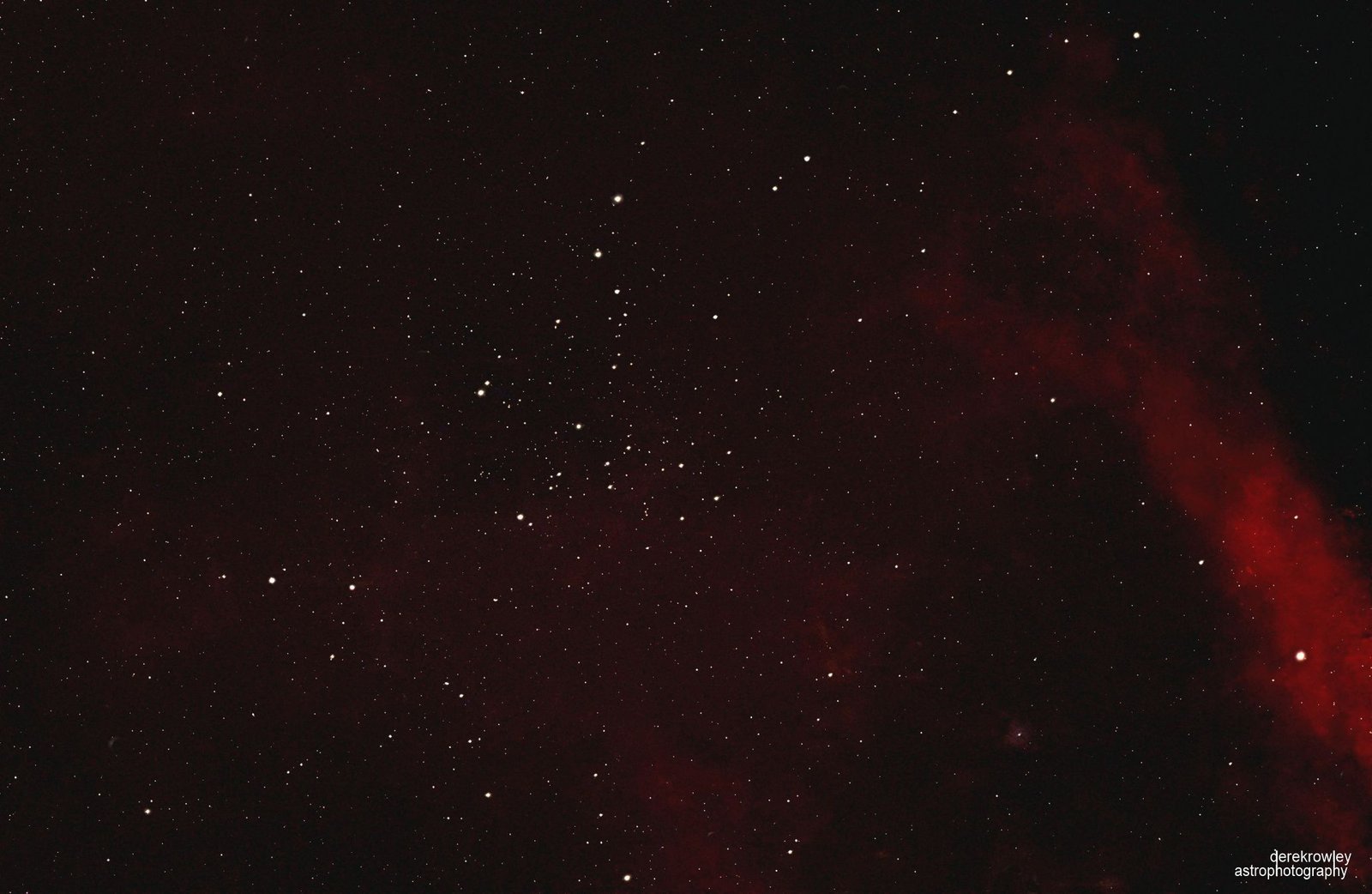
Messier 38 (Starfish Cluster)
- When astrophotographers capture Messier 38 in wide-field images, the cluster often appears embedded in or sitting next to a striking glow of red cosmic gas.
o - The “Starfish” Shape
It earned its popular nickname because its brightest stars trace out a ragged, trailing pattern that resembles a starfish, an oblique cross.
o - M38 is a rich cluster hosting more than 100 confirmed stars.
o - Its most prominent and brightest member is a “yellow giant with the apparent magnitude +7.9 and spectral type G0” which shines 900 times more luminously than our Sun.
o - M38 cannot be seen with the naked eye but is a very easy target for binoculars.
- Object Name
M38
- Object Type
Open Cluster
- Constellation
Auriga
- Magnitude
+7.4
- Distance
2,800 light-years
- Age
220 million years old
oooo
Equipment
Telescope:
Mount:
Accessories:
Sky-Watcher Esprint 80ED Triplet
Sky-Watcher AZ-EQ6 GT
ZWO ASIair Plus
Camera:
Guiding:
Filter:
ZWO ASI2600MC Pro cooling
ZWO ASI1200MM
Optolong L-eXtreme
oooo
Bortle Scale: Milton Keynes, Buckinghamshire (Bortle 6.3)
oooo
oooo
Integration
- Date:
Tuesday 1st September 2026
o - Time:
01:00
- Moonlit:
Waning Gibbous 20 days old
Magnitude: -12.5
Moonlit: 83%
- Total:
180’s x 9 subs = 27 minutes
Stopped at 27 minutes due the clouds interrupted.
oooo
oooo
Constellation :- Auriga (The Charioteer)
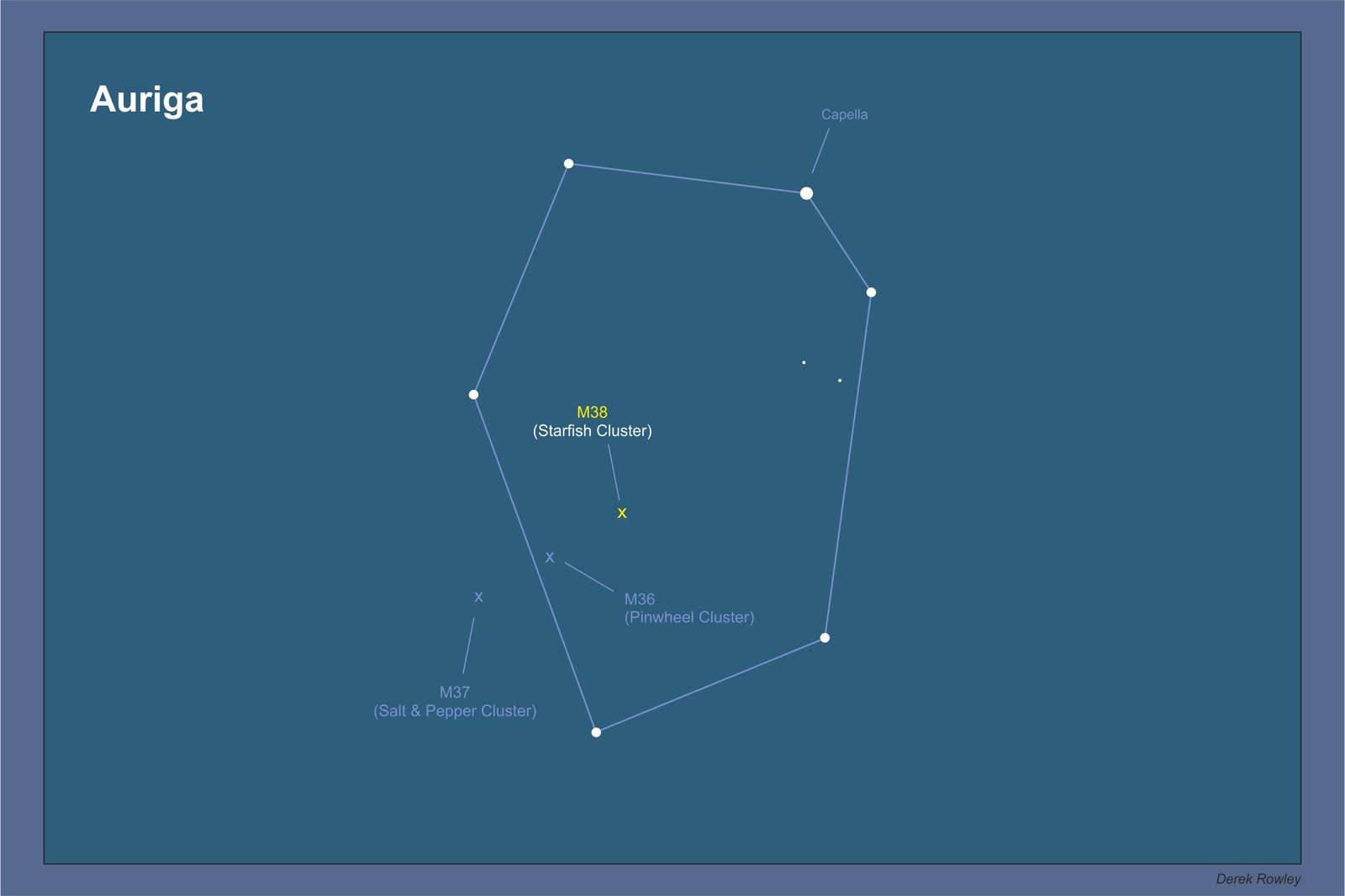
Object :-
oooo
Object :-
Other name :-
Type :-
Magnitude :–
Distance :-
Constellation :-
Right Ascension :-
Declination :-
oooo
oooo
M38
NGC 1912
Open Cluster
+7.4
2,800 light years / 16 light years across
Aur (Auriga / The Charioteer)
05h 28m 07s
+35° 50′ 12″
Enlarge on click the map.
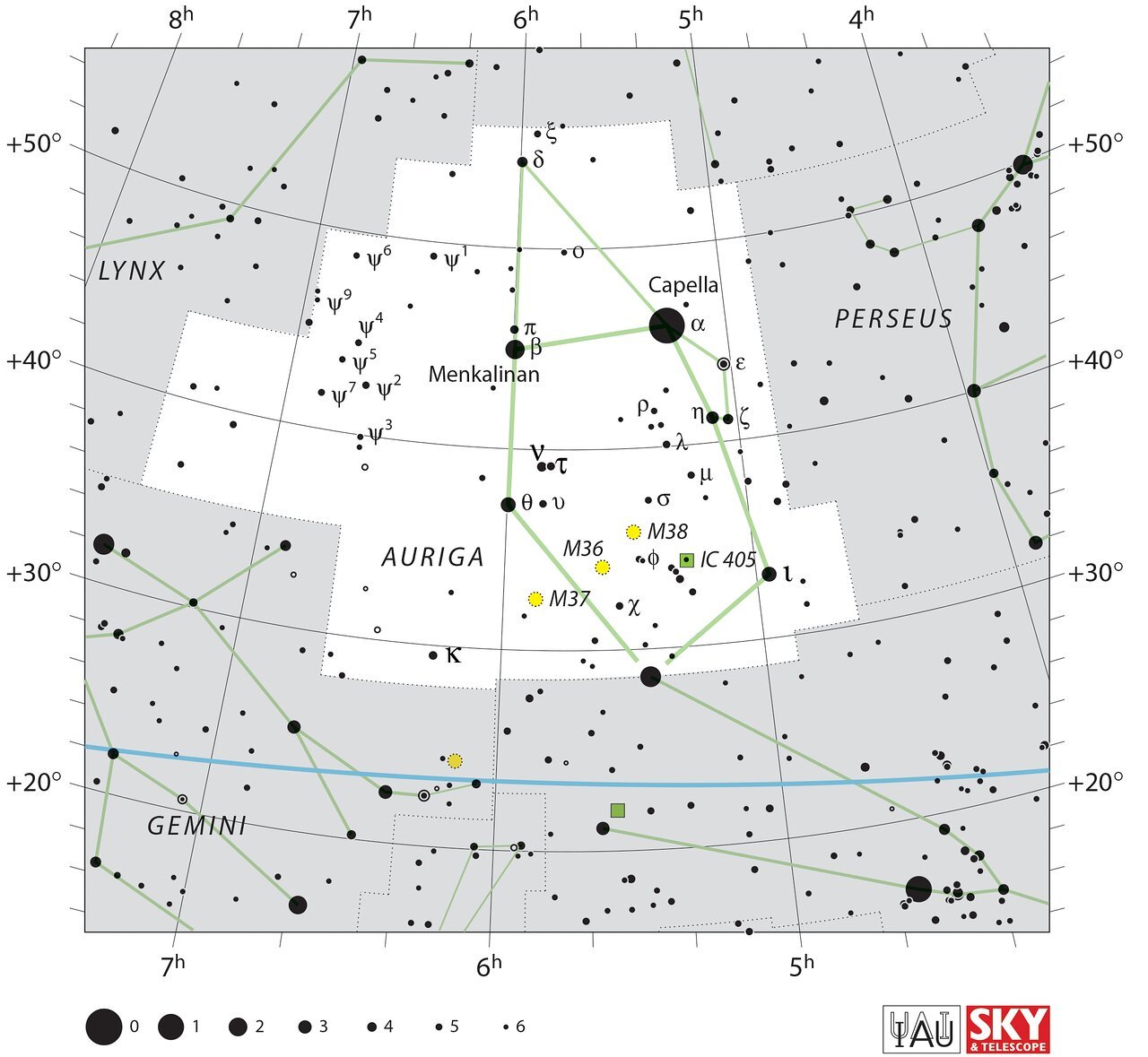
(Click the map above for a large view.)
| Abbreviation: Aur (Auriga) |
| English Name: The Charioteer |
| Genitive: Capella |
| Hemisphere: Northern Hemisphere |
| Location: Between the constellations of Taurus and Camelopardis. |
| Visible between latitudes: +90 and -40 degrees |
| Best season: Winter |
| Seen in three seasons: Autumn, Winter and Spring |
| Best seen in: January and February (This constellation of Auriga stays in the sky all the year.) (map) |
| Seen between: October and March |
| Right Ascension (RA): 06 hour |
| Declination (DEC): +40 degrees |
| Area (square degrees): 657 (21st) |
oooo
Why it is named the Starfish Cluster?
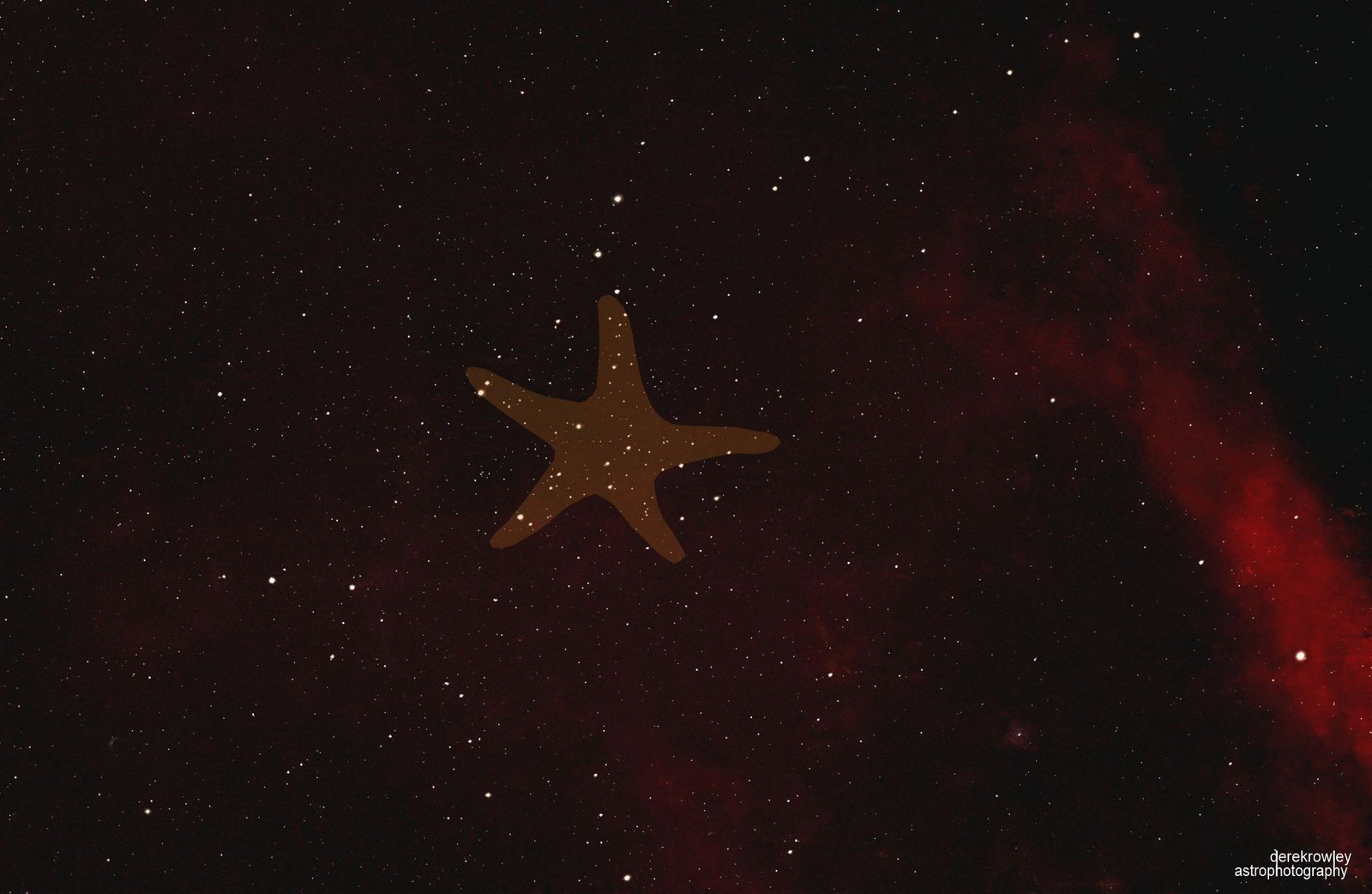
- Messier 38 is called the Starfish Cluster because of it’s conspicuous “X” shape as seen through a telescope.
o
oooo
oooo
oooo
oooo
oooo
oooo