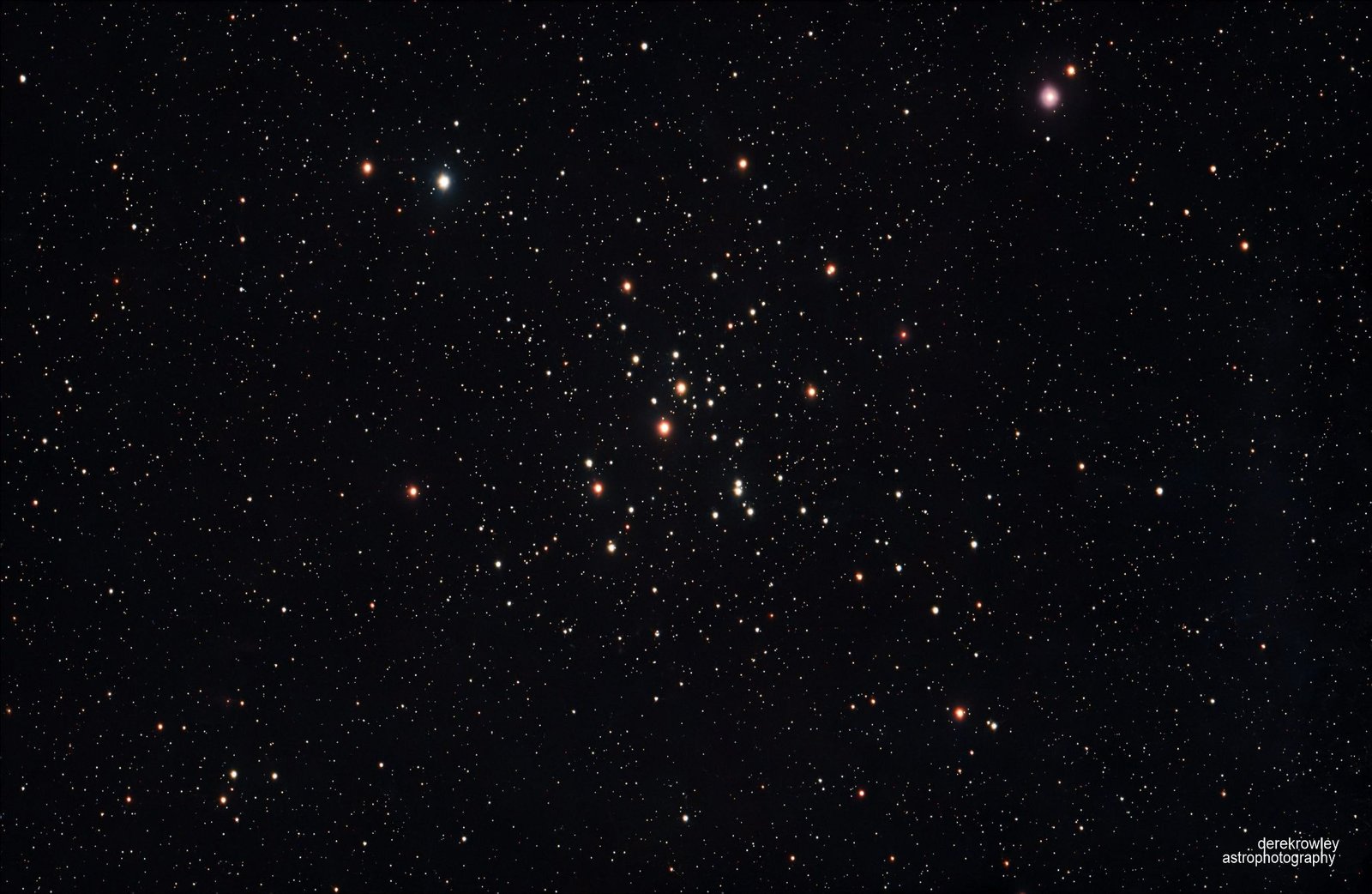
Messier 41 (Open Cluster) / NGC 2287 / Little Beehive Cluster
- Found just about four degrees directly south of Sirius, the brightest star in the night sky.
o - It is a stunning, easy target for standard 10×50 binoculars and wide-field low-power telescope eyepieces.
o - Its bright red giant stars ~ M41 contains several red or orange giants, including a prominent central K‑type giant of magnitude +6.7 ~ these give the cluster its warm, colourful look.
o
- Object Name
M41
- Object Type
Open Cluster
- Constellation
Canis Major
- Magnitude
+4.5
- Distance
2,300 light-years
- Age
190 billion years
oooo
oooo
Equipment
Telescope:
Mount:
Accessories:
Sky-Watcher Esprint 80ED Triplet
Sky-Watcher AZ-EQ6 GT
ZWO ASIair Plus / PixInsight
Camera:
Guiding:
Filter:
ZWO ASI585MC Pro cooling
ZWO ASI1200MM
2″ Optolong eNchance
oooo
Bortle Scale: Welbourne, North Norfolk (Bortle 6.6)
oooo
oooo
Integration
- Date:
Wednesday 24th September 2025
- Moonlit:
Waxing Crescent 3 days old
Magnitude: -9.8
Moonlit: 7.8%
- Total:
180’s x 10 subs = 30 minutes
oooo
oooo
Constellation :- Canis Major / The Great Dogs
Object :-
oooo
Object :-
Other name :-
Type :-
Magnitude :–
Distance :-
Constellation :-
Right Ascension :-
Declination :-
oooo
oooo
M41
NGC 2287 / Cr 118 / Little Beehive Cluster
Open Cluster
+4.5
2,300 light years / 26 light years across
CMa (Canis Major / The Great Dogs)
06h 46m 00s
-20° 46′ 38″
Enlarge on click the map.
(Click the map above for a large view.)
| Abbreviation: CMa (Canis Major) |
| English Name: The Great Dogs |
| Genitive: Sirius |
| Hemisphere: Southern Hemisphere |
| Location: Between the constellations of Monoceros and Lepus. |
| Visible between latitudes: +60 and -90 degrees |
| Best season: Winter |
| Seen in three seasons: Autumn, Winter, and Spring |
| Best seen in: February (map) and March (map) |
| Seen between: October and March |
| Right Ascension (RA): 07 hour |
| Declination (DEC): -20 degrees |
| Area (square degrees): 380 (43th) |
oooo
oooo
Facts about M41
oooo
- Its size and visibility ~ it spans about the size of the full Moon and shines at magnitude 4.5, making it visible to the naked eye under dark skies and excellent in binoculars.
o
o
oooo
oooo
oooo
oooo
oooo
oooo