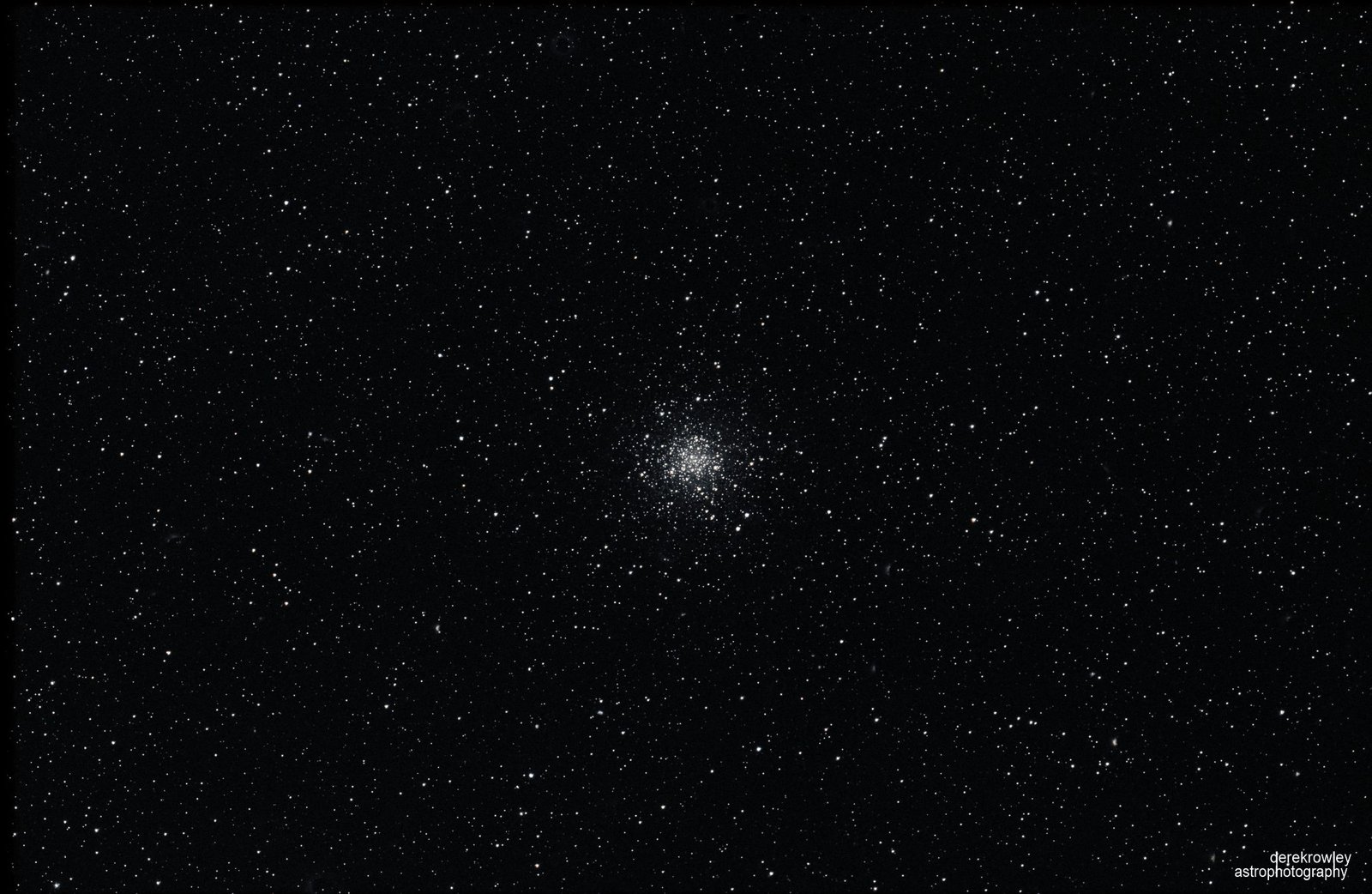
Messier 56 (Globular Cluster) / NGC 6779
- Roughly 13.7 billion years old, meaning its stars formed very early in the history of the universe ~ a big ball of ancient stars.
o - Its orbital behaviour suggests it may have been captured from a dwarf galaxy during early Milky Way mergers.
o - Scale comparison – M56 is twice size of M13’s core. (Messier 13)
o - Magnitude +8.3, making it visible through medium-sized amateur telescopes or binoculars under dark skies.
o
o
- Object Name
M56
- Object Type
Globular Cluster
- Constellation
Lyra
- Magnitude
+8.3
- Distance
32,900 light-years
- Age
13.7 billion years old
oooo
Equipment
Telescope:
Mount:
Accessory:
Celestron 8-inch Edge HD
ZWO AM7 (equatorial mount)
ZWO ASIair Plus / PixInsight
Camera:
Guiding:
Filter:
ZWO ASI2600MC Pro cooling
ZWO ASI1290MM
2″ Optolong L-Pro
oooo
Bortle Scale: Kirby Farm, Shipston-on-Stour, Warwickshire (Bortle: 4.6)
oooo
oooo
Integration
- Date:
Saturday 12th September 2026
- Moonlit:
Waxing Crescent 1 days old
Magnitude: -5.0
Moonlit: 3%
- Total:
60’s x 20 subs = 20 minutes
oooo
oooo
Constellation :- Lyra (The Lyra)
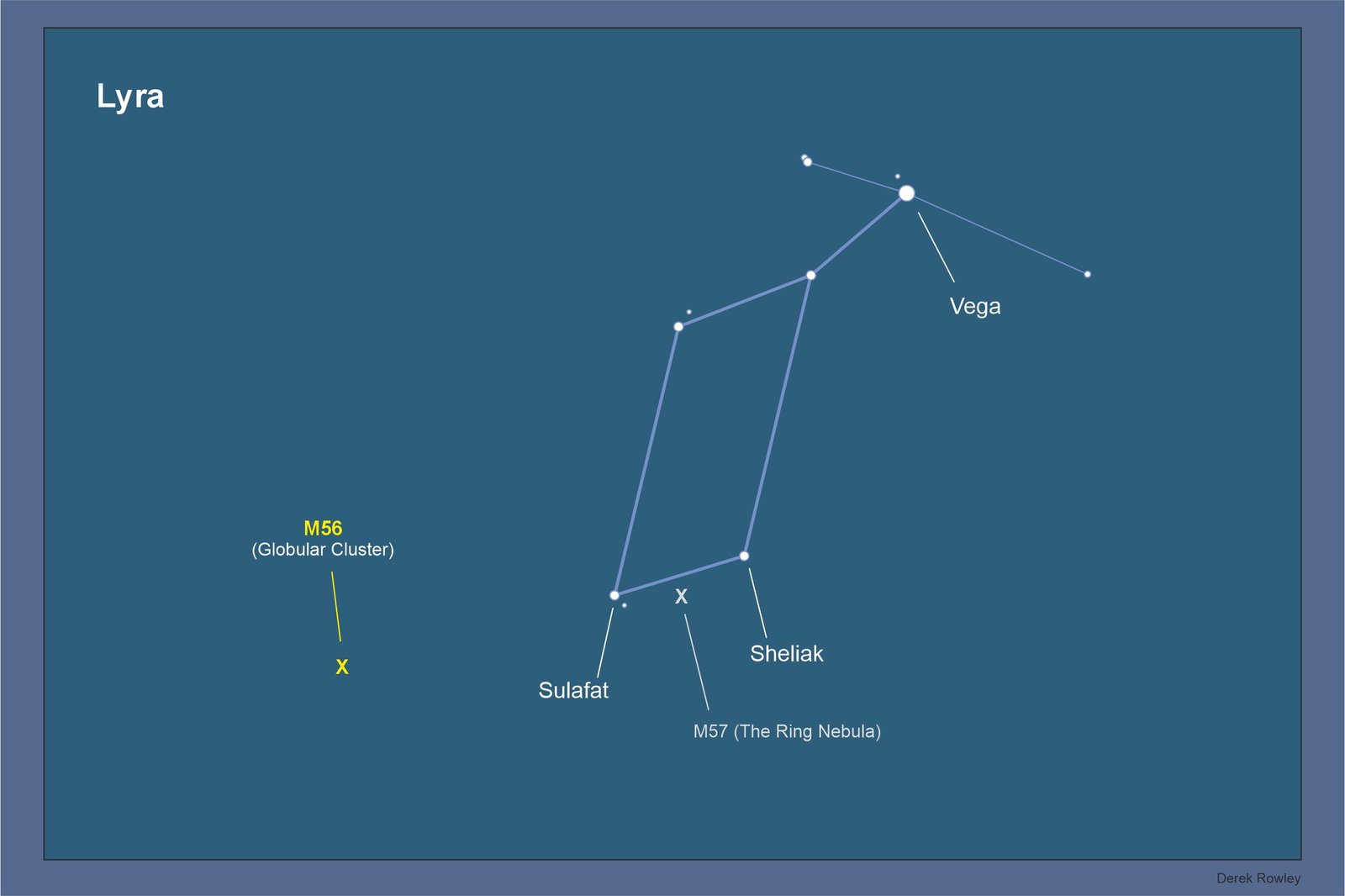
Object :-
oooo
Object :-
Other name :-
Type :-
Magnitude :–
Distance :-
Constellation :-
Right Ascension :-
Declination :-
oooo
oooo
M56
NGC 6779 / Mel 220
Globular Cluster
+8.4
32,900 light years / 84 light years across
Lyr (Lyra / The Lyra)
19h 16m 36s
+30° 11′ 00″
Enlarge on click the map.
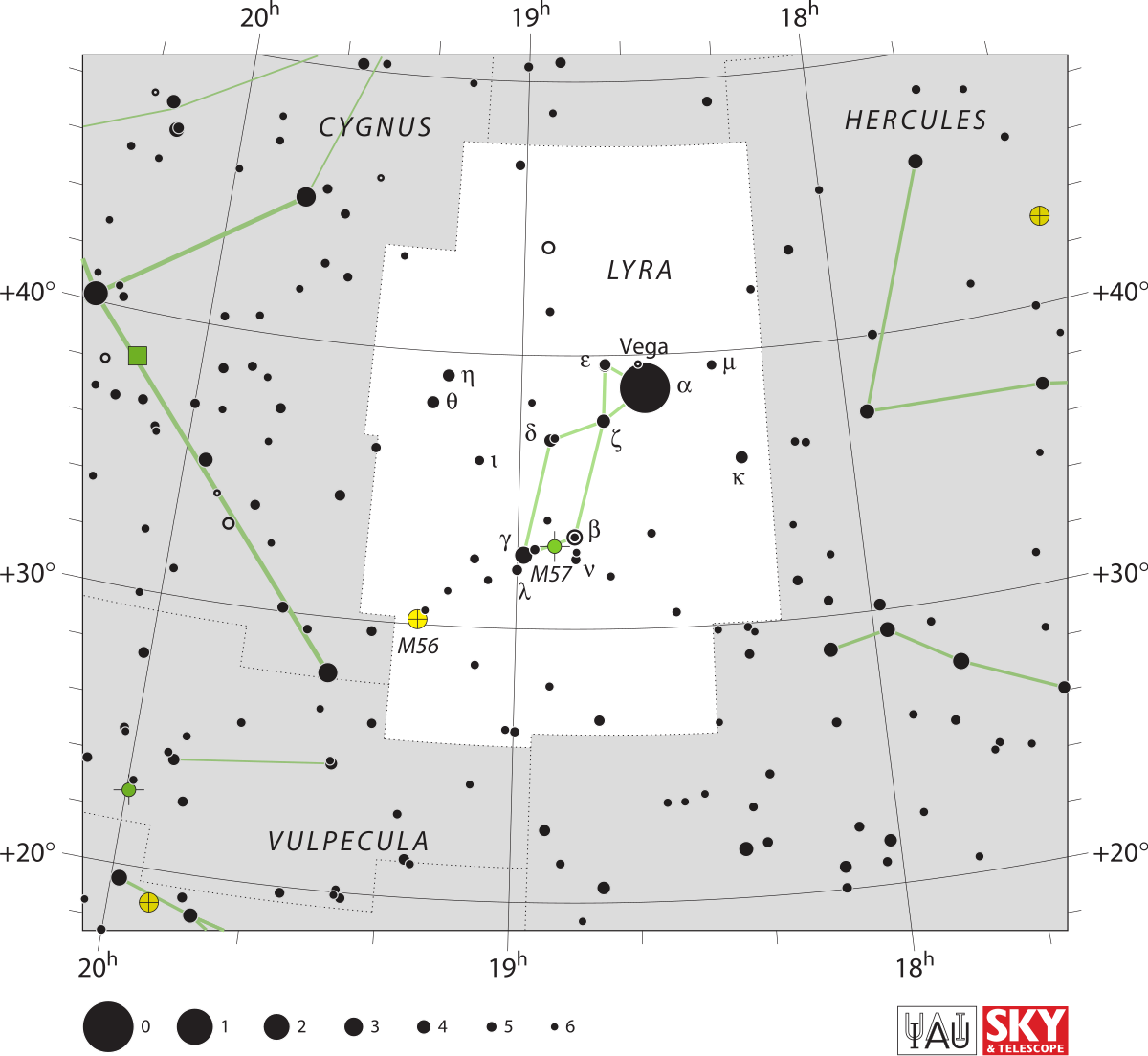
(Click the map above for a large view.)
| Abbreviation: Lyr (Lyra) |
| English Name: The Lyra |
| Genitive: Vega |
| Hemisphere: Northern Hemisphere |
| Location: Between the constellations of Cygnus and Hercules. |
| Visible between latitudes: +90 and -40 degrees |
| Best season: Summer |
| Seen in three seasons: Spring, Summer, & Autumn. |
| Best seen in: Early August (map) |
| Seen between: April and November |
| Right Ascension (RA): 19 hour |
| Declination (DEC): +40 degrees |
| Area (square degrees): 286 square degrees (52nd) |
oooo
oooo
Observational Notes
- Appearance:
– In binoculars: faint fuzzy patch.
– In small telescopes: loose, grainy halo.
– In larger telescopes: outer stars begin to resolve.
o - Best season (UK):
– Summer evenings (June–September) when Lyra is high.
o
oooo
oooo
oooo
oooo
oooo
oooo