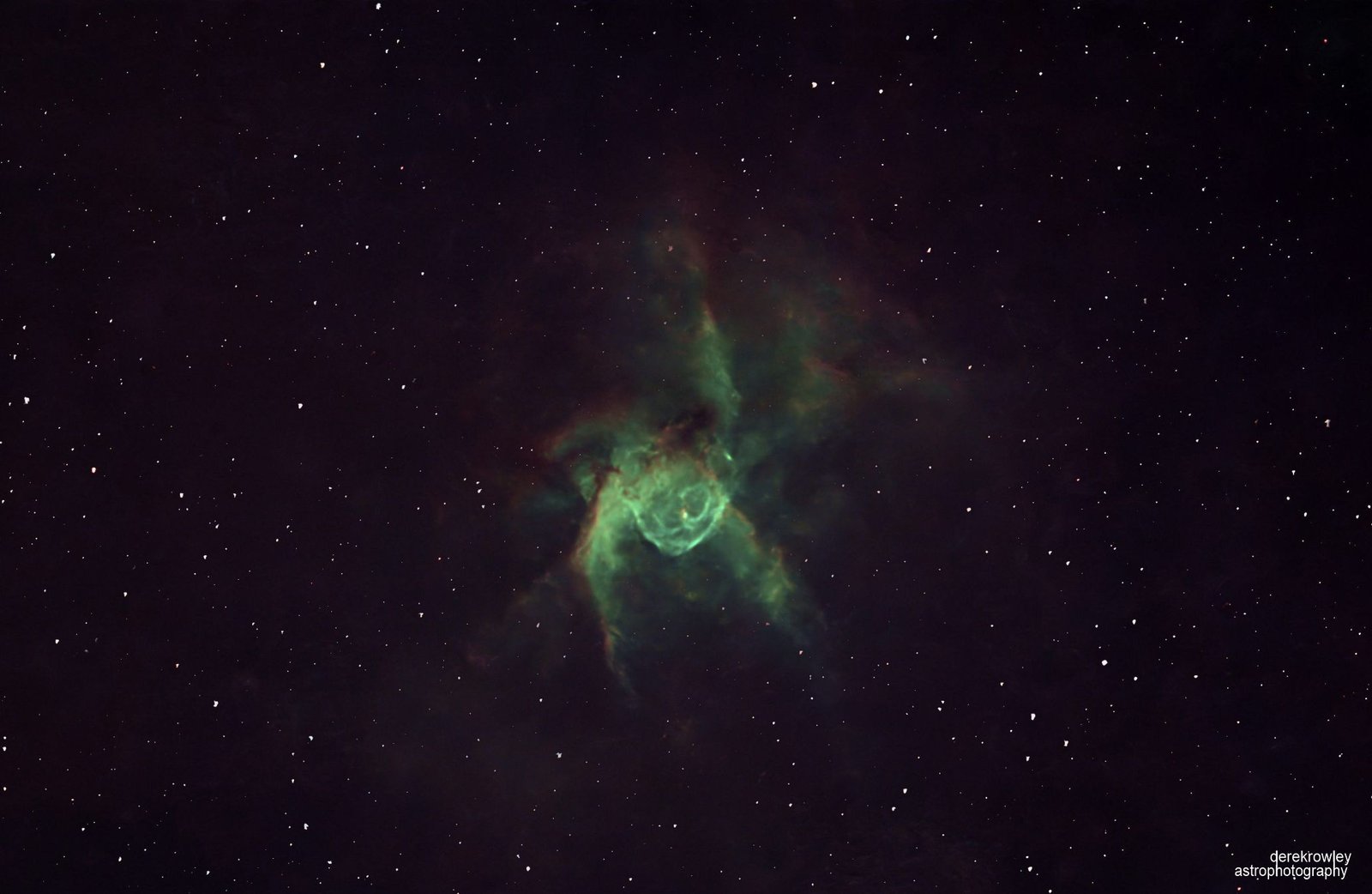
NGC 2359 (Thor’s Helmet Nebula)
- NGC 2359, widely known as Thor’s Helmet, is a massive glowing cloud of gas and dust located roughly 15,000 light-years away in the constellation Canis Major.
o - It gets its famous nickname because its round shape and sweeping, wing-like extensions perfectly resemble the battle headwear of the Norse god of thunder.
o
o
o
- Object Name
NGC 2359
- Object Type
Emission Nebula
- Constellation
Canes Major
- Magnitude
+11.5
- Distance
15,000 light-years
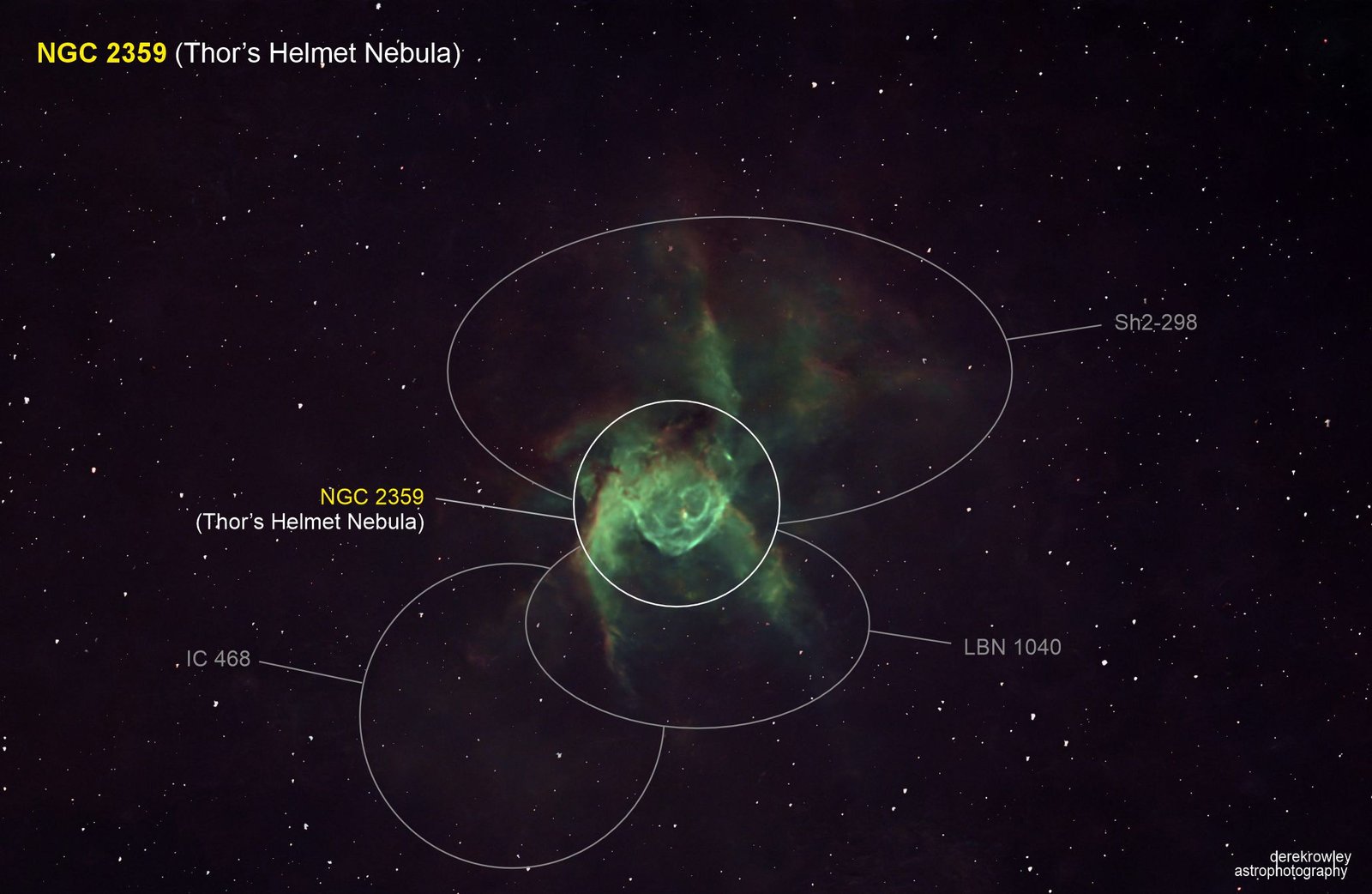
- Annotated
oooo
Equipment
Telescope:
Mount:
Accessories:
Sky-Watcher Esprint 80ED Triplet
ZWO AM7 Equatorial Mount
ZWO ASIair Plus / PixInsight
Camera:
Guiding:
Filter:
ZWO ASI2600MC Pro cooling
ZWO ASI1200MM
2″ Optolong L-Pro
oooo
Bortle Scale: Haw Wood Farm, Saxmundham, Suffolk (Bortle 4.2)
oooo
oooo
Integration
- Date:
Sunday 19th April 2026
Tuesday 22nd October 2024
- Moonlit:
Waxing crescent: 1.8 days old
Magnitude: -9.7
Moonlit: 5%
- Total:
180’s x 30 subs = 1 hours 30 minutes
oooo
oooo
Constellation :- Canes Major (The Great Dogs)
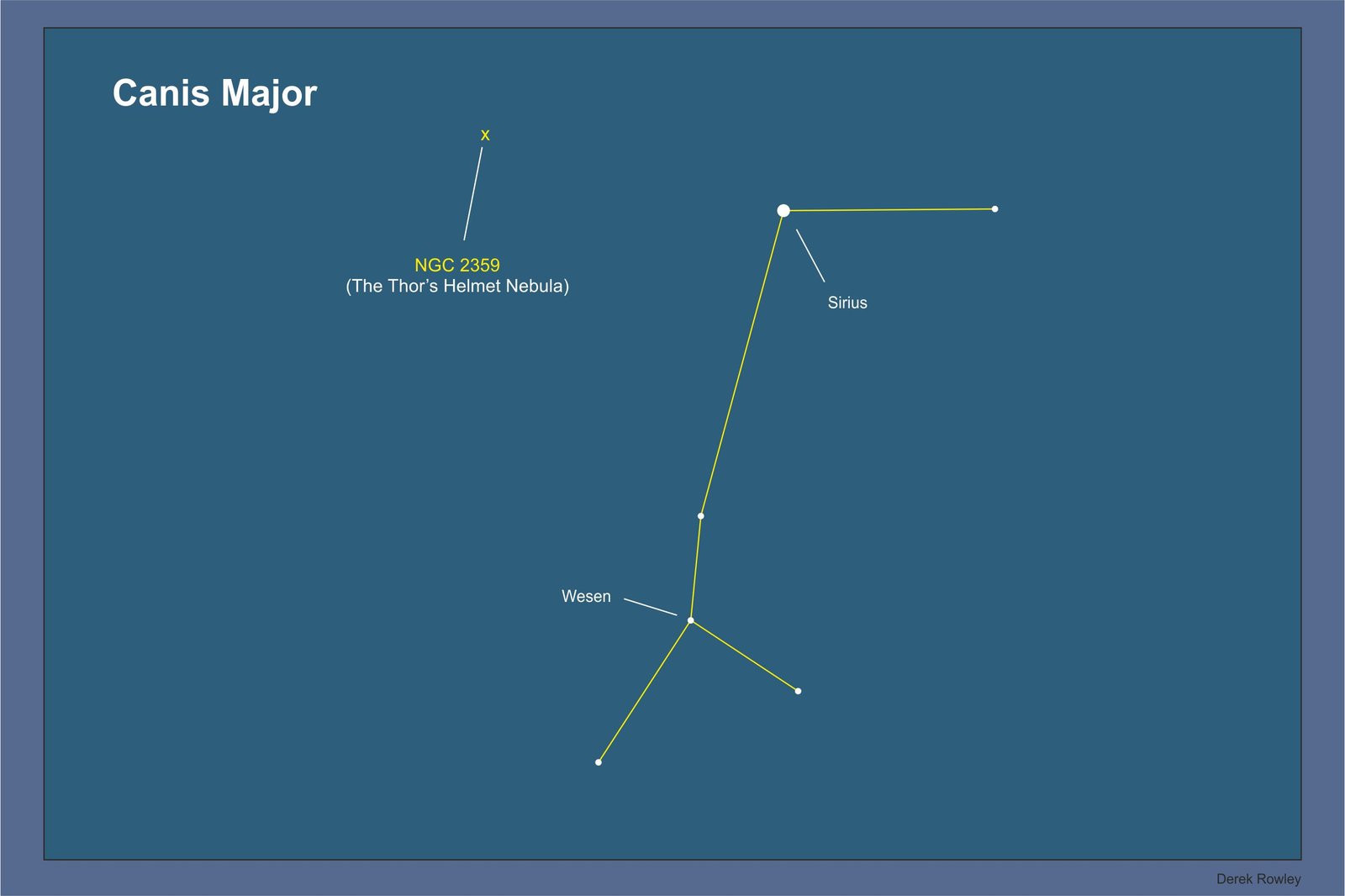
Object :-
oooo
Object :-
Other name :-
Type :-
Magnitude :–
Distance :-
Constellation :-
Right Ascension :-
Declination :-
oooo
oooo
NGC 2359
Thor’s Helmet Nebula
Emission Nebula
+11.5
15,000 light years / 30 light years across
CMa (Canis Major / The Great Dogs)
07h 18m 06s
+13° 12′ 27″
Enlarge on click the map.
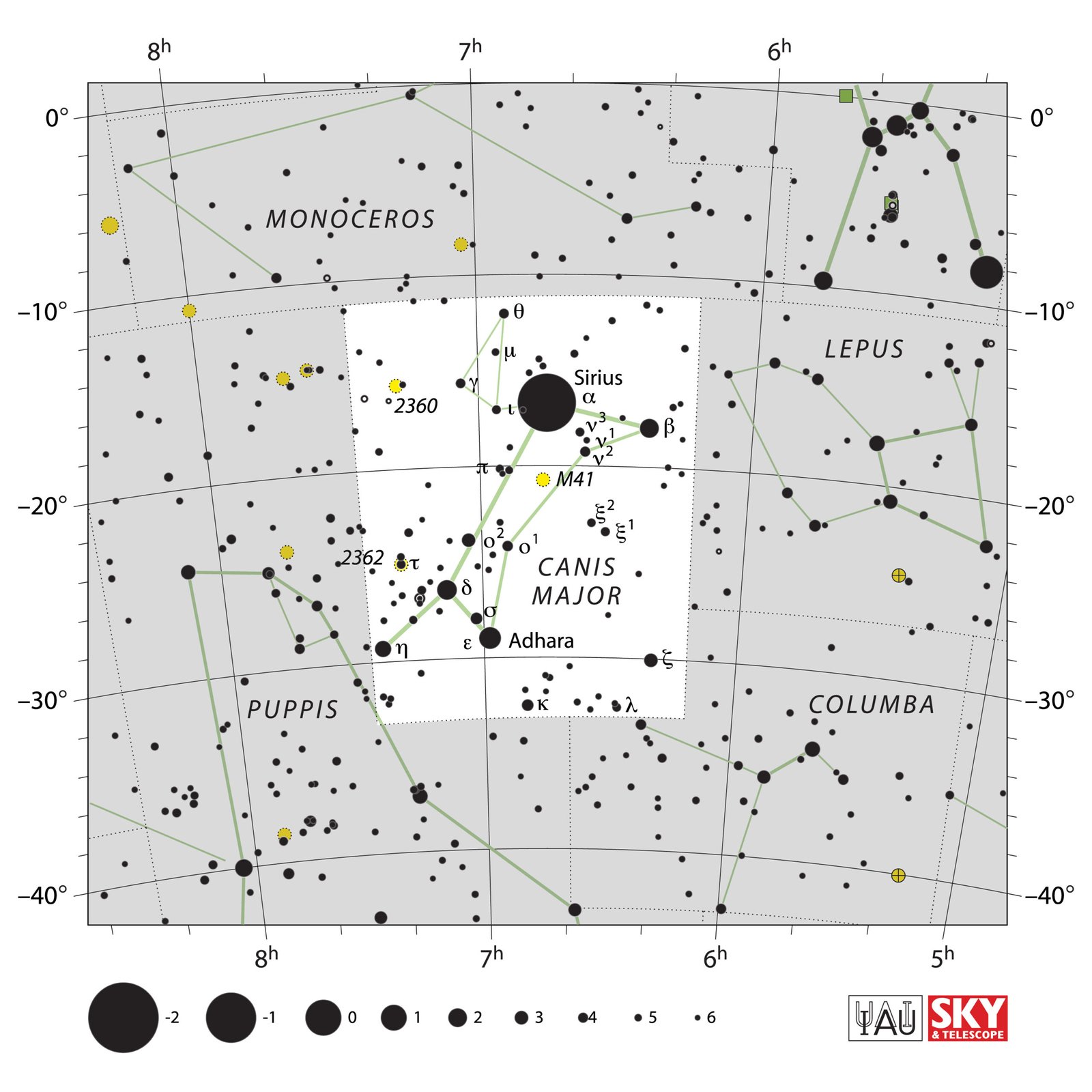
(Click the map above for a large view.)
| Abbreviation: CMa (Canis Major) |
| English Name: The Great Dogs |
| Genitive: Sirius |
| Hemisphere: Southern Hemisphere |
| Location: Between the constellations of Monoceros and Lepus. |
| Visible between latitudes: +60 and -90 degrees |
| Best season: Winter |
| Seen in three seasons: Autumn, Winter, and Spring |
| Best seen in: February (map) and March (map) |
| Seen between: October and March |
| Right Ascension (RA): 07 hour |
| Declination (DEC): -20 degrees |
| Area (square degrees): 380 (43th) |
oooo
oooo
The Glowing Colours are Chemical Reactions
- When astrophotographers take pictures of Thor’s Helmet, it glows with brilliant teals, blues, and reds.
o - The intense ultraviolet radiation from the central star zaps the surrounding gas.
o - The blue-green glow comes from highly energized oxygen atoms, while the deep red strands are glowing hydrogen gas.
o
oooo
oooo
oooo
oooo
oooo
oooo
oooo
oooo