oooo
Visual observing or Deep-sky astrophotography?
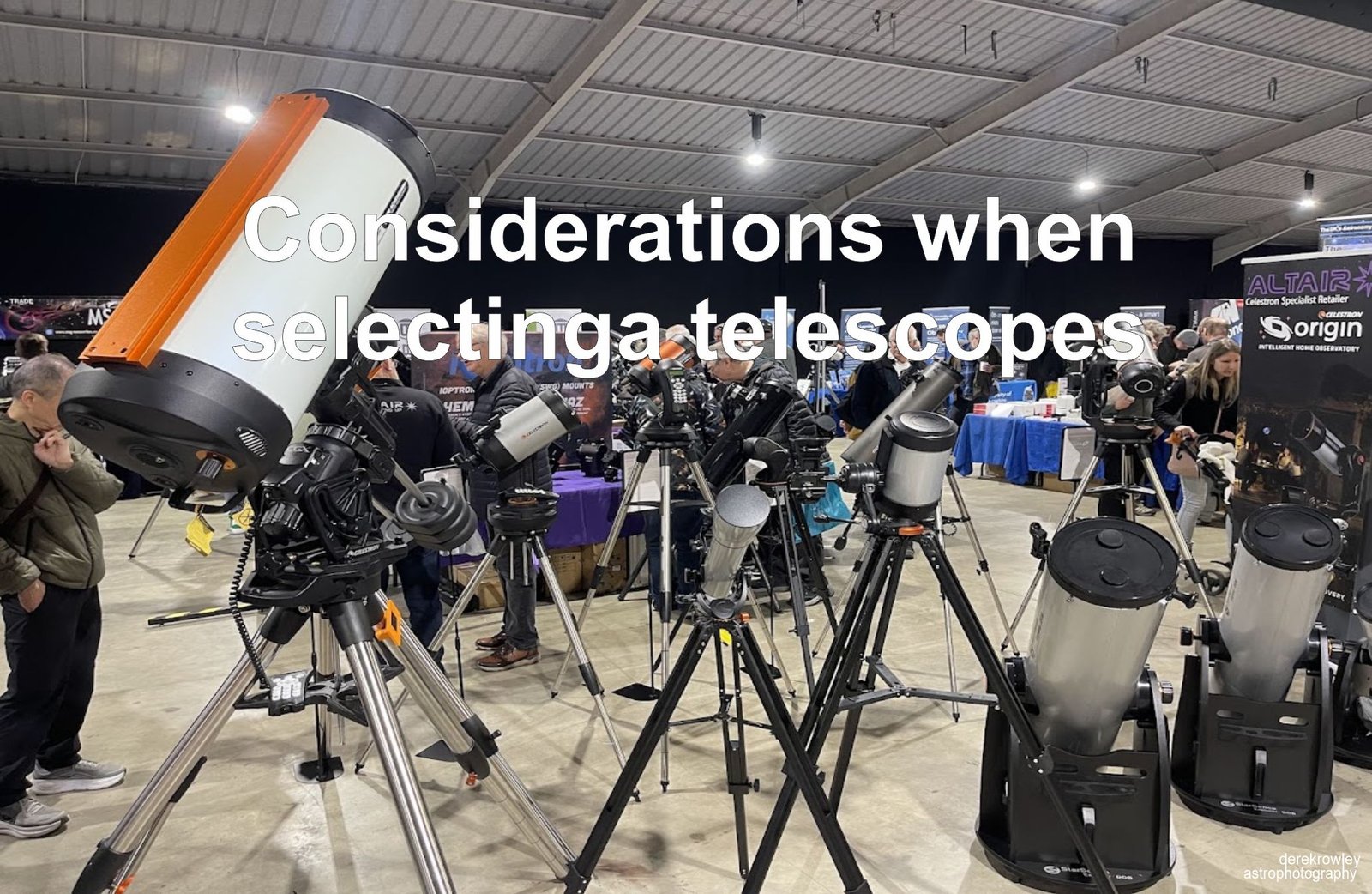
When selecting a telescope, the right choice depends heavily
on whether your primary focus is
visual observing or deep-sky astrophotography.
oooo
oooo
Below are the primary optical parameters,
telescope types, and key considerations to guide your choice.
oooo
Core Optical Specifications
oooo
o
1) Aperture
O
o
Aperture:
Diameter of the primary lens or mirror.
o
The single most important speciation:
Determines light-gathering power and resolution.
o
o
Larger aperture:
Brighter images and finer detail.
oooo

oooo
oooo
o
2) Focal Length
O
o
Focal Length:
Distance from the lens/mirror to the focal point.
o
What it means:
The single most important speciation ~ determines light-gathering power and resolution.
o
o
Why it matters:
Larger aperture – brighter images and finer detail.
oooo
oooo
oooo
o
3) Focal Ratio
O
o
Focal Ratio:
Focal Length..÷..Aperture..= ..f/number
o
What it means:
Distance from the lens/mirror to the focal point.
o
o
Why it matters:
Dictates image magnification and field of view (FOV);
oooo
Short telescope
Shorter focal length = low magnification, wider FOV / bright
o
Longer telescope
Longer focal length = higher magnification, narrower FOV / dim
oooo
oooo
oooo
oooo
oooo
Major Telescope Optical Designs
oooo
1. Refractors (Lens-Based)
O
o
Best For:
Wide-field nebulae imaging, portability, low maintenance.
o
Pros:
– pinpoint star clarity.
– no optical alignment (collimation) required.
– rapid setup.
o
o
Cons:
– expensive per inch of aperture.
– standard Achromats exhibit chromatic aberration (colour fringing)
– apochromatic (APO) doublets or triplets are required for colour-accurate astrophotography.
oooo
oooo
oooo
oooo
oooo
oooo
2. Reflectors (Newtonian / Mirror-Based)
oooo
Best For:
Maximum aperture on a budget (visual astronomy), deep-sky imaging.
o
Pros:
– excellent value for light collection.
– fast focal ratios (f/4 – f/5).
o
o
Cons:
– requires regular collimation.
– larger models are heavy and vulnerable to wind.
– needs a coma corrector lens for wide-field astrophotography.
oooo
oooo
oooo
oooo
oooo
oooo
3. Catadioptrics (Schmidt-Cassegrain / Maksutov-Cassegrain)
oooo
oooo
Best For:
Lunar, planetary, and small deep-sky targets (galaxies, planetary nebulae).
o
Pros:
– compact optical tubes with very long focal lengths (1500mm – 3000mm.
– highly versatile when paired with focal reducers.
o
o
Cons:
– narrow field of view.
– slower focal ratios (f/10 – f/12).
– requiring longer exposure times for deep-sky targets.
– needs a coma corrector lens for wide-field astrophotography.
oooo
oooo
oooo
oooo
oooo
oooo
Key Decision Factors
O
o
1) Primary Intended Use
o
Visual Observing:
Prioritise aperture ~ an 8-inch or 10-inch Dobsonian (Newtonian reflector on an alt-azimuth base) offers the best light-gathering capability per pounds (£).
o
Deep-Sky Astrophotography:
Prioritise a short focal length (250mm – 500mm) and a fast focal ratio ((f/4 – f/6) on an Equatorial (EQ) tracking mount.
o
Short focal length refractors are far more forgiving to track and frame.
o
oooo
oooo
oooo
oooo
oooo
oooo
2) Mount & Payload Weight
o
Tube:
The telescope tube is only half the equation.
o
o
For astrophotography:
The tracking mount is often more critical than the optics.
o
o
Payload capacity:
Ensure the mount’s payload capacity comfortably exceeds the total weight of the optical tube assembly (OTA), camera, finder scope, and accessories (ideally loaded at under 60% – 70% capacity for imaging stability).
oooo
oooo
oooo
oooo
oooo
oooo
3) Field Correction & Accessories
O
o
Camera sensors expose optical distortions that human eyes miss:
o
Field Flattener:
Refactors typically require a field flattener or Petzval optical design to ensure sharp stars across the frame edge.
o
o
Coma Corrector:
Reflectors require a coma corrector.
oooo
oooo
oooo
oooo
oooo
4) Environment & Ergonomics
O
o
Consider transportability:
o
Environment:
Storage space, and dark-sky access.
o
o
Ergonomics:
A large telescope that stays stored away due to its weight gathers less light than a compact telescope that gets taken out under the stars regularly.
oooo
oooo
oooo
oooo
oooo
oooo
Back to
oooo
Back to page 16
Next to page 18
oooo
Page 17 – Considerations when selecting a telescopes Derek Rowley – Derekscope’s BSL Guide to Deep-Sky Imaging
oooo
oooo