oooo
oooo
oooo
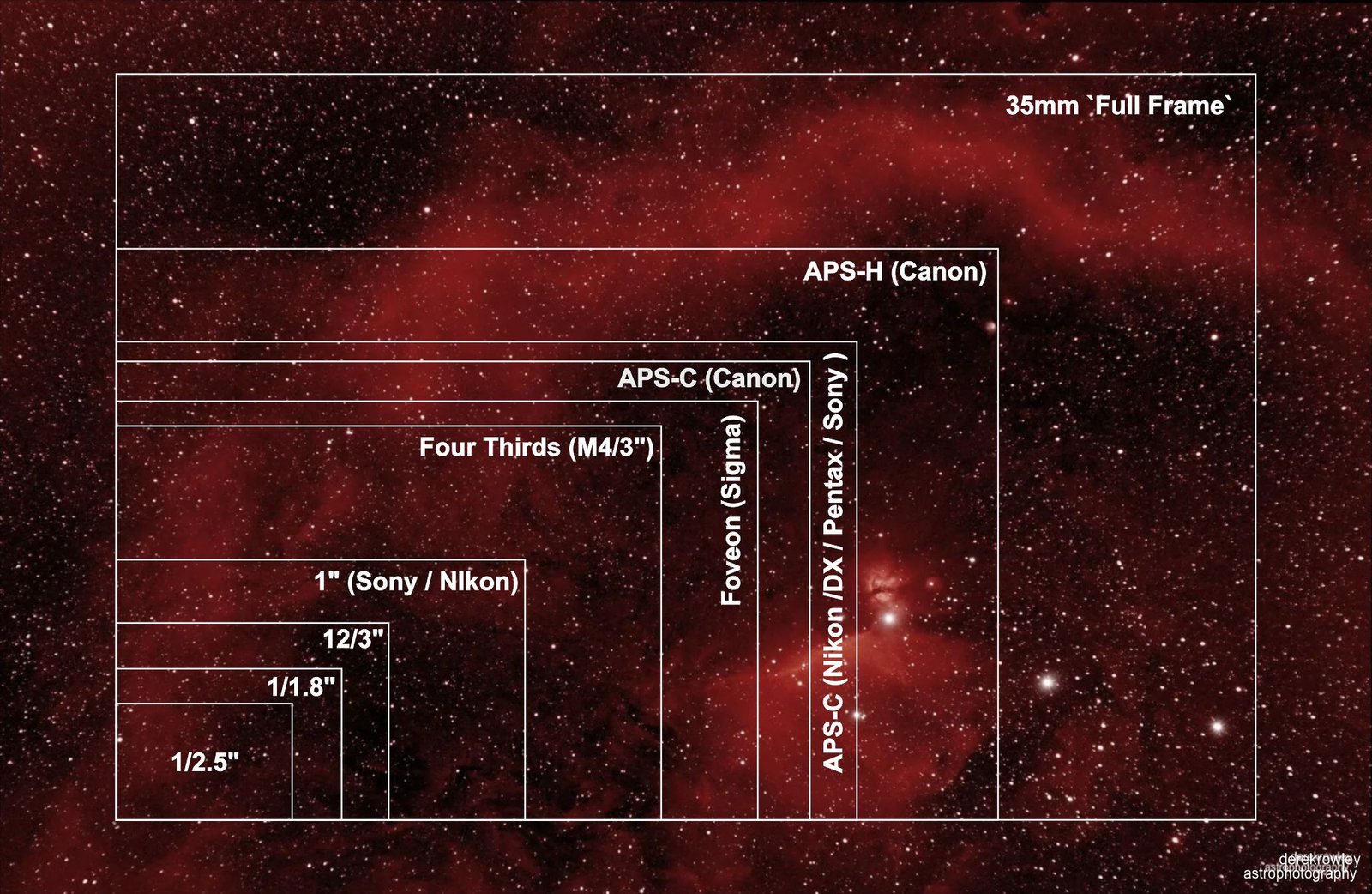
Imaging chip size (sensor size) for cameras
A dedicated astrophotography camera is built specifically to capture
is faint celestial objects like nebulae, galaxies, and star clusters through a telescope,
unlike standard DSLR or mirrorless cameras meant for daytime photography.
oooo
oooo
o
oooo
oooo
Dedicated astronomy cameras
oooo
oooo
o
o
Imaging chip size :
When evaluating imaging chip size (sensor size) for cameras, whether for photography, astrophotography, or video.
o
The sensor dimensions directly determine the camera’s field of view, light-gathering ability, resolution capabilities, and compatibility with lenses or optical systems.
oooo
oooo
oooo
oooo
oooo

oooo
oooo
Common Sensor Sizes (Smallest to Largest)
Here is a breakdown of how imaging chip size impacts camera selection and performance
oooo
| Typical Dimensions | Crop Factor (vs Full Frame) | Common Uses |
| 1/2.8″ to 1/1.8″ (5–7 mm) | 7x – 10x | Guiding, planetary imaging, action cams, webcams |
| 13.2 x 8.8 mm | 2.7x | Compact enthusiast cameras, entry-level planetary/deep-sky |
| 17.3 x 13.0 mm | 2.0x | Compact mirrorless, deep-sky astrophotography |
| 23.5 x 15.6 mm | 1.5x .(1.6x Canon) | General photography, DSLR/mirrorless, deep-sky imaging |
| 36.0 x 24.0 mm | 1.0x (Reference) | Professional photography, wide-field astrophotography |
| 43.8 x 32.9 mm+ | 0.79x or lower | Commercial, high-resolution portrait, landscape |
| o |
oooo
Key Factors Affected by Sensor Size
oooo
o
oooo
oooo
1) Field of View (FOV) & Focal Length
o
Larger Sensors (Full Frame / Medium Format):
Capture a much wider field of view for any given focal length. They are ideal for wide landscapes, large nebulae/galaxies, or architecture.
Smaller Sensors (APS-C / Micro Four Thirds):
Introduce a crop factor that narrows the field of view, effectively giving lenses more “reach.”
o
This makes smaller sensors advantageous for wildlife, sports, or planetary imaging (where magnification of a small target is preferred).
o
o
oooo
oooo
oooo
oooo
2) Signal-to-Noise Ratio & Low-Light Performance
oooo
o
Photosizes:
For a given resolution (megapixel count), a larger sensor has physically larger individual pixels (photosites).
Photons:
Larger pixels collect more light (photons) per exposure, resulting in:
– lower image noise (especially at high ISO/gain setting
– better dynamic range (preserving highlight detail and deep shadows simultaneously).
– high Quantum Efficiency (QE) and cleaner shadow stretching in post-processing.
o
o
oooo
oooo
3) Optical & Lens Requirements (Image Circle)
o
Cost & Weight:
Larger sensors require bigger, heavier, and significantly more expensive optical elements.
o
o
Image Circle Coverage:
The lens or telescope optics must produce an illumination circle large enough to cover the entire sensor.
o
Vignetting & Aberrations:
Larger sensors require larger, higher-quality lenses or optical correctors (e.g., field flatteners or coma correctors).
o
If optics fall short, full-frame sensors suffer from corner vignetting (darkening) or edge distortion/astigmatism.
oooo
oooo
oooo
4) Depth of Field & Focus Tolerances
o
o
Critical Focus Zone:
Cameras with larger sensors have tighter focus tolerances and are more sensitive to sensor tilt or optical misalignments across the image frame.
Shallow Depth of Field:
Larger sensors make it easier to achieve a shallow depth of field and soft background blur (bokeh) at equivalent field-of-view settings.
oooo
oooo
oooo
oooo
oooo
Back to
oooo
Back to page 28
Next to page 30
oooo
Page 29 – Camera Specifications Derek Rowley – Derekscope’s BSL Guide to Deep-Sky Imaging
oooo
oooo