oooo
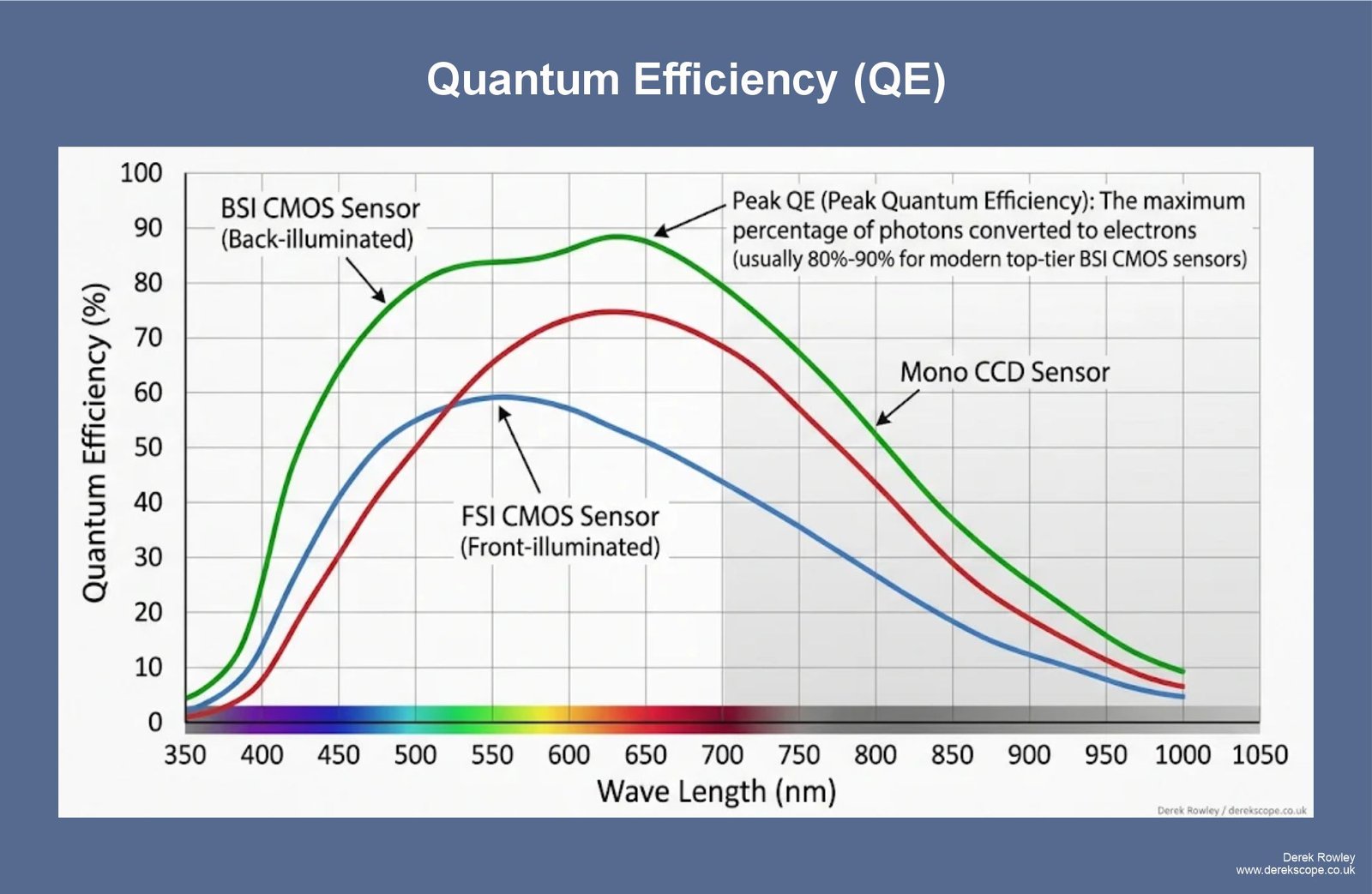
Quantum Efficiency (QE)
QE(%) = (Number of Electrons Generated ÷ Number of Photons Received) x100
oooo
Peak Quantum Efficiency (Peak QE)
oooo
oooo
Peak Quantum Efficiency (Peak QE):
It is a key specification for image sensors (CMOS/CCD) used in astrophotography and digital imaging.
o
It measures the maximum percentage of incident photons hitting the sensor that are successfully converted into photoelectrons at the sensor’s most sensitive wavelength.
o
o
Higher:
A higher Peak Quantum Efficiency (Peak QE) is generally better because it means the senor or device converts a large percentage of incoming photons incoming photons into electrical signals.
oooo

oooo
What is a “best” percentage?
QE benchmarks vary depending on the device and application.
oooo
| 80% – 90% Top-tier for modern back-illuminated CMOS astronomy sensors |
| 60% – 80% Good Sensitivity |
| 40% – 60% Average Sensitivity |
| 10% – 40% Low Sensitivity |
oooo
oooo
Key Concepts & Formula
oooo
oooo
Definition & Formula:
oooo
Quantum Efficiency (QE) =
(Number of Electrons ÷ Generated Number of Photons Received)
Spectral Dependence:
Sensor sensitivity varies across different light wavelengths (colours).
o
o
Highest efficiency point:
Peak QE refers specifically to the highest efficiency point on the sensor’s spectral response curve (often in the green or red portion of the visible spectrum).
o
Modern Sensor Performance:
Modern back-illuminated (BSI) CMOS sensors (such as Sony Exmor R/STARVIS series used in deep-sky astronomy cameras) regularly achieve peak QE levels between 80% and 90%+, compared to older front-illuminated sensors which often maxed out around 50–60%.
oooo
oooo
oooo
oooo
oooo
o
Why it matters in Deep-Sky Imaging?
o
o
o
o
Signal-to-Noise Ratio (SNR):
A higher QE means the sensor captures more light from faint deep-sky targets (nebulae, galaxies) in less exposure time, resulting in a cleaner image with a higher signal-to-noise ratio.
o
Narrowband Imaging Efficiency:
Knowing where the peak QE occurs helps determine how well the camera performs when capturing specific emission lines, such as H-alpha (656.3 nm), OIII (500.7 nm), or SII (672 nm).
ooo
oooo
oooo
oooo
oooo
oooo
oooo
oooo
oooo
oooo
Back to
oooo
Back to page 34
Next to page 36
oooo
Page 35 – QE (Peak Quantum Efficiency) Derek Rowley – Derekscope’s BSL Guide to Deep-Sky Imaging
oooo
oooo