oooo
oooo
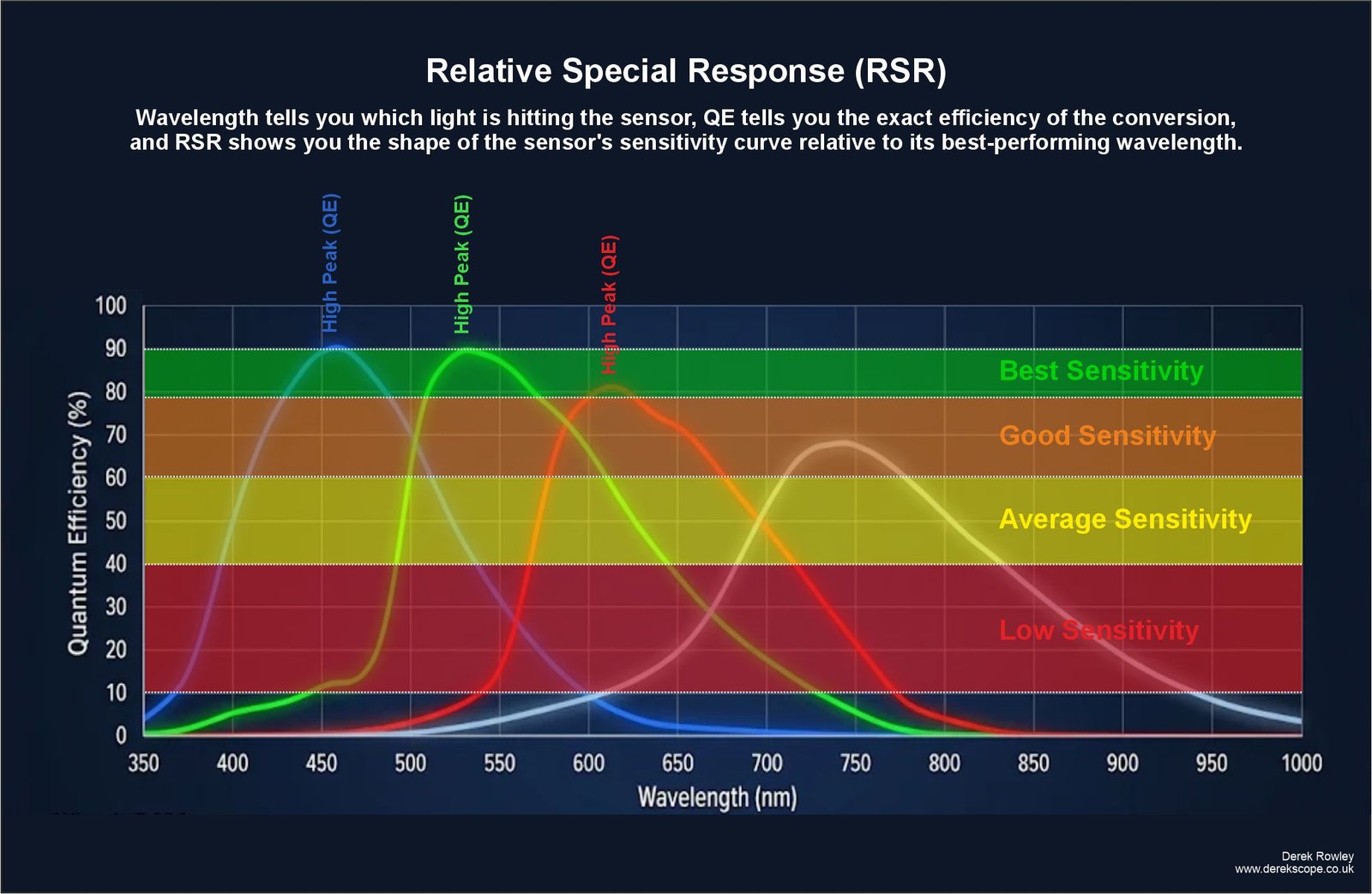
Relative Special Response (RSR)
oooo
oooo
Horizon ~ Wavelength (nm):
To measures how sensitive an image sensor is across different wavelengths of light relative to its highest sensitivity point.
o
o
Vertical ~ Peak Quantum Efficiency (High Peak QE):
It is a key specification for image sensors (CMOS/CCD) used in astrophotography and digital imaging.
o
o
Relative Special Response (RSR):
Wavelength tells you which light is hitting the sensor, QE tells you the exact efficiency of the conversion, and RSR shows you the shape of the senor’s sensitivity curve relative to its best-performing wavelength.

oooo
oooo
oooo
Quantum Efficiency (Peak QE):
oooo
What is a “best” percentage?
QE benchmarks vary depending on the device and application.
oooo
| 80% – 90% Top-tier for modern back-illuminated CMOS astronomy sensors |
| 60% – 80% Good Sensitivity |
| 40% – 60% Average Sensitivity |
| 10% – 40% Low Sensitivity |
More information:
QE = Peak Quantum Efficiency (Page 35)
oooo
oooo
Key Concepts & Formula
oooo
oooo
oooo
oooo
oooo
Back to
oooo
Back to page 35
Next to page 37
oooo
Page 36 – Relative Special Response Derek Rowley – Derekscope’s BSL Guide to Deep-Sky Imaging
oooo
oooo