oooo
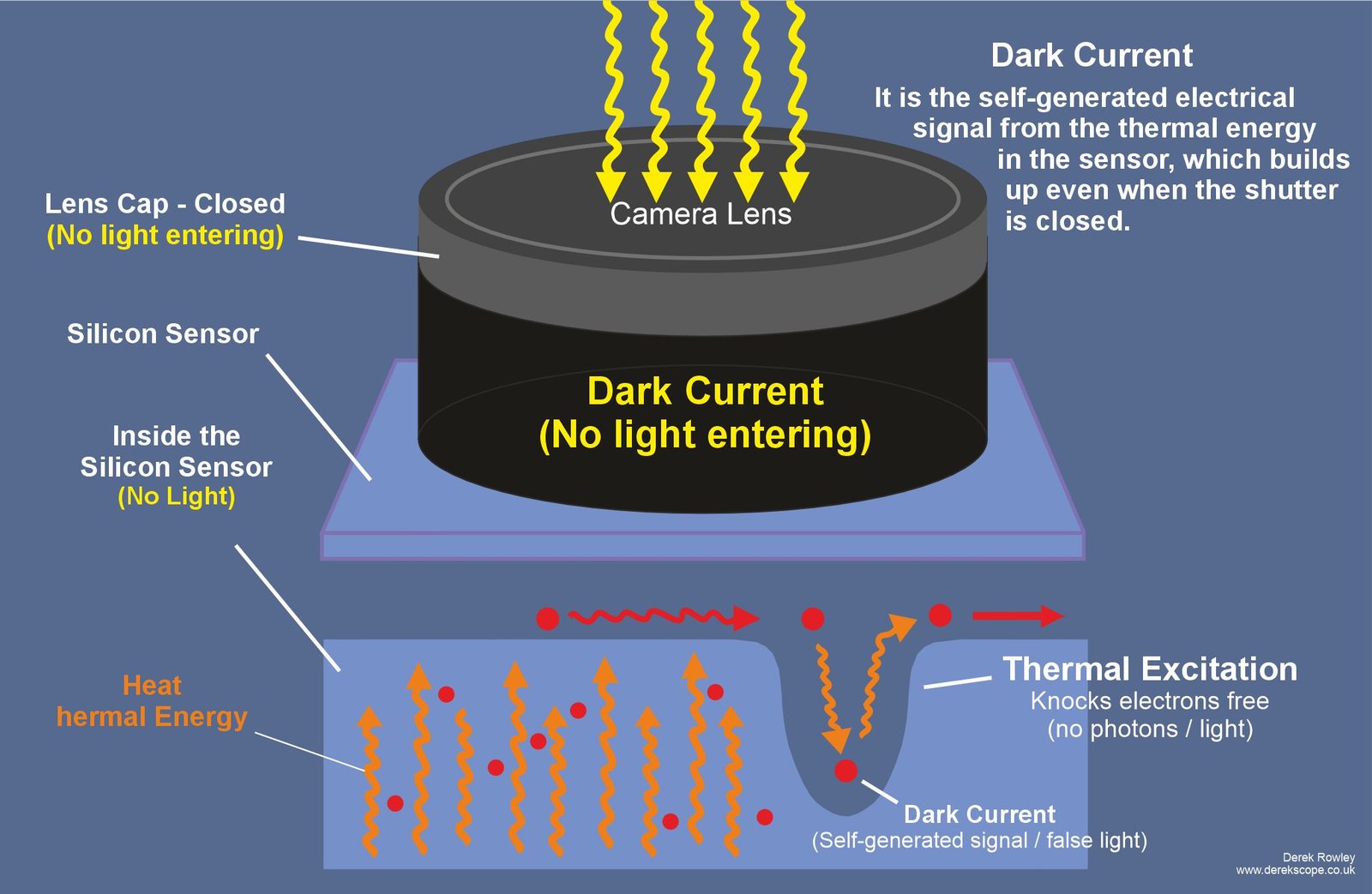
Inside the Silicon Sensor
Dark Current (No light entering)
oooo
oooo
oooo
Dark Current
oooo
oooo
Dark Current:
It is a persistent background electric current generated within an image sensor (CMOS or CCD) even when no light is entering the camera (i.e., in complete darkness).
oooo
oooo
What Causes It?
Indistinguishable from Light:
To the camera sensor, thermally generated electrons look identical to electrons generated by incoming light photons.
Thermal Energy:
Random vibrations in the sensor’s silicon structure thermally excite electrons, knocking them loose into the pixel wells.
oooo
oooo
oooo

oooo
oooo
How does it impacts Astrophotography?
oooo
oooo
Signal Build-Up Over Time:
Dark current accumulates linearly with exposure time. During short daytime snapshots (for example: 1/500 seconds), it is imperceptible.
o
During long exposures (for example: 300 seconds) required for faint deep-sky targets (galaxies, nebulae), dark current creates a noticeable thermal background layer.
o
Thermal Shot Noise:
The random quantum variation in dark current creates dark current shot noise (grainy background noise).
o
Hot Pixels & Non-Uniformity:
Pixels do not accumulate dark current at the exact same rate.
o
Defective or sensitive pixels accumulate charge very rapidly, showing up as bright white or coloured specks (“hot pixels”).
oooo
oooo
oooo
How to Control & Mitigate Dark Current
oooo
oooo
OOOO
Sensor Cooling (-10° or -20°):
Dedicated astronomy cameras use Thermoelectric Coolers (TEC / Peltier cooling) to chill the sensor down to -10° or -20°, dropping dark current to negligible levels.
oooo
Dark Frames Subtraction:
In astrophotography image processing, long-exposure images (“dark frames”) taken with the telescope/lens covered at the same temperature and exposure time are subtracted from light frames to remove the fixed thermal background and hot pixels.
o
o
Dark frame:
It is a calibration image taken with the lens cap on (or the camera shutter closed) using the exact same exposure time, ISO/gain, and sensor temperature as your actual astrophotography shots.
o
See more information about Dark Frames (Page ##).
o
oooo
oooo
oooo
oooo
oooo
Back to
oooo
Back to page 36
Next to page 38
oooo
Page 37 – Dark Current Derek Rowley – Derekscope’s BSL Guide to Deep-Sky Imaging
oooo
oooo