oooo
oooo
The important of Camera Offset in Astrophotography
oooo
oooo
oooo
oooo
Camera Offset:
adds a baseline value to prevent shadow data from being clipped to absolute black during digital conversion.
o
o
Camera offset (also called bias):
It is a baseline digital voltage added to your sensor’s readout signal before the analogue-to-digital conversion occurs. It ensures that all shadow data and noise fluctuations are captured without being cut off.

oooo
oooo
Why Camera Offset Matters
oooo
oooo
Prevents Black Clipping :
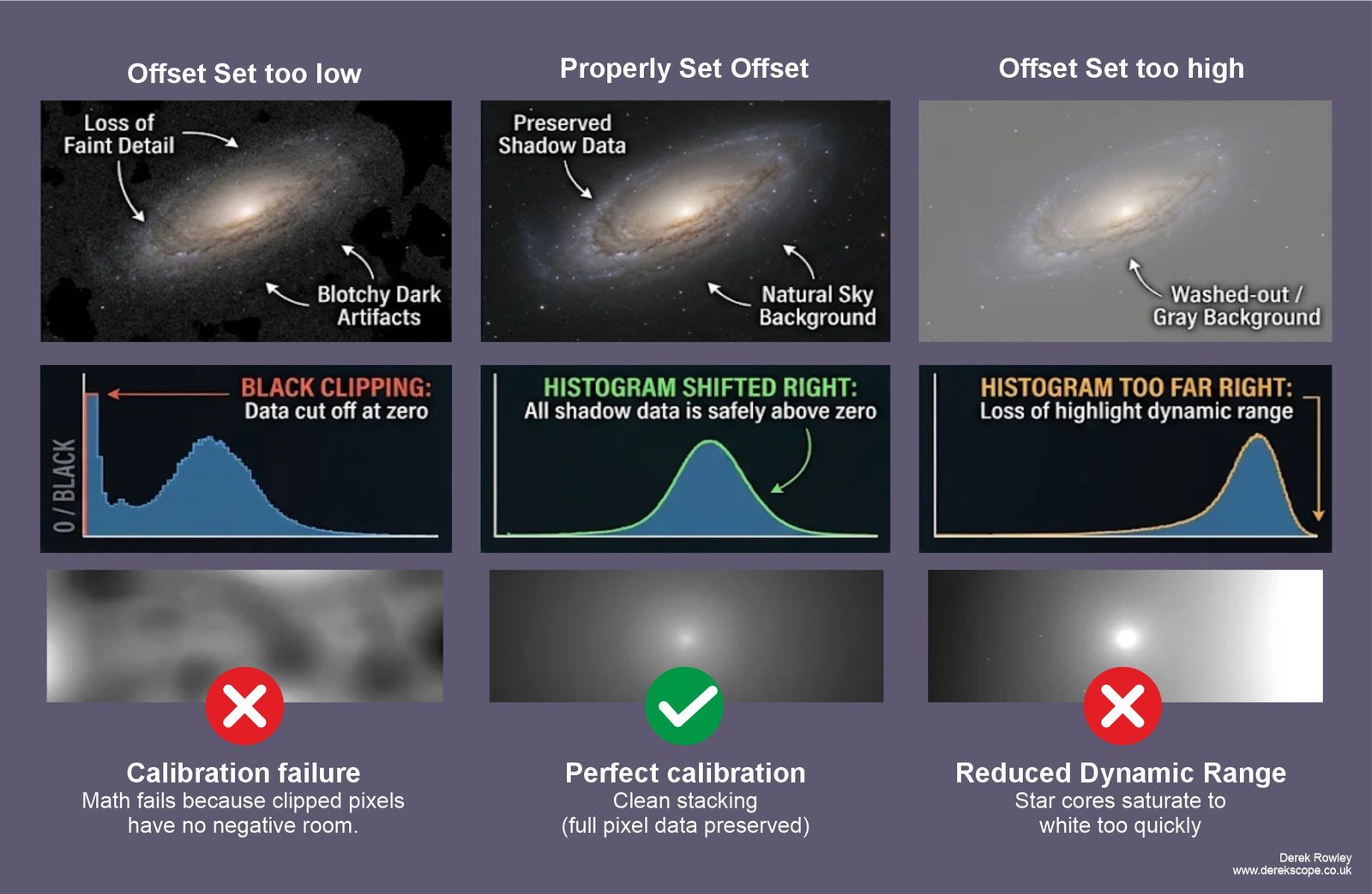
Sensor readout noise naturally fluctuates up and down. Without an offset (or if it is set to zero), any negative fluctuations in dark background areas hit a hard digital limit of zero, permanently destroying faint background nebulosity and dim stars.
o
Preserves Faint Shadow Detail:
By adding a baseline offset value (lifting the baseline to a safe positive number, typically around a few hundred ADU in 16-bit counts), even the darkest sky background pixels stay safely above zero. This lets faint details sit cleanly on top of the noise floor.
o
Enables Accurate Calibration & Stacking:
Pre-processing deep-sky images relies on subtracting dark frames and bias frames to remove thermal noise and sensor artifacts. If background pixels are clipped to zero, the subtraction math breaks, resulting in ugly dark blotches and calibration artifacts across your stacked image.
oooo
oooo
oooo
The Three Scenarios
oooo
oooo
| Offset Setting | What Happens to Data | Visual Impact |
| Too Low (Zero) | Noise drops below 0 and gets clipped | Faint nebulae crushed, blotchy dark artifacts, broken calibration |
| Properly Set | Histogram’s left tail is safely shifted right, away from the zero line | Smooth, natural sky background; full shadow detail preserved |
| Too High | Wastes the sensor’s full-well capacity and dynamic range | Highlights and bright star cores saturate to solid white much faster |
| . |
oooo
oooo
oooo
oooo
oooo
Back to
oooo
Back to page 37
Next to page 39
oooo
Page 38 – Offset Derek Rowley – Derekscope’s BSL Guide to Deep-Sky Imaging
oooo
oooo