oooo
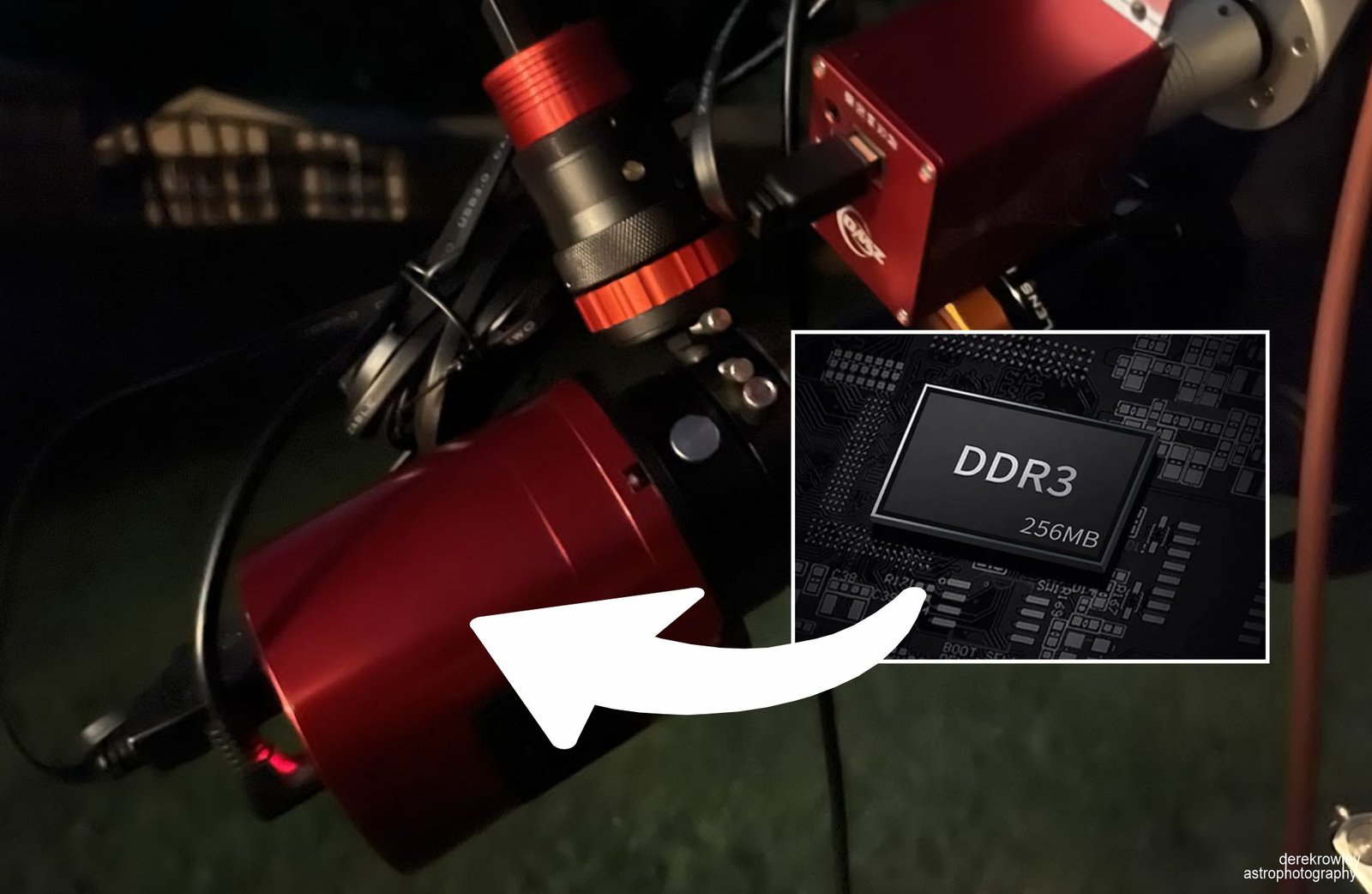
Memory Buffer
This is a high-speed memory chip built inside the astro-camera
that can store data while the camera is in use.
oooo
oooo
Key Functions & Benefits
oooo
o
oooo
oooo
1) Prevents Dropped Frames:
o
Image Files:
High-resolution astrophotography sensors generate massive image files.
o
o
Captured Frame:
A DDR memory buffer holds the captured frame instantly, allowing the camera to queue and stream data smoothly to the host computer even if the computer’s CPU, USB bus, or hard drive experiences temporary lag.
o
(DDR = Double Data Rate)
o
o
oooo
oooo
oooo
oooo

oooo
oooo
oooo
2) Mitigates Amplifier Glow (Amp Glow):
oooo
CCD / CMOS:
On many CCD and CMOS sensors, active amplifier circuitry generates heat and faint infrared light during exposure or data transfer, creating bright fan-shaped streaks along the image edges.
(CCD = Charge-Coupled Device)
(CMOS = Complementary Metal-Oxide-Semiconductor)
o
DDR Buffer:
By temporarily caching frames in the DDR buffer, the camera rapidly completes sensor readout and offloads the data, minimizing the time amplifier electronics remain continuously powered on.
o
(DDR = Double Data Rate)
oooo
oooo
oooo
oooo
oooo
oooo
o
3) Ensures data stability over USB 2.0 / USB 3.0
oooo
USB:
When using long cables, USB hubs, or older USB 2.0 connections with lower bandwidth, a memory buffer prevents buffer underrun errors and frame corruption during batch acquisitions or sequence captures.
o
o
USB 3.0:
Most astronomy cameras require a USB 3.0 type-A to Type-B cable (often included in the box) to achieve full data transfer speeds.
o
o
Speed:
Cameras with USB 3.0 ports are backward compatible and will work if you plug in a USB 2.0 cable, but your frame rate and download speed will drop significantly down to USB 2.0 limits.
o
o
0.75 or 2 metres Cable Length:
Cables usually come in lengths like 0.75 metre or 2 metres ~ long USB 3.0 cables (above 3 meters) can cause signal dropouts or frame-loss issues unless you use a powered USB hub or active extension.
ooo
oooo
oooo
oooo
oooo
oooo
oooo
o
4) Supports Fast Planetary & Lunar Imaging
o
High-speed video recording:
High -Speed Imaging produces hundreds of frames per second.
o
The DDR buffer caches rapid bursts of raw frames before sending them to storage without dropping frames.
o
oooo
oooo
oooo
oooo
oooo
Back to
oooo
Back to page 30
Next to page 32
oooo
Page 31 – Memory Buffer Derek Rowley – Derekscope’s BSL Guide to Deep-Sky Imaging
oooo
oooo