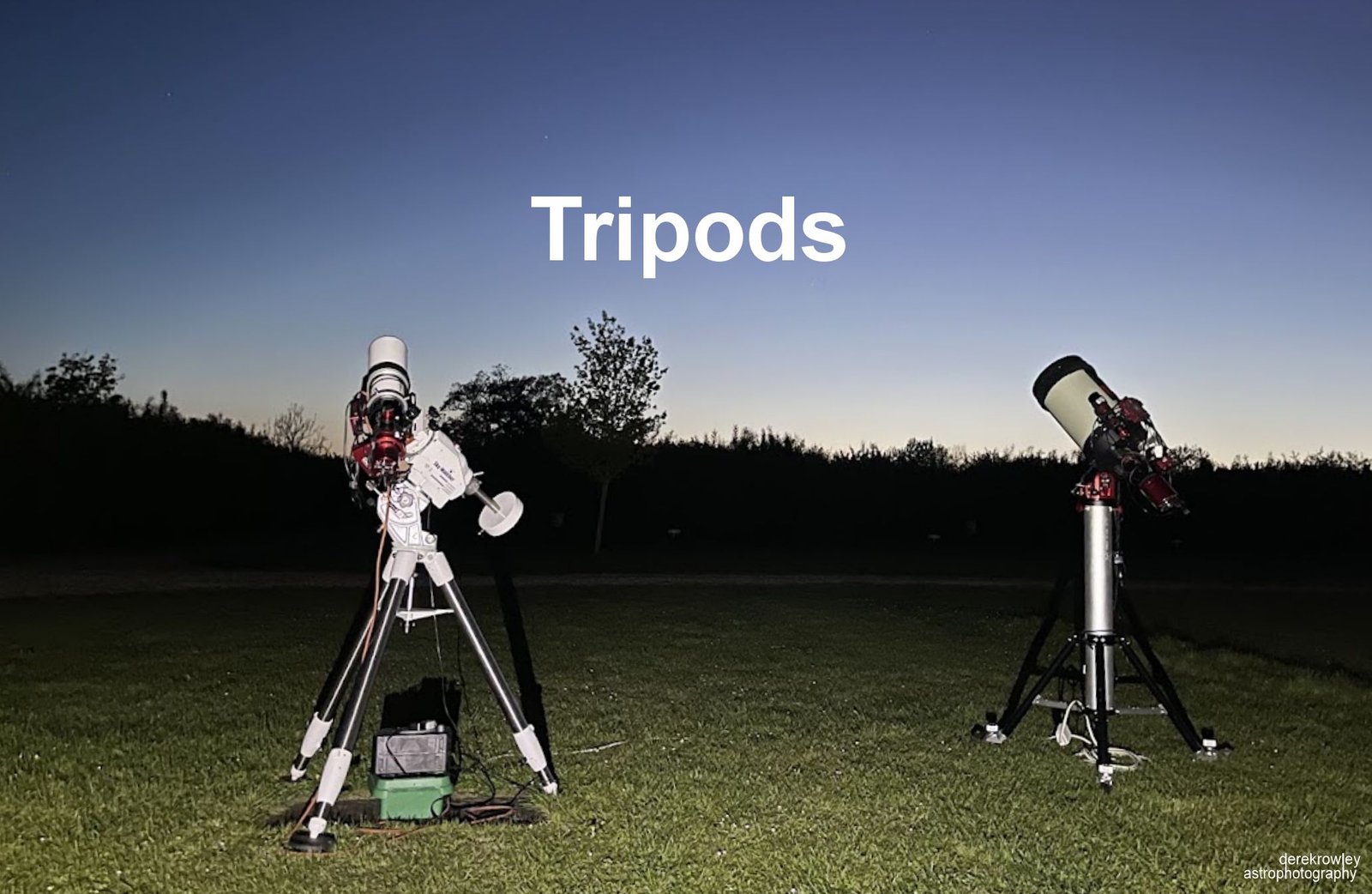
A tripod is a portable, three-legged stand designed to support and stabilize a camera, telescope, tracking mount, or other equipment.
oooo
oooo
o
Tripods
A sturdy, reliable tripod is the literal foundation of any good astrophotography setup.
o
Because deep-sky imaging relies on long exposure times, even the slightest vibration from wind, shutter movement, or walking near the setup ~ can blur stars into streaks and ruin hours of data.
o
o

oooo
oooo
o
o
Key Factors to Consider When Choosing a Tripod
oooo
oooo
Payload Capacity:
Ensure your tripod (and its head) can comfortably support well over the total weight of your camera, lens, tracking mount, and any accessories.
o
A higher weight rating ensures structural rigidity under load.
oooo
oooo
Material Selection:
Carbon Fibre
Excellent for mobile astrophotographers ~ it is lightweight, handles temperature swings well, and naturally dampens vibrations quickly.
o
Aluminium
Affordable and rigid, though heavier and more prone to thermal expansion or contraction in freezing night conditions.
o
Steel / Wood
Often used for heavy-duty stationary or observatory setups. Wood and steel offer phenomenal vibration-damping properties for heavy telescopes and tracking mounts.
o
Centre Columns (The Less, The Better)
While convenient for adjusting height quickly, extended centre columns act like a monopod perched on top of your tripod, vastly increasing vulnerability to wind and vibrations.
o
For astrophotography, it is always best to keep the centre column fully lowered or choose a flat-base tripod.
o
o
oooo
oooo
oooo
oooo
oooo
oooo
oooo
Best Practices for Maximum Stability in the Field
oooo
oooo
oooo
1) Extend Thicker Sections First
o
Always extend the upper, thickest leg segments first, and leave the thin bottom segments retracted unless absolute maximum height is required.
o
o
oooo
oooo
oooo
oooo
2) Weigh It Down
o
Utilize the weight hook underneath the centre column (or a suspended rock bag) to hang your camera bag or a water jug.
o
This lowers the centre of gravity and anchors the tripod against gusts of wind.
o
o
oooo
oooo
oooo
oooo
3) Secure Your Footing
o
Press the tripod feet firmly into soft earth, or swap rubber feet for metal spikes if you are shooting on grass or soil to prevent slippage.
o
o
oooo
oooo
oooo
oooo
4) Hands-Off Shooting
o
Never touch the tripod or camera while an exposure is running.
o
Use an intervalometer, a remote shutter cable, or a camera self-timer delay to eliminate physical contact blur.
o
o
oooo
oooo
oooo
oooo
oooo
Back to
oooo
Back to page 7
Next to page 9
oooo
Page 8 – Tripods Derek Rowley – Derekscope’s BSL Guide to Deep-Sky Imaging
oooo
oooo