Here are two examples of different camera models below.
oooo
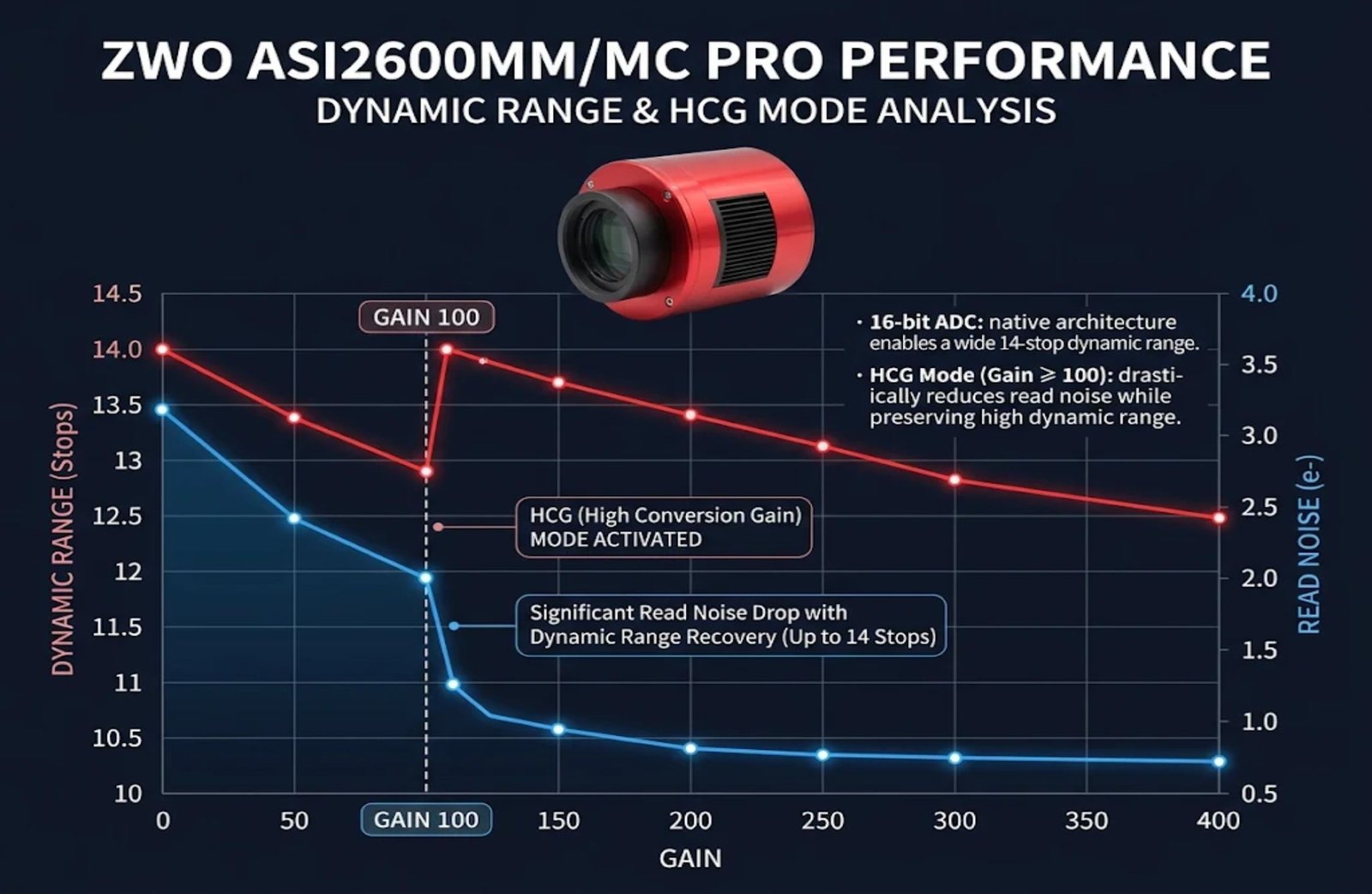
ZWO ASI2600MM/MC Pro
ZWO ASI58MM/MC Pro
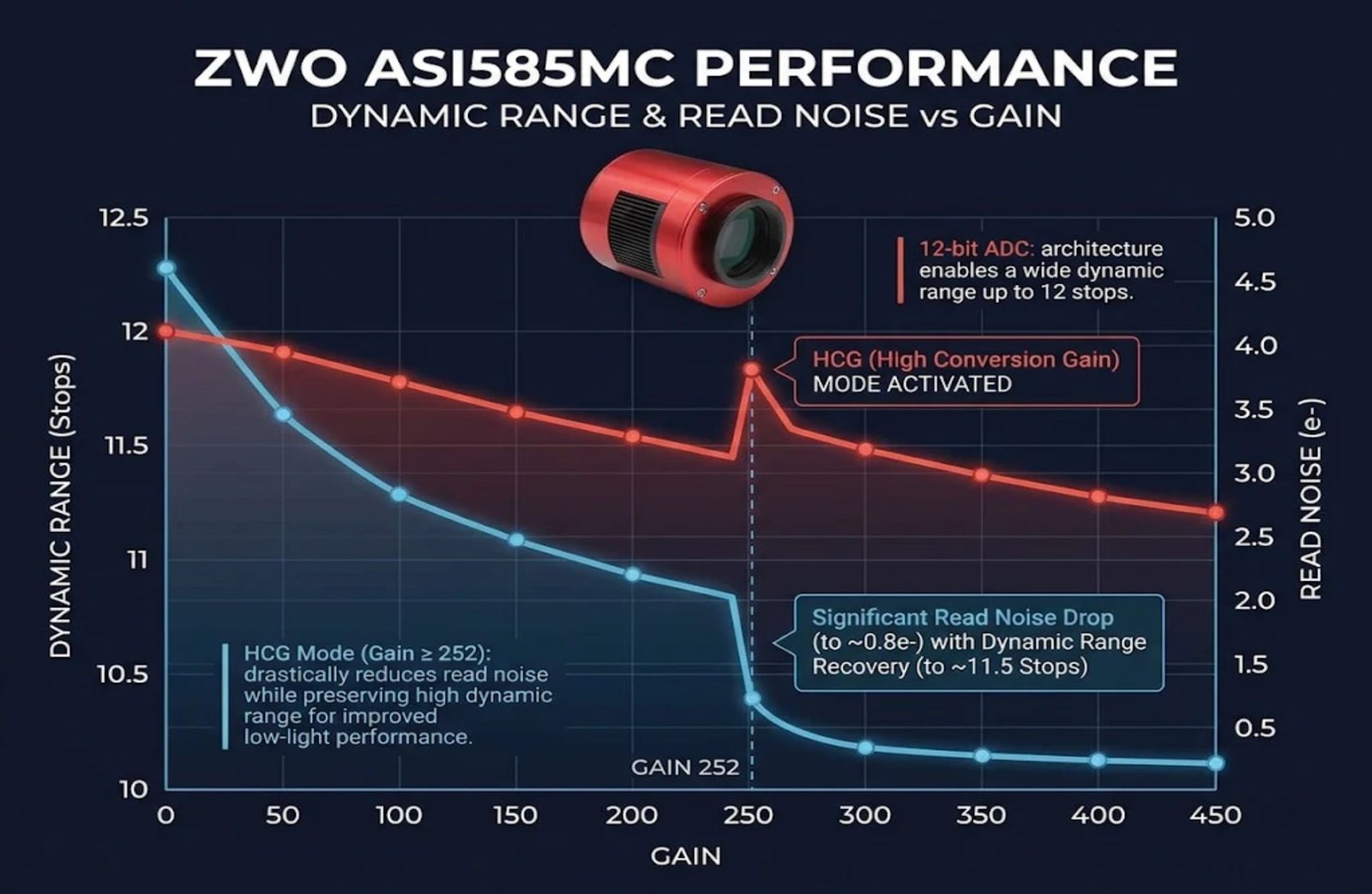
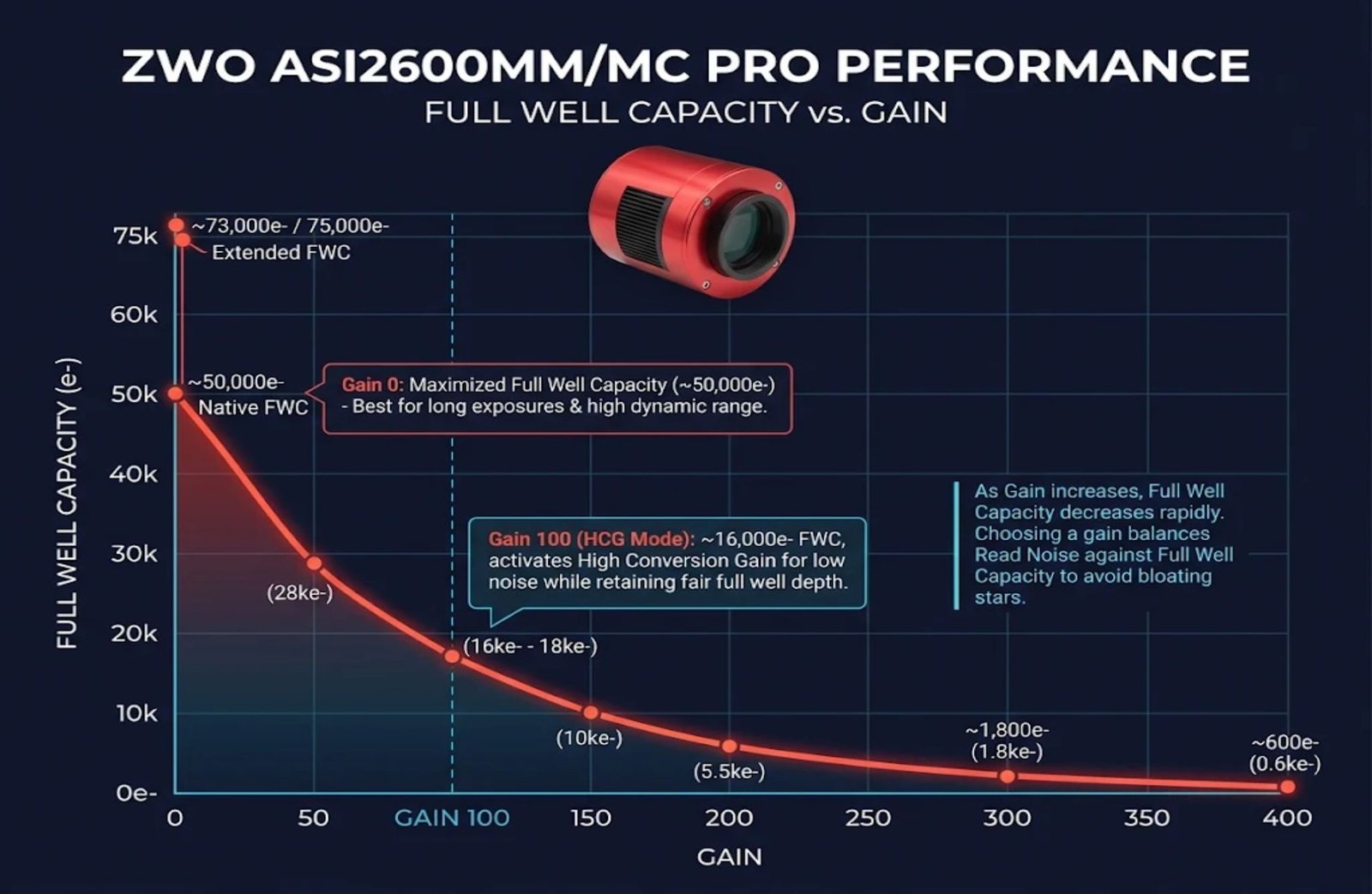
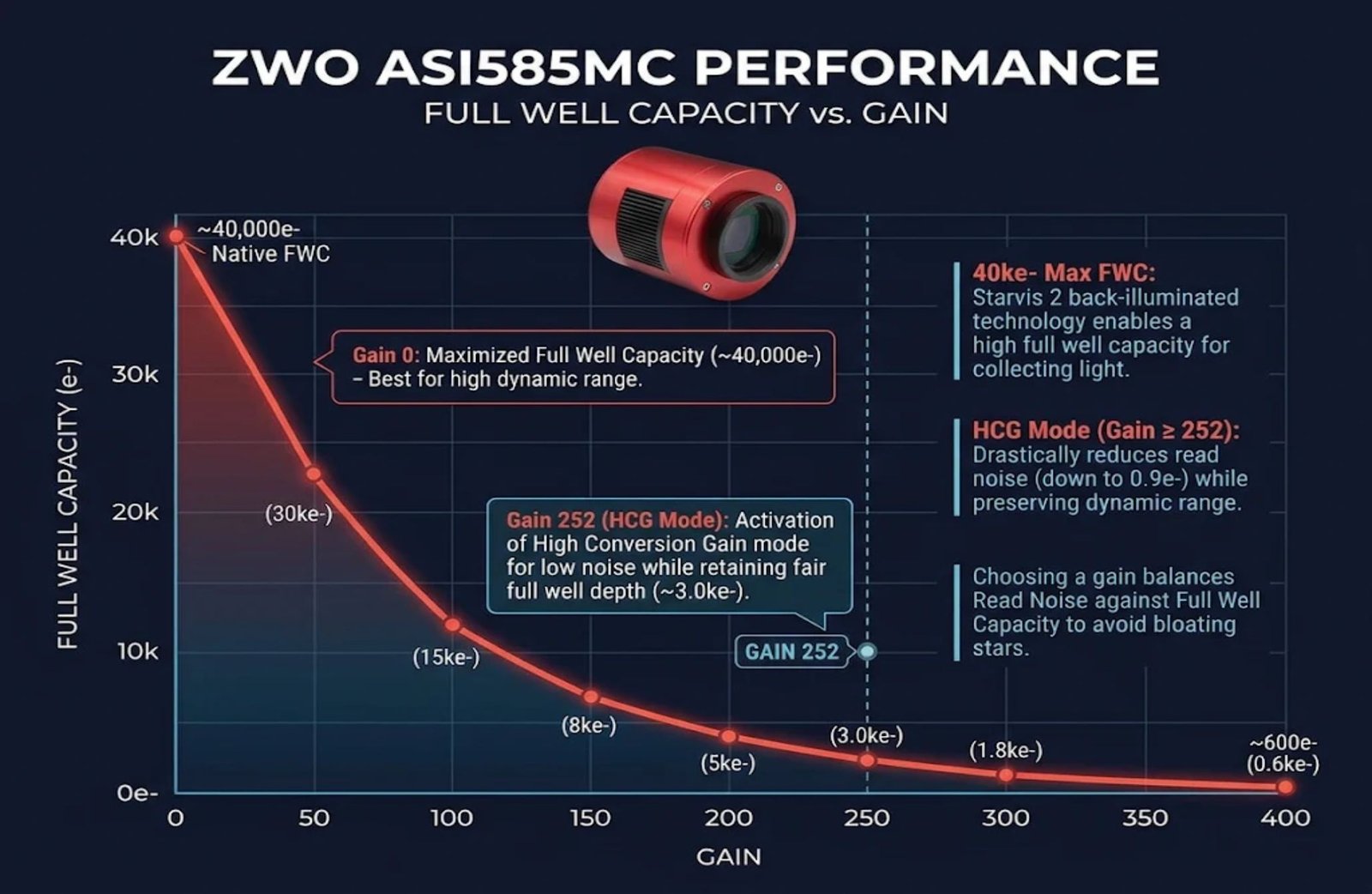
(Click each box above to enlarge)
oooo
Full Well Capacity, Read Noise, and Dynamic Range
They are fundamental sensor specifications in digital imaging and astrophotography.
oooo
oooo
oooo
oooo
Full Well Capacity, Read Noise, and Dynamic Range
oooo
They are fundamental sensor specifications in digital imaging and astrophotography.
o
Together, they determine how much signal a camera can capture before saturating, how faint a light signal it can detect, and the overall breadth of light intensity it can record in a single frame.
(DDR = Double Data Rate)
o
o

oooo
1) Full Well Capacity (FWC)
o
Definition:
The maximum charge (measured in electrons, e⁻) that an individual pixel can store before it saturates.
Impact:
A larger full well capacity allows pixels to collect more light without clipping.
When a pixel exceeds its full well capacity, it becomes saturated (reaching pure white, ADU max), causing bright targets (such as star cores or bright nebulae) to lose colour and structural detail.
o
(ADU = Analog-to-Digital Unit)
Typical Range:
~10,000 e⁻ to over 100,000 e⁻ depending on pixel size and sensor architecture.
oooo
oooo
oooo
oooo
oooo
o
2. Read Noise (RN)
oooo
Definition:
The uncertainty or electronic noise introduced by the camera’s readout circuitry and analogue-to-digital converter (ADC) during sensor readout, measured in electrons (e⁻).
o
o
Impact:
Read noise sets the camera’s absolute noise floor – the minimum detectable light signal ~ Signals weaker than or buried beneath the read noise floor cannot be easily separated from background noise.
o
Lower read noise allows shorter exposures to be stacked effectively without degradation from accumulated sensor read errors.
o
o
Typical Range:
~0.5 e⁻ to 7 e⁻ (varies inversely with gain settings).
ooo
oooo
oooo
oooo
oooo
oooo
oooo
o
3) Dynamic Range (DR)
o
Definition:
The ratio of the maximum readable signal (FWC = Full Well Capacity) to the noise floor (Read Noise) within a single exposure.
oooo
o
Mathematical Formula:
Dynamic Range (Linear Ratio) = FWC ÷ Read Noise
o
Dynamic Range (Stops) = log2 (FWC.÷.Read Noise)
o
Dynamic Range (dB) = log10 (FWC.÷.Read Noise)
oooo
oooo
Impact:
High dynamic range enables a camera to simultaneously capture faint details in shadow regions without blowing out highlight areas.
oooo
oooo
oooo
oooo
Interplay & Gain Trade-Offs
| Parameter | Low Gain | High Gain | High Conversion Gain (HCG) Mode |
| Full Well Capacity (FWC) | Maximum | Reduced (saturates faster) | Slightly lower than base |
| Read Noise (RN) | Higher | Substantially lower | Drops dramatically |
| Dynamic Range (DR) | Maximum headroom for highlights | Slightly lower total range | Optimizes both low read noise & high DR |
| Best Target Use | Bright targets, star clusters, high light levels | Narrowband, faint targets, planetary | Deep-sky imaging with weak signals |
oooo
oooo
oooo
Back to
oooo
Back to page 32
Next to page 34
oooo
Page 33 – Full Well / Dynamic Range / Read Noise Derek Rowley – Derekscope’s BSL Guide to Deep-Sky Imaging
oooo
oooo