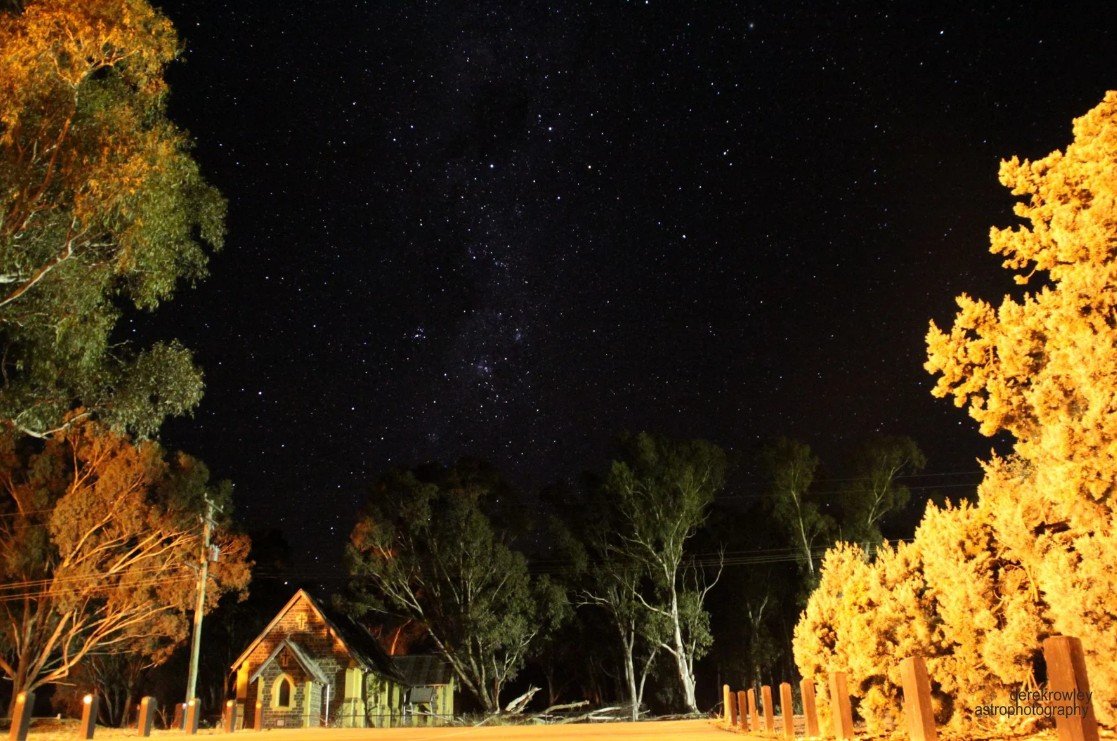
Only one warm light breaking through the darkness ~ captured this cosy scene during my trip to Australia.
Key camera settings for astrophotography control how much light reaches your camera’s sensor
while avoiding unwanted blur, star trailing, and image noise.
oooo
oooo
1. Aperture (f-stop)
oooo
What it does:
Controls the size of the lens opening to let in light.
How to set it
Use the widest aperture available on your lens (the lowest f-number, such as f/1.4, f/1.8, or f/2.8).
Why it matters
Faint stars and deep-sky objects require as much light as possible. A wider opening allows shorter exposure times while capturing maximum detail.

oooo
oooo
2. Exposure Time (Shutter Speed)
oooo
What it does:
Controls the size of the lens opening to let in light.
How to set it
Use the widest aperture available on your lens (the lowest f-number, such as f/1.4, f/1.8, or f/2.8).
Why it matters
Faint stars and deep-sky objects require as much light as possible. A wider opening allows shorter exposure times while capturing maximum detail.
oooo
oooo
2a. Calculating Max Exposure
oooo
The 500 Rule
To avoid star trailing on a fixed tripod,
calculate your maximum shutter speed using the 500 Rule:
o
Max Exposure (seconds) =
500 / Focal length (mm) x Crop Factor
oooo
- Full-frame camera:
Crop factor is 1.0 for a 20mm lens:
o
Max Exposure = 500/20 = 25 seconds
oooo
o - APS-C camera
Canon crop factor is 1.6 for a 20mm lens:
o
Max Exposure = 500/20×1.6 = 15.6 seconds
oooo
oooo
oooo
oooo
oooo
oooo
oooo
3. ISO (Sensor Gain)
oooo
oooo
What it does:
Amplifies the light signal collected by your camera sensor.
How to set it:
Start between ISO 1600 and ISO 6400 (commonly ISO 3200).
Why it matters:
Higher ISO brightens faint dark-sky features, but setting it too high introduces excessive digital noise and reduces dynamic range.
oooo
oooo
4. Focus & Camera Modes
oooo
Focusing:
Always use Manual Focus (MF). Switch to Live View, zoom in digitally on a bright star, and adjust focus until the star is as small and sharp as possible.
Shooting Mode:
Use Manual Mode (M) so aperture, shutter speed, and ISO remain locked.
File Format:
Always capture in RAW rather than JPEG. RAW preserves uncompressed image data needed for post-processing and star stacking.
White Balance:
Set to Daylight (~5500K) or Kelvin (3800K–4200K) for a natural dark blue sky background.
oooo
oooo
oooo
oooo
Back to
oooo
Back to page 9
Next to page 11
oooo
Page 10 – Camera Settings Derek Rowley – Derekscope’s BSL Guide to Deep-Sky Imaging
oooo
oooo