oooo
o
oooo
oooo
Optical Aberration
o
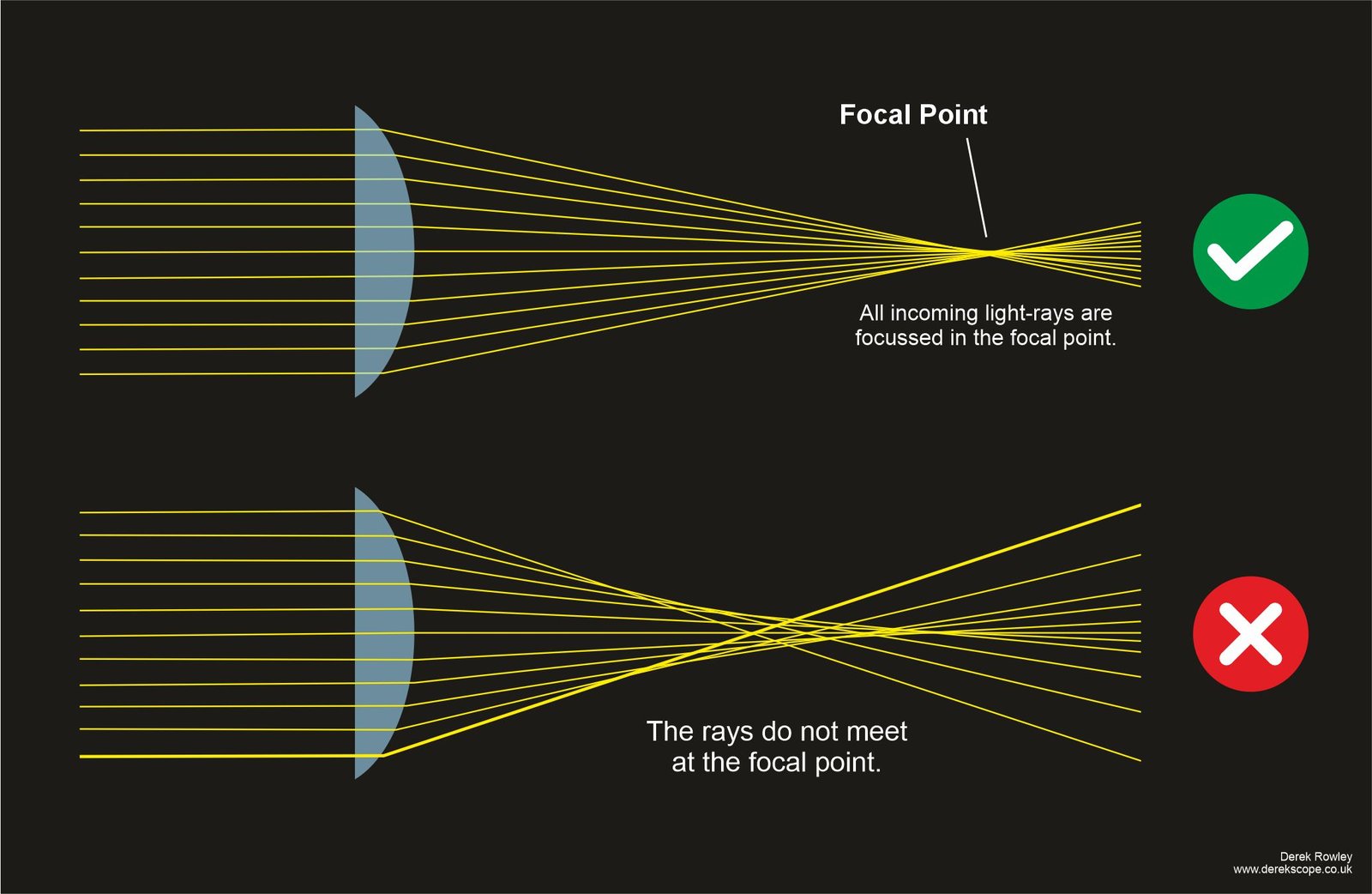
An optical aberration is any flaw or distortion that prevents a lens or mirror from focusing light to a single, perfectly crisp point.
When an optical system (like a telescope, camera lens, or pair of eyeglasses) isn’t perfect, the light rays passing through it scatter or bend unevenly.
o
This creates blurry, distorted, or strangely shaped images – especially noticeable in astrophotography when imaging sharp light sources like stars.
o
o
oooo
oooo
oooo

oooo
Primary Types of Optical Aberrations
o
1) Chromatic Aberration (“Colour Fringing”)
o
What it is:
Occurs when a glass lens acts like a prism, focusing different colours (wavelengths) of light at slightly different points.
What it looks like:
Purple, blue, or yellow halos around bright objects, like the Moon or bright stars.
Common in:
Reflector telescopes don’t have this, but simpler/cheaper refracting telescopes and basic camera lenses often do.
o
o
oooo
oooo
oooo
oooo
o
oooo
2) Spherical Aberration
o
What it is:
Occurs when light hitting the outer edge of a curved lens or mirror focuses at a slightly different distance than light hitting the centre.
oooo
What it looks like:
The entire image appears soft, hazy, or out of focus, lacking sharp contrast even when properly focused.
o
o
oooo
oooo
oooo
oooo
o
3) Coma (Comatic Aberration)
o
What it is:
Light rays entering the telescope at an angle (off-axis) focus at different locations depending on where they hit the mirror or lens.
What it looks like:
Stars near the outer edges of your field of view stretch out and look like tiny comets or flared triangles, even while stars in the center remain sharp pinpoints.
Common in:
Fast Newtonian reflector telescopes.
o
o
oooo
oooo
oooo
oooo
o
oooo
oooo
4) Astigmatism
o
What it is:
Occurs when a lens or mirror is slightly asymmetrical (curved unevenly in horizontal vs. vertical directions).
What it looks like:
Stars appear oval or stretched into cross-like shapes instead of round dots.
o
o
oooo
oooo
oooo
oooo
o
oooo
oooo
5) Field Curvature
o
What it is:
The camera sensor (or your eye) is flat, but the focal plane produced by the optics is naturally curved.
What it looks like:
If the stars in the centre of your image are sharply in focus, the stars at the edges will be blurry (and vice versa).
o
o
oooo
oooo
oooo
oooo
oooo
oooo
How astrophotographers fix aberrations
oooo
o
Fix aberations
o
Collimation:
Aligning mirrors precisely eliminates misaligned astigmatism and uneven coma.
o
Correctors & Flatteners:
Adding optical elements (like a Coma Corrector for Newtonians or a Field Flattener for Refractors) straightens out off-axis light before it hits the camera sensor.
o
Apochromatic (APO) Glass:
Using high-grade low-dispersion glass lenses eliminates colour fringing.
o
oooo
oooo
oooo
oooo
oooo
oooo
oooo
Back to
oooo
Back to page 22
Next to page 24
oooo
Page 23 – Optical Aberrations Derek Rowley – Derekscope’s BSL Guide to Deep-Sky Imaging
oooo
oooo