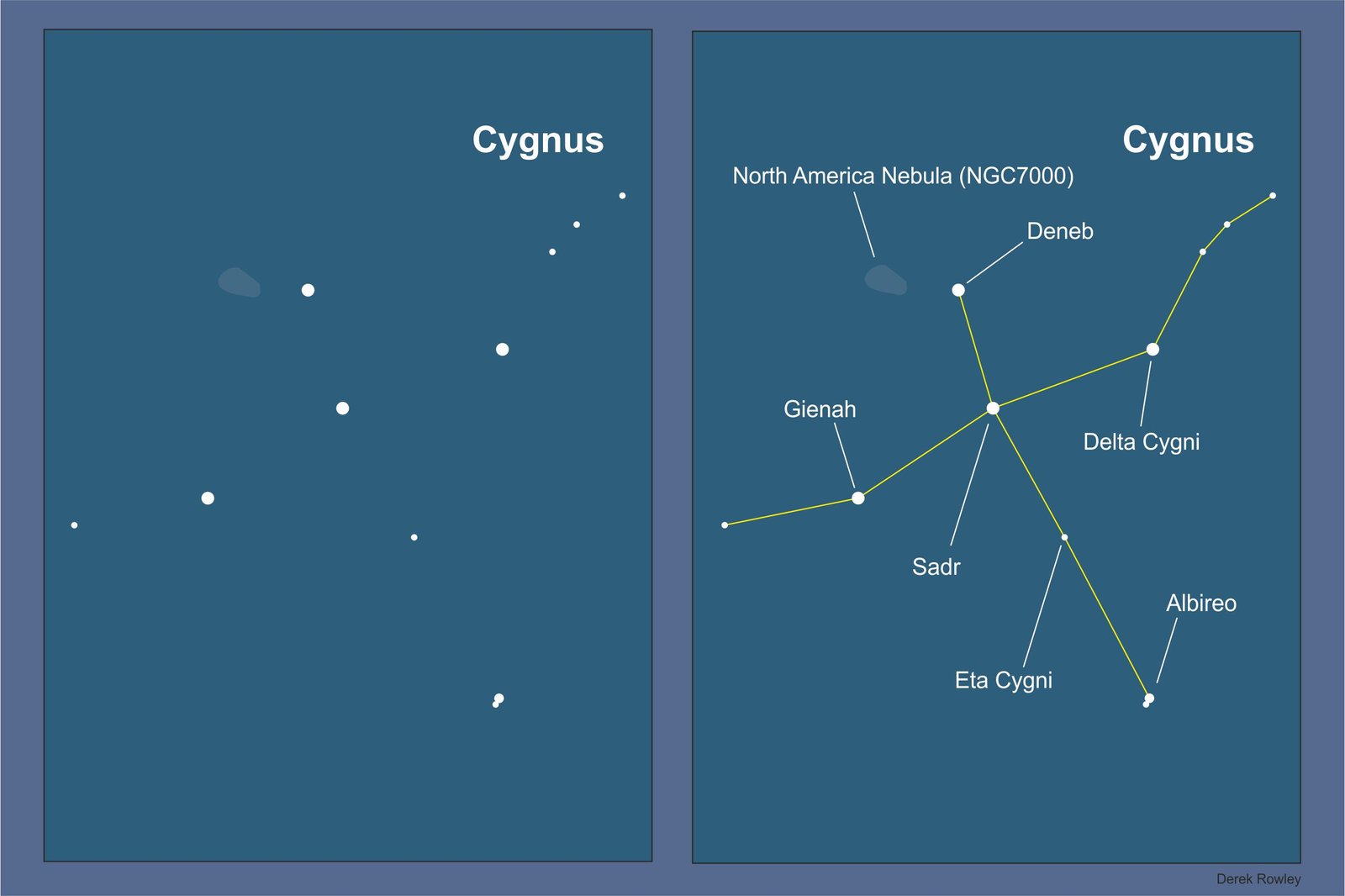
OOOO
| Abbreviation: Cyg (Cygnus) |
| English Name: The Swan |
| Genitive: Deneb |
| Hemisphere: Northern Hemisphere |
| Location: Between the constellations of Cephus and Draco. |
| Visible between latitudes: +90 and -40 degrees |
| Best season: Autumn |
| Seen in three seasons: Summer, Autumn & Winter |
| Best seen in: August (map) and September (map) |
| Seen between: May and November |
| Right Ascension (RA): 21 hour |
| Declination (DEC): +40 degrees |
| Area (square degrees): 804 (16th) |
OOOO
Cygnus (The Swan)
- Feature constellation of Cygnus, often nicknamed “The Northern Cross”; its brightest star is Deneb (Magnitude: +1.3)
o - Deneb forms one corner of the Summer Triangle, with Vega in Lyra and Altair in Aquila.
o - It lies in a rich part of the Milky Way.
oooo
OOOO
Messier Objects in Cygnus
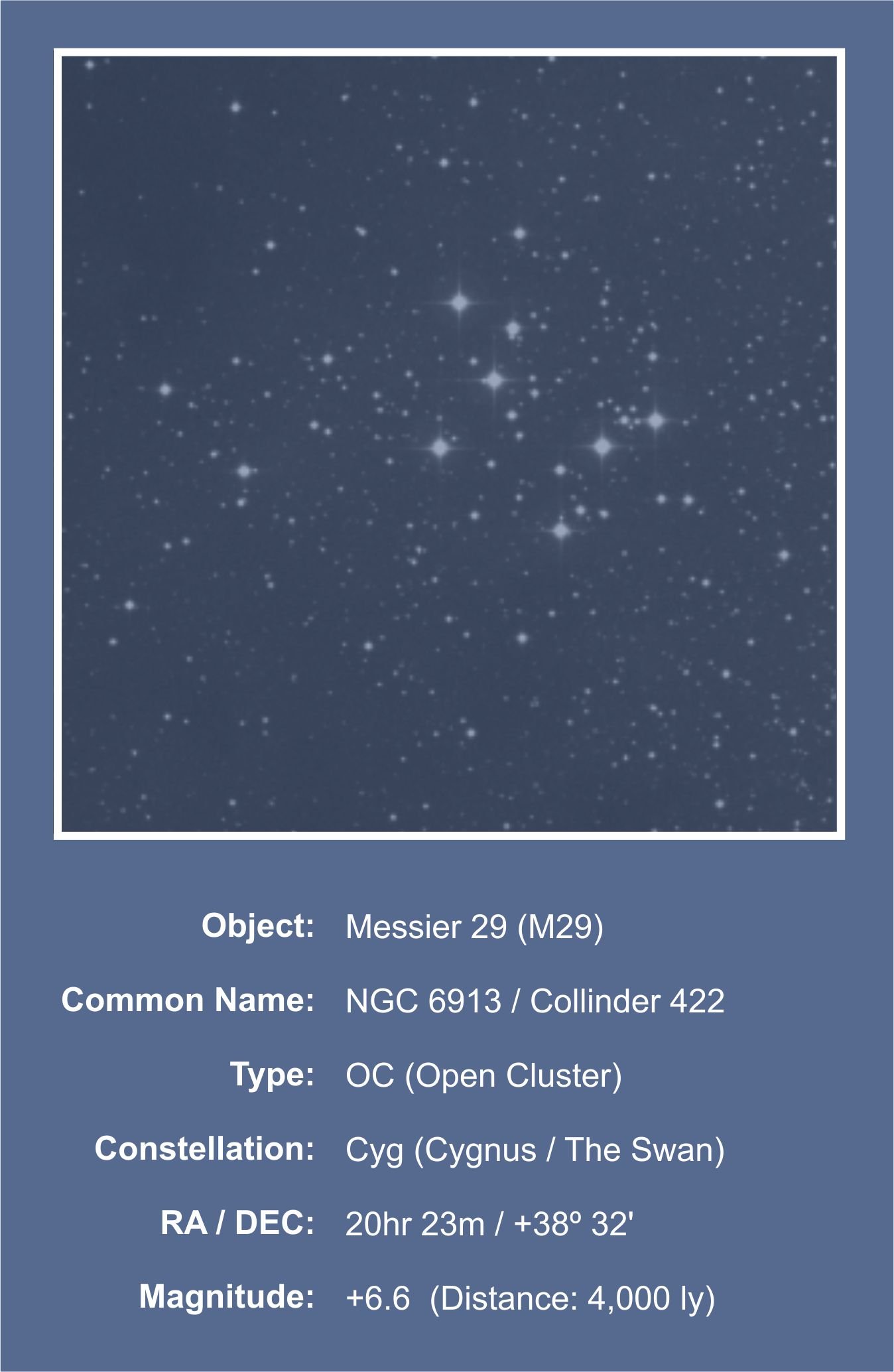
- Messier 29
Open Cluster; similar to the Seven Sister (M45), M29 is ten times farther away and is much less famous than The Seven Sisters.
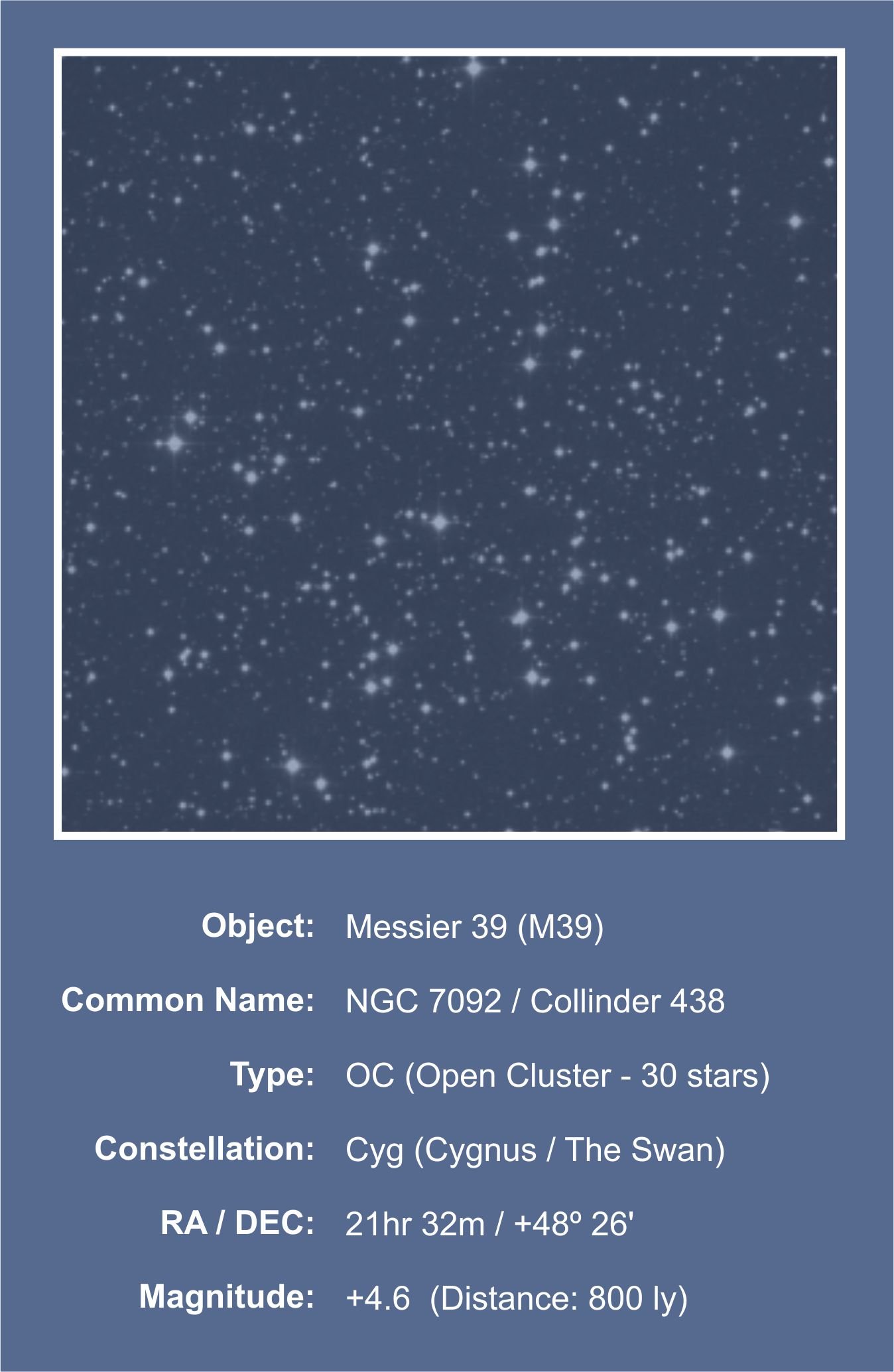
- Messier 39
Bright open star cluster in the constellation Cygnus, making it an excellent target for binoculars and small telescopes.
oooo
Other objects in Cygnus
| Select Catalog | No of Objects |
| Barnard (B) | 31x objects |
| Caldwell (C) | 7x objects |
| Collinder (Cr) | 27x objects |
| New General Catalogue (NGC) | 69x objects |
| Index Catalogue (IC) | 24x objects |
| Sharpless (Sh2) | 32x objects |
oooo
Features of Interest
- NGC 7000 – North America Nebula; large nebula, visible under dark skies with binoculars or a wide field eyepiece for telescope – also known as Caldwell 20 (C20), the astrophotography takes the image that resembles the outline of North America map.
o - NGC 6826 – The Blinking Planetary; also known as Caldwell 15 (C15), is a planetary nebula – too bright with large telescopes to have the striking “blinking” effect seen with smaller telescopes.
o - NGC 6992 – The Veil Nebula; left behind by the explosion of a massive star thousands of years ago – a large supernova remnant as left over to be seen today in Cygnus.
o - Albireo – one of the great small-telescope showpieces in the sky; even low magnification views resolve it into a double star – brighter yellow star making a striking colour contrast with its fainter blue star.
OOOO
OOOO
Named Stars
- Deneb (Alpha Cyg)
- Albireo (Beta 1 Cyg)
- Sadr (Gamma Cyg)
- Gienah Cygni (Epsilon Cyg)
- Azelfafage (Pi 1 Cyg)
- Ruchba (Omega 2 Cyg)
- more list of stars in Cygnus
oooo
oooo
Planetarium / Constellation Map
| Live constellation visible from the UK :- Planetarium (Cygnus) | Best Seen in: August (map) and September (map) | Seen between: May and November |
IAU Sky Chart: Cygnus

OOOO
OOOO
Go To
Constellations – Visible from the UK
OOOO
oooo
Parts visible from the UK
| Antlia | Columba | Eridanus | Fornax | Microscopium | ||
| Piscis Austrinus | Puppis | Pyxis | Sagittarius | Scorpius | ||
| Sculptor |
oooo
oooo
Constellations: Southern Celestial Hemisphere
…..– never seen from the UK
oooo
oooooooo
OOOO