





Stay up-to-date with all of our
most interesting observational highlights
for this month by following us on social media.
oooo
oooo
Stay up-to-date with all of our
most interesting observational highlights
for this month by following us on social media.
oooo
oooo

NGC2244 know as the Rosette Nebula Cluster, is an open cluster located in the constellation Monoceros, near the celestial equator ~ embedded within the large Rosette Nebula, a stunning region of star formation.
Best viewing time – December through February (magnitude +4.8, making it visible through binoculars and small telescopes in dark skies.)

The shape of “rosette” shape gives the nebula its name, appearing as a flower in astrophotography.
Guides to the night sky
Deep Sky Object: NGC2237 (Rosette Nebula)
Constellation: Monoceros (Mon)

If we compare this B33 (Horsehead) in constellation Orion, to our Earth, the nebula is so massive that you could fit more than a million Earths across it!

The Rosette Nebula (Caldwell 49) is a huge star-forming region spanning 65 light across and located 5,200 light year away – the open cluster NGC2244 / Caldwell 50 is closely associated with the nebulosity, the stars of cluster having been formed the nebula’s matter in the constellation Monoceros.

To see interesting aspect of the Sun is its sunspots ~ dark areas where the magnetic field is around 2,500 times stronger than Earth’s magnetic field.

Only 20 minutes sacked to stop after the clouds interrupted ~ Sh2-119 is a large patch of emission nebula and sits right next to the North America Nebula (NGC7000) in the constellation Cygnus.

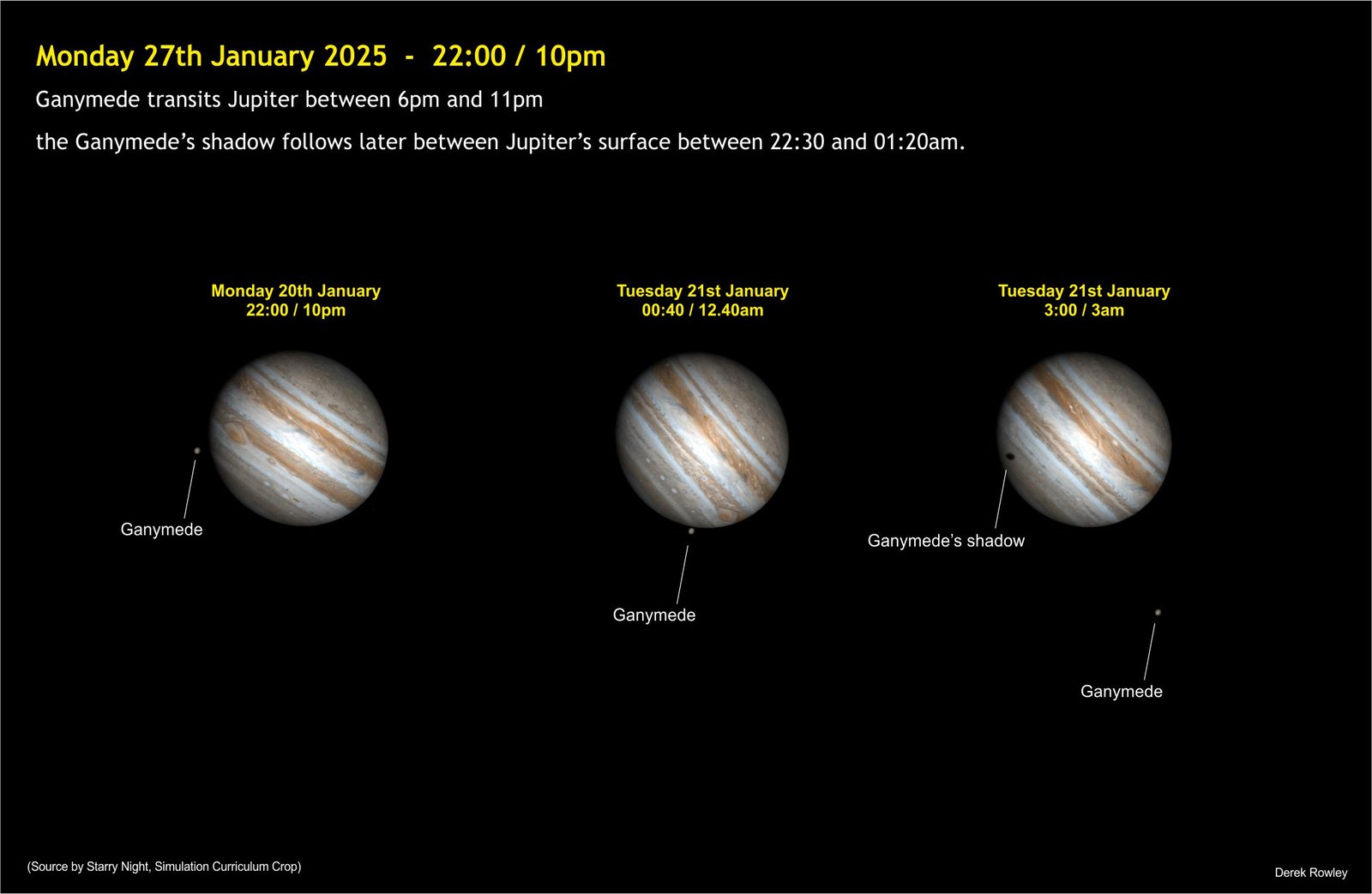
A shadow transit of Europa is when the shadow of Jupiter’s moon Europa passes across the face of Jupiter.

C/2023 A3 Tsuchinshan-ATLAS was seen by a naked-eye from my outside location of Milton Keynes.