




Tuesday 9th June 2026

  • Venus will appear brilliantly bright, while Jupiter should show a steadier golden glow nearby.
    o
  • A pair of 10×50 binoculars is usually enough to fit both planets comfortably in the same field of view, which makes the pairing especially dramatic just after sunset or before sunrise depending on your location and timing.
    o

Posted in Homepage (Posts) | Comments Off on Tuesday 9th June 2026

Venus is close to Jupiter tonight

  • Venus and Jupiter are close tonight
    – Look low in the west after sunset – two bright lights side by side.
    – Venus is the brighter one ~ Jupiter sits below Venus.
    – They meet at their closest tomorrow.

    o

Posted in Homepage (Posts) | Comments Off on Venus is close to Jupiter tonight

Monday 8th June 2026

  • The Last Quarter Moon occurs on Monday 8th June 2026 at 11.03am BST.
    o
  • At this phase, the Moon appears half illuminated, with the left half lit as it wanes toward the New Moon.
    o

Posted in Homepage (Posts) | Comments Off on Monday 8th June 2026

Sat 6th thru Sat 13th June 2026

  • Conjunction of Venus and Jupiter
    – Saturday 6th & Sunday 7th June ~ noticeably close.
    – Monday 8th June ~ extremely close.
    – Tuesday 9th June ~ most impressive closest conjunction.
    – Wednesday 10th thru Saturday 13th June ~ still close but gradually separating.
    oooo
  • This will be one of the best naked-eye planetary pairings of 2026
    – Look 30 – 45 minutes after sunset.
    – face west to northwest.
    – Venus will be the brighter object than Jupiter.
    – Binoculars will make the pairing especially striking.
    oooo

Posted in Homepage (Posts) | Comments Off on Sat 6th thru Sat 13th June 2026

Jupiter & Venus

  • Jupiter and Venus really are “crossing paths” this month, and June 2026 is the perfect time to keep looking up.
    o

Posted in Homepage (Posts) | Comments Off on Jupiter & Venus

Sunday 1st June 2026

  • The Moon reaches apogee ~ the farthest point in its orbit from Earth.
    o
  • The Moon appears slightly smaller and dimmer in the sky compared to perigee.
    o
    o

2026 Apogee Dates
(Moon Furthest from Earth)

  • Tuesday 13th January
  • Tuesday 10th February
  • Tuesday 10th March
  • Tuesday 7th April
  • Monday 4th May
  • Monday 1st June
  • Thursday 28th June
  • Saturday 25th July
  • Saturday 22nd August
  • Saturday 19th September
  • Friday 16th October
  • Thursday 13th November
  • Friday 11th December

2026 Perigee Dates
(Moon Closest to Earth)

  • Thursday 1st January
  • Thursday 29th January
  • Monday 24th February
  • Saturday 22nd March
  • Sunday 30th March
  • Sunday 19th April
  • Sunday 17th May
  • Monday 15th June
  • Monday 13th July
  • Monday 10th August
  • Sunday 6th September
  • Thursday 1st October
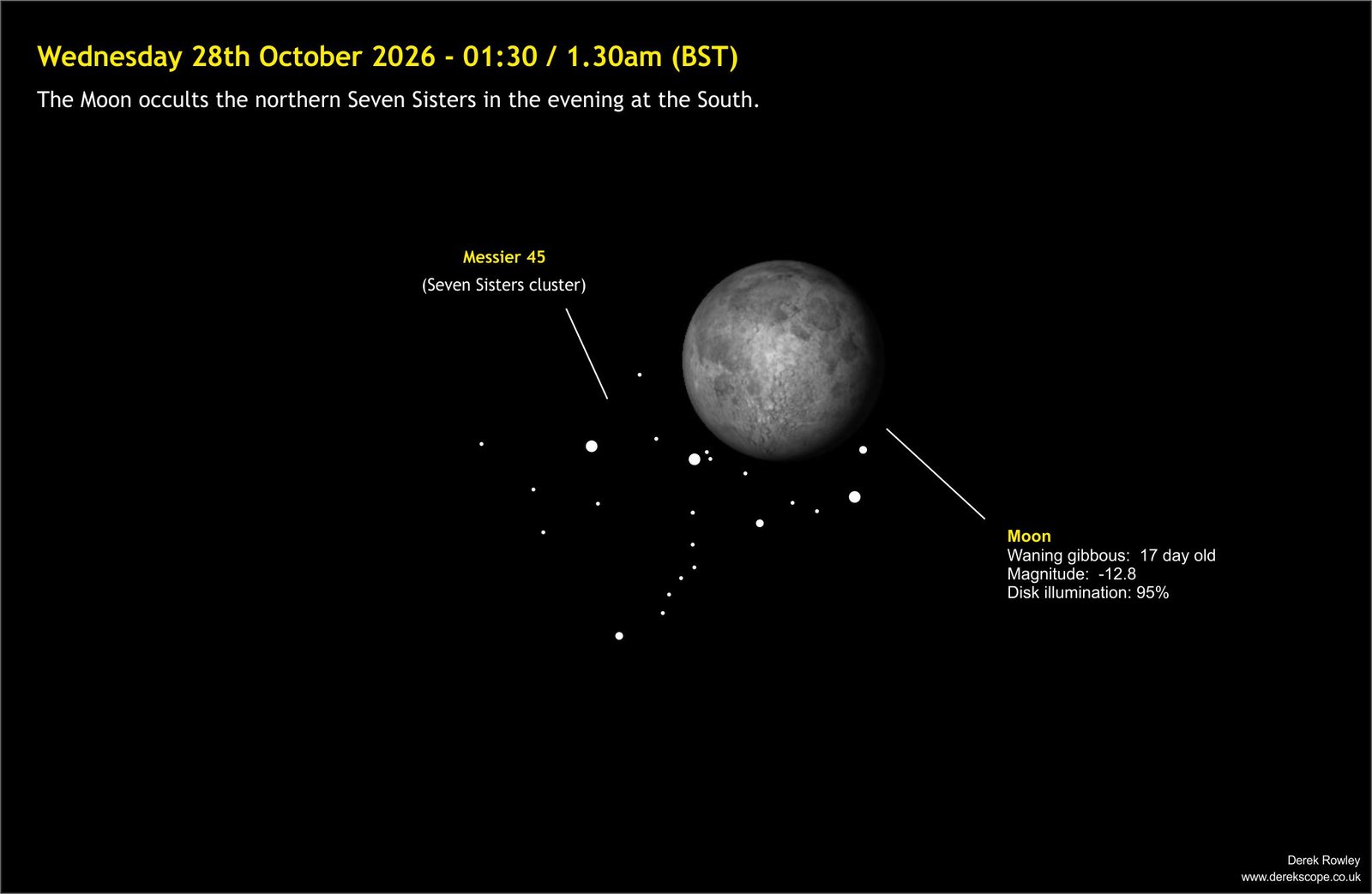
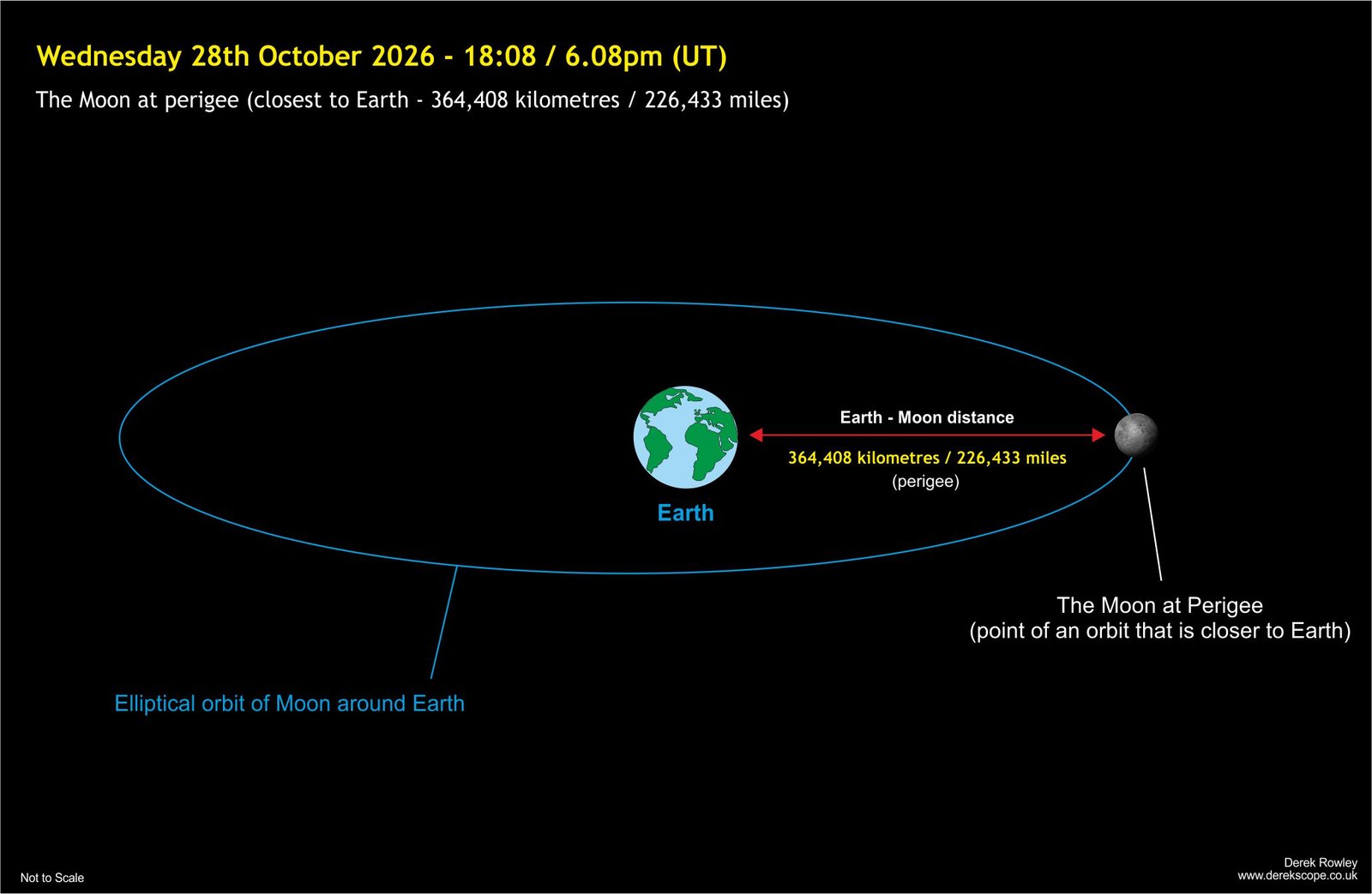
  • Wednesday 28th October
  • Wednesday 25th November
  • Thursday 24th December
    oooo

Posted in Homepage (Posts) | Comments Off on Sunday 1st June 2026

Sunday 31st May 2026

  • A rare “monthly” Blue Moon will occur in May 2026, featuring a second full moon on Sunday 31st May 2026, at 09:45 BST, following an initial full moon on Friday 1st May.
    o
  • This makes 2026 a year with 13 full moons, with the next full moon after the Blue Moon arriving as the Strawberry Moon on Sunday 29th June 2026.
    o

Posted in Homepage (Posts) | Comments Off on Sunday 31st May 2026

Tuesday 26th May 2026

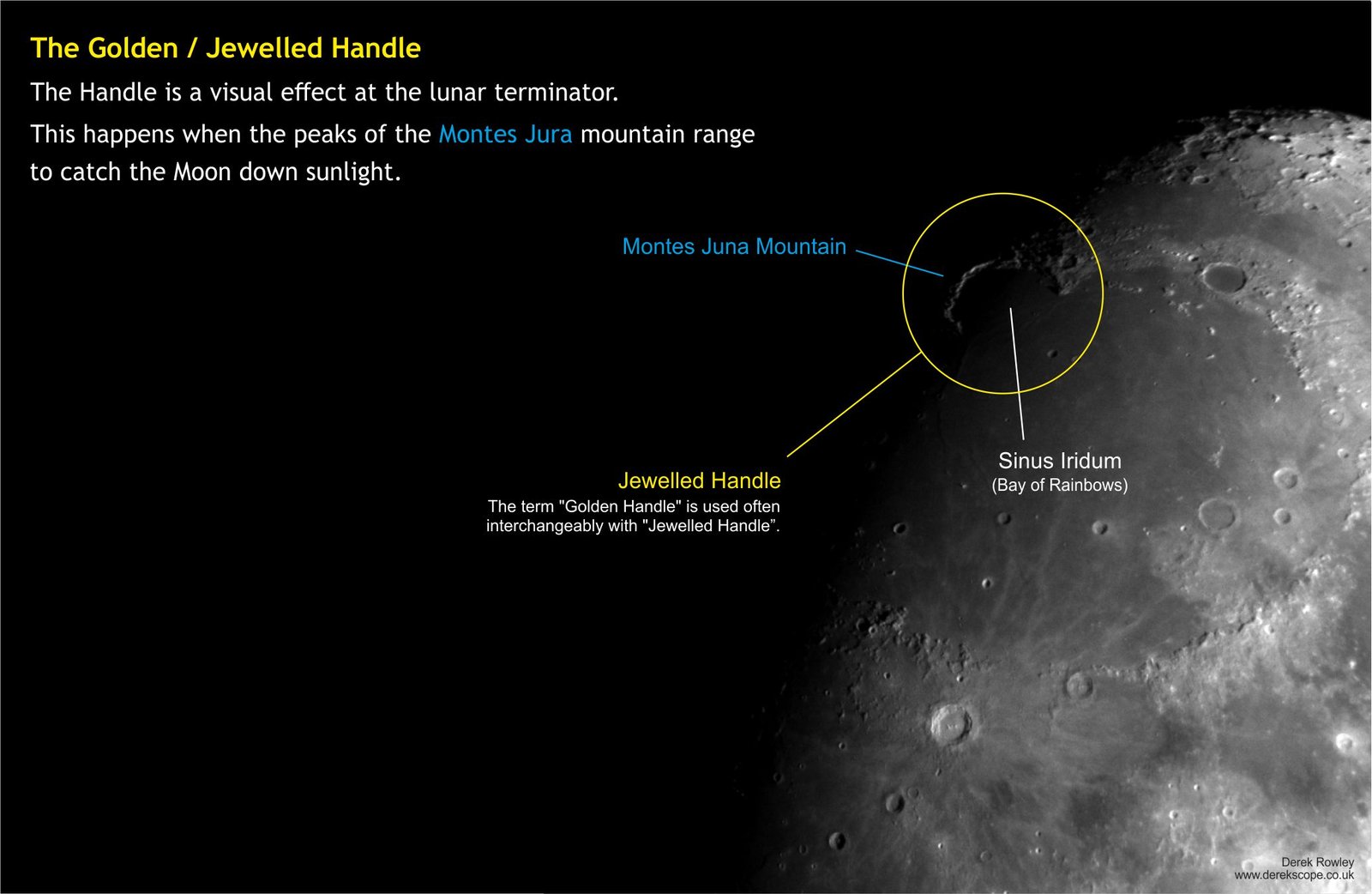
The Jewelled / Golden Handle for the UK Observers

(Photo above The Jewelled Handle ~ Image by Derek Rowley)
o

  • The Jewel Handle or Golden Handle
    The Moon’s Golden Handle is visible from the UK once each lunar month, roughly 2-4 days after First Quarter Moon, when the Sun grazes the Montes Jura and lights their peaks while Sinus Iridum is still in darkness ~ this creates the bright “handle” effect along the terminator.
    o
  • After the First Quarter Moon (half-moonlit), the Moon increases towards the Full Moon in the waxing gibbous phase ~ the time when the Jewelled handle shines brightest.
    o
  • This effect is only visible for a few days each month ~ roughly 2-4 days after the first quarter Moon.
    o
  • Equipment
    You will need a small telescope or binoculars (8×42 or 10×50) are enough to show the arc beautifully.
    o
  • Timetable ~ The Jewelled / Golden Handle for the UK Observers
    2026 / 2027 / 2028 / 2029 / 2030
    o

(More search for The Clair-Obscur Effects from her website for
essentially the dates, times, explanations or how to observe them – www.marymcintyres.astronomy.co.uk)


Posted in Homepage (Posts) | Comments Off on Tuesday 26th May 2026

Saturday 23rd May 2026

  • Lunar X and Lunar V
    Sunlight catches rims at lunar first quarter to create the bright V and X shapes.
  • Best viewing time in the UK
    The phenomenon occurs in the late evening for British Summer Time (BST).
    o
    Today: Saturday 23rd May 2026
    Start formation: 22:45 / 10.45pm (become visible)
    Peak visibility: 00:45 / 12.50am (fully formed as best contrast – Sunday 24th May)
    Fade disappearing: 02:45 / 2.45am (Sunday 24th May)
    Visible: good (late-night viewing low on the horizon).
    o
  • The Moon repeats its cycle every 29½ days, so these effects happen every month, just on slightly different dates – see the complete full timetable for 2026, 2027, 2028, 2029 and 2030.
    o
  • Equipment
    While sometimes visible with high-power binoculars, a telescope is recommended to see the fine detail of the crater rims forming the Lunar X and V.
    o

Posted in Homepage (Posts) | Comments Off on Saturday 23rd May 2026

Mon 18th thru Wed 20th May 2026

  • Look west to west-northwest about 30 – 60 minutes after sunset.
    o
  • A clear, unobstructed horizon will help because the objects will sit fairly low.
    o
  • Binoculars should give a beautiful view of the crescent Moon with the bright planets nearby.
    o

Posted in Homepage (Posts) | Comments Off on Mon 18th thru Wed 20th May 2026