





signWOW opensthe night sky forDeaf beginners withclear,visual, & hands‑onlearning,made possiblethroughsignWOW kindlygesture in contributing two iPads.
Two signWOW iPads fordiscovering how to capturethe Moon, planets, andstars using simple tools,step‑by‑step guidance,and the support of acommunity that signs,shares, and shinestogether.
Direction Look toward the west-southwest horizon. o
Time Start looking 45 minutes after sunset during evening twilight. o
Altitude The pair (Venus and Spica) will sit very low, roughly 10 degrees above the horizon, meaning you will need a completely unobstructed view clear of buildings or trees. o
Visual Appearance Venus will dominate the sky, blazing white at a spectacular magnitude of -4.5. In contrast, Spica will appear much subtler as a vivid blue-white point at magnitude 1.0, about 50 times fainter than Venus. o
Equipment and Viewing Tips
Naked Eye Venus is easily visible even in bright twilight, while Spica will become clearer as the sky darkens. o
Binoculars Highly recommended. Because they are less than 2 degrees apart, both objects will fit beautifully within a single binocular field of view, highlighting their intense colour contrast. o
Telescopes A small telescope will reveal that Venus is on its inside track around the Sun, appearing as a waning crescent shape that is only about 38% to 45% illuminated. o
Posted inHomepage (Posts)|Comments Off on Tuesday 1st September 2026
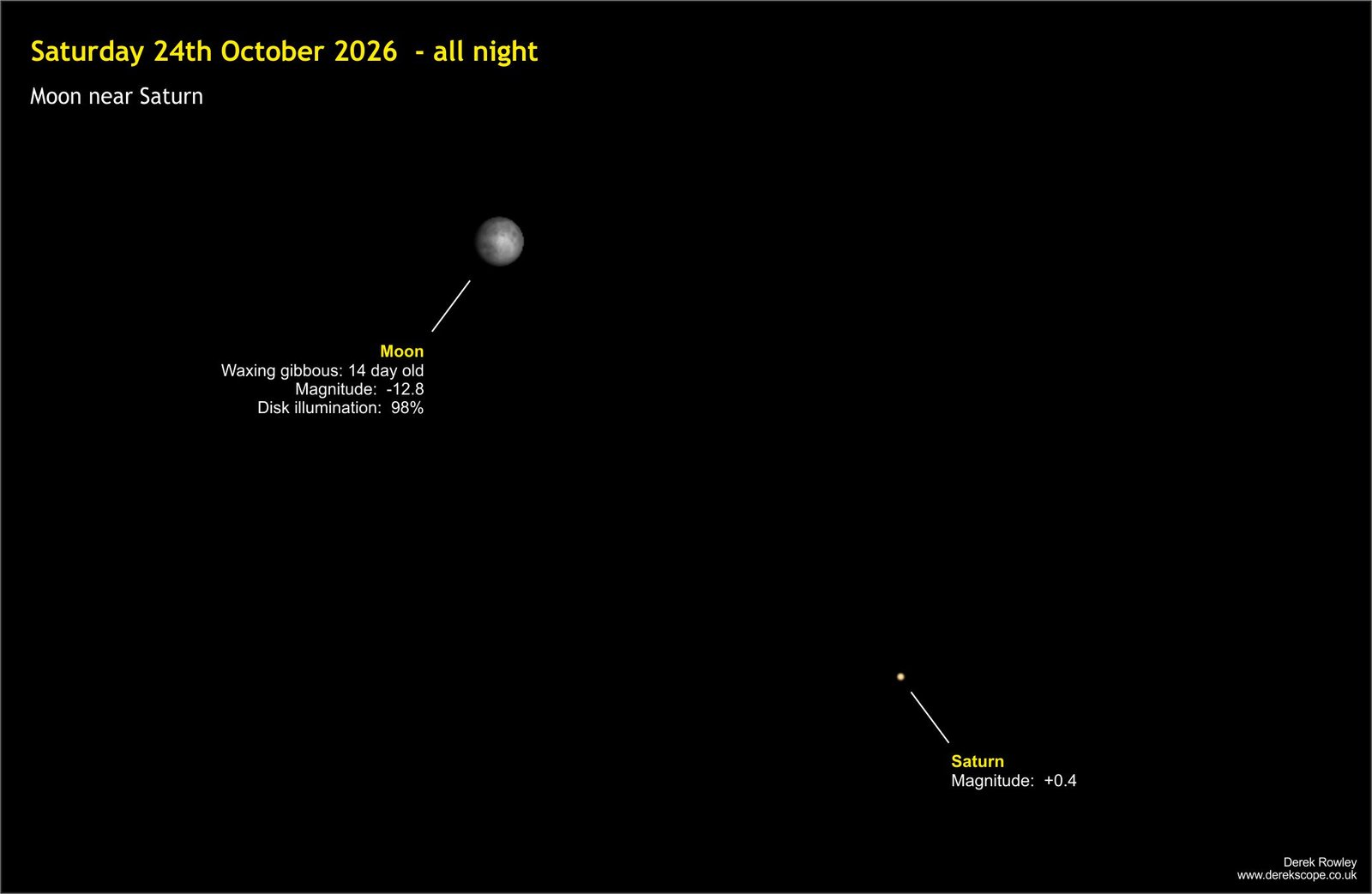
The Moon and Saturn will make an attractive pairing in the night sky. o
The Moon will appear close to Saturn in the sky, making Saturn easy to locate. o
They will rise in the evening and remain visible for most of the night, reaching their highest point around the early morning hours. o
To the unaided eye, Saturn will look like a steady, yellowish point of light near the Moon. o
Through even a small telescope (75–100 mm aperture), Saturn’s famous rings should be visible, although the Moon’s brightness can reduce contrast somewhat. o
Posted inHomepage (Posts)|Comments Off on Sunday 30th August 2026
The UK saw a deep partial lunar eclipse in the early hours of Friday 28 August 2026, and here’s exactly what happened in clear, structured detail.
These photos were captured in Milton Keynes between 2 am and 5.30 am. o
A partial lunar eclipse occurs when the Moon passes into Earth’s shadow but not fully into the darkest part (the umbra). Yesterday’s event was unusually deep: around 90–93% of the Moon entered the umbra, giving it a dramatic blood‑moon appearance. o
At the maximum of the eclipse (5am BST) Around 93% of the Moon’s visible surface will be covered by the darkest part of the Earth’s shadow (the umbra) for viewers in the UK in the early morning hours of Friday 28th August 2026.
The Moon will be very low on the west-southwestern horizon during its peak, so you will need to find an elevated spot with a completely clear, unobstructed view to the southwest. o
UK Timings (BST): – 02:23 am ~ Penumbral eclipse begins (a subtle, hard-to-see shading). – 03:33 am ~ Partial eclipse begins (the shadow noticeably takes a bite out of the Moon). – 05:12 am ~ Maximum eclipse (the peak of the spectacular deep shadow ~ Blood Moon). – 06:15 am ~ The Moon sets while still partially eclipsed. o o
Why is the Moon red? The Moon turns red during a lunar eclipse because Earth’s atmosphere filters and bends sunlight. (More information explained withBSL) o o
Please note In my BSLvideo, I mentioned looking at the northwest horizon that was an error. It should be the southwest. Please accept my apologies for the incorrect information.
Posted inHomepage (Posts)|Comments Off on Friday 28th August 2026
Pluto reaches opposition on Wednesday 26 August when Earth passes directly between the Sun and Pluto. o
Although Pluto is still extremely faint, opposition is the best time of the year to observe it because: o – it rises at sunset and sets at sunrise, so it is visible all night. – it is at its brightest for the year, around magnitude +14.3 to +14.5, though still far too faint for small telescope.
Posted inHomepage (Posts)|Comments Off on Wednesday 26th August 2026
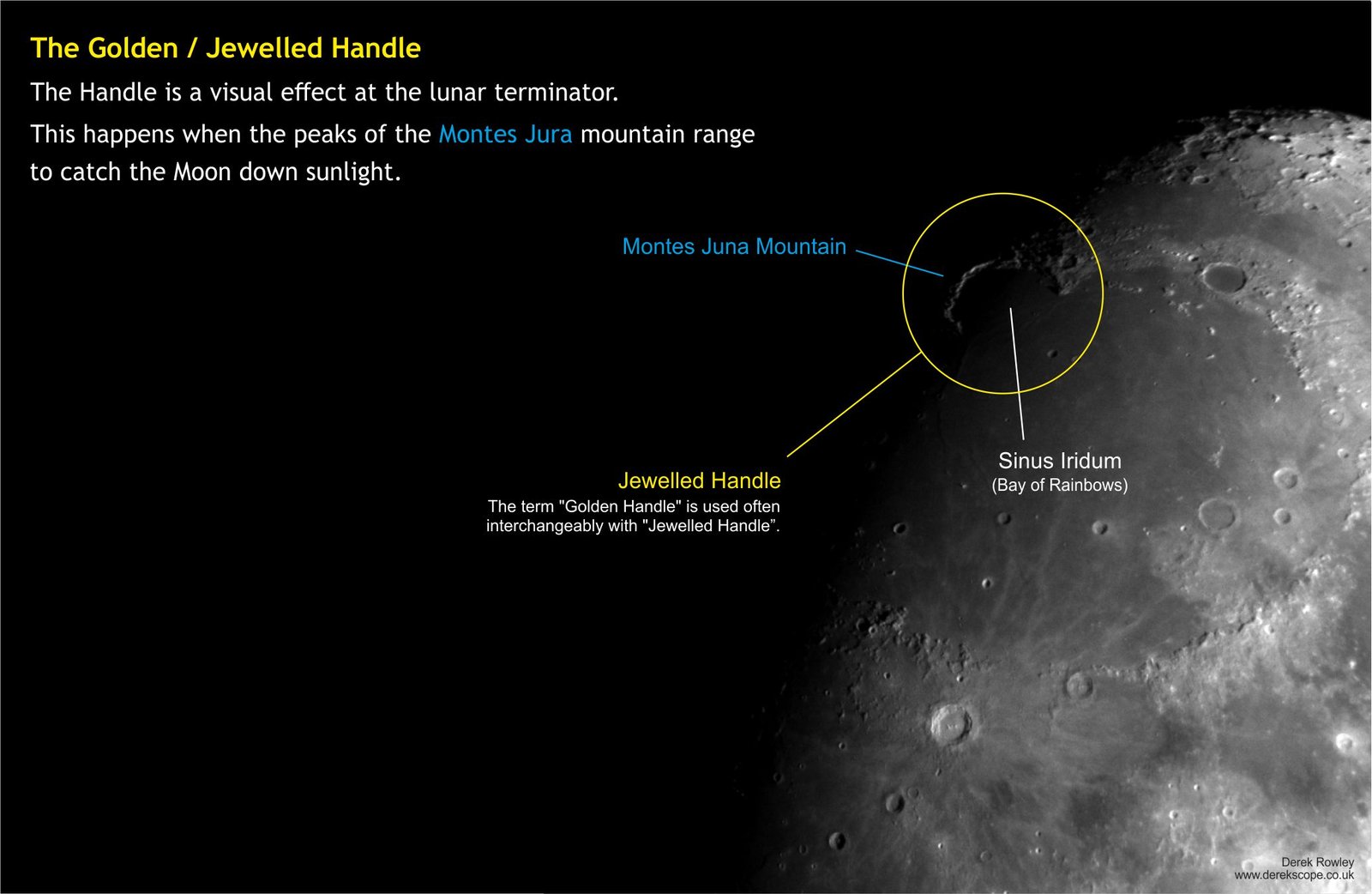
(Photo above The Jewelled Handle ~ Image by Derek Rowley) o
The Jewelled Handle or Golden Handle The Moon’s Golden Handle is visible from the UK once each lunar month, roughly 2-4 days after First Quarter Moon, when the Sun grazes the Montes Jura and lights their peaks while Sinus Iridum is still in darkness ~ this creates the bright “handle” effect along the terminator. o
After the First Quarter Moon (half-moonlit), the Moon increases towards the Full Moon in the waxing gibbous phase ~ the time when the Jewelled handle shines brightest. o
This effect is only visible for a few days each month ~ roughly 2-4 days after the first quarter Moon. o
Equipment You will need a small telescope or binoculars (8×42 or 10×50) are enough to show the arc beautifully. o
Lunar Eclipse A deep partial lunar eclipse will be visible in the UK in the early hours of Friday 28th August 2026.
oooo
oooo
What you will see – An exceptionally deep partial eclipse where over 90% of the Moon enters the Earth’s darkest shadow (the umbra). – Because it just misses a total eclipse, it will look like an impressive “almost blood moon,” with the lunar surface glowing reddish-orange.
UK Timings (BST): – 02:23 am ~ Penumbral eclipse begins (a subtle, hard-to-see shading). – 03:33 am ~ Partial eclipse begins (the shadow noticeably takes a bite out of the Moon). – 05:12 am ~ Maximum eclipse (the peak of the spectacular deep shadow ~ Blood Moon). – 06:15 am ~ The Moon sets while still partially eclipsed.
The Moon will be very low on the west-southwestern horizon during its peak, so you will need to find an elevated spot with a completely clear, unobstructed view to the southwest. o
Unlike a solar eclipse, it is completely safe to view with the naked eye. o o
Why is the Moon red? in BSL explanation
oooo
oooo oooo
Posted inHomepage (Posts)|Comments Off on Friday 28th August 2026