
OOOO
| Abbreviation: Leo (Leo) |
| English Name: The Lion |
| Genitive: Regulus |
| Hemisphere: Northern / Southern Hemisphere (Bold means the more area in square feet in Northern Hemisphere.) |
| Location: Between the constellations of Virgo and Cancer. |
| Visible between latitudes: +90 and -65 degrees |
| Best season: Spring |
| Seen in three seasons: Winter, Spring and Summer |
| Best seen in: April (map) |
| Seen between: January and June |
| Right Ascension (RA): 11 hour |
| Declination (DEC): +15 degrees |
| Area (square degrees): 947 square degrees (12th) |
OOOO
Leo (The Lion)
- Large and easily identified constellation of the Ecliptic.
o - Its brightest star is magnitude +1.0 Regulus, you can find Leo in the sky by looking for the “Sickle” starting at Regulus and following the backwards question mark or a hook by an easily recognizable pattern of six stars. (To find Regulus, use the Big Dipper for the “Sickle“.)
o - Leo contains many bright galaxies; there are five of Messier’s Catalog.
o - The Sun passes through it from 10 August to 16 September, so better to view it in the month of April.
OOOO
OOOO
Messier Objects in Leo
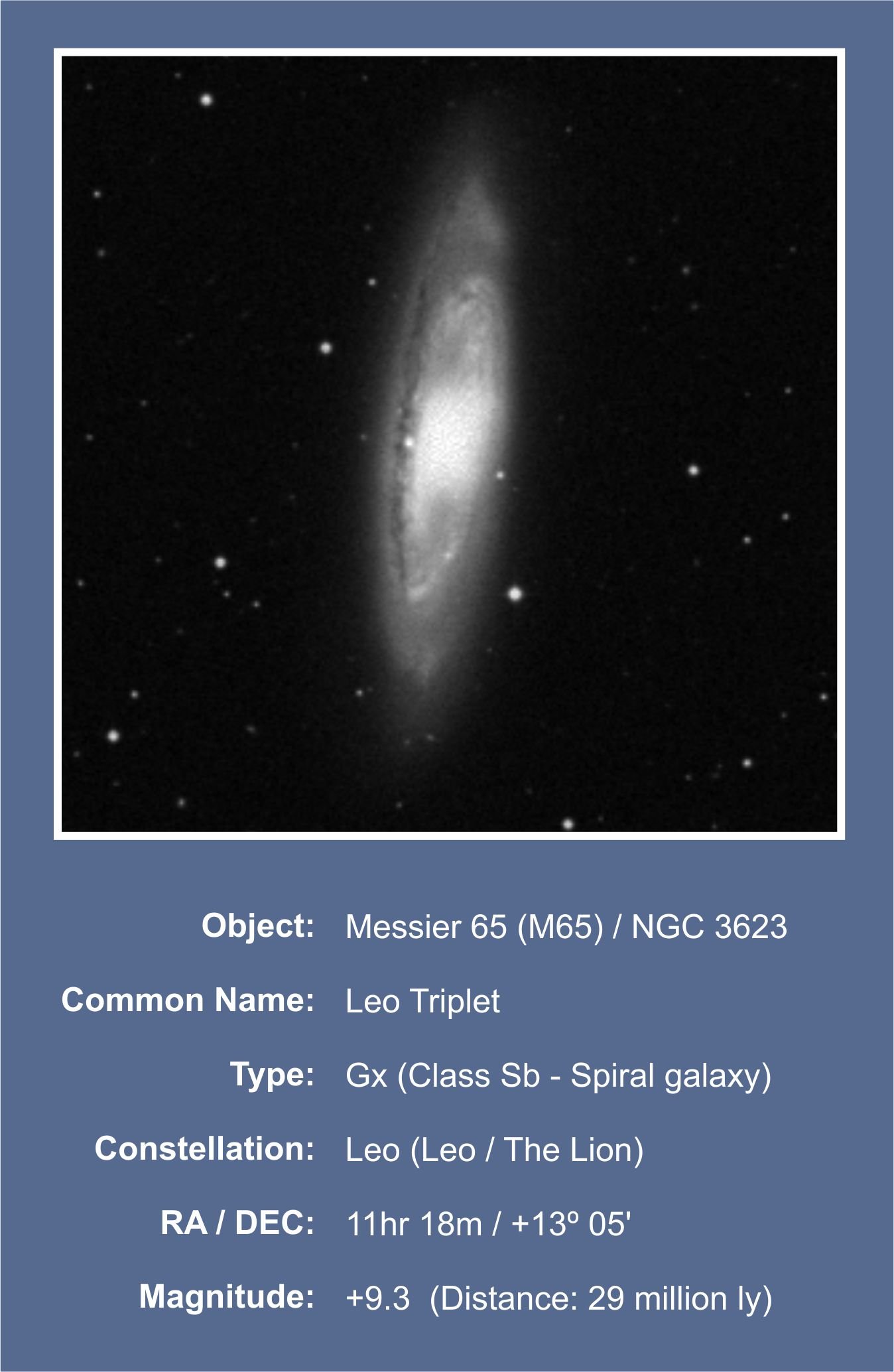
- Messier 65
A bright central bulge and tightly wound spiral arms. It contains mostly older stars in its core, while younger stars and dust are found in its spiral arms.
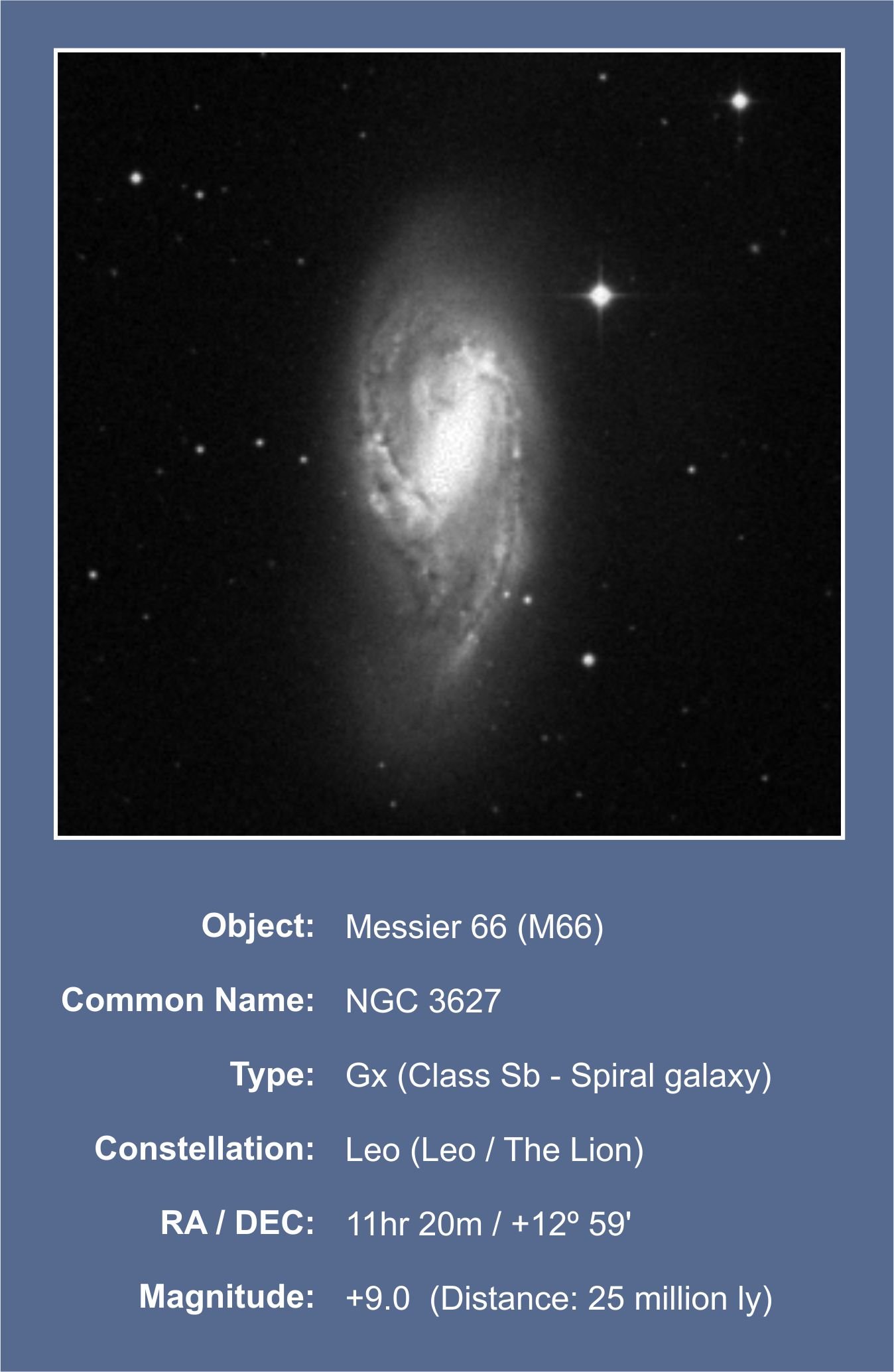
- Messier 66
A bright central bar and asymmetric spiral arms rich in gas, dust, and active star-forming regions. Its distorted shape is the result of gravitational interactions with its neighbouring galaxies in the Leo Triplet.
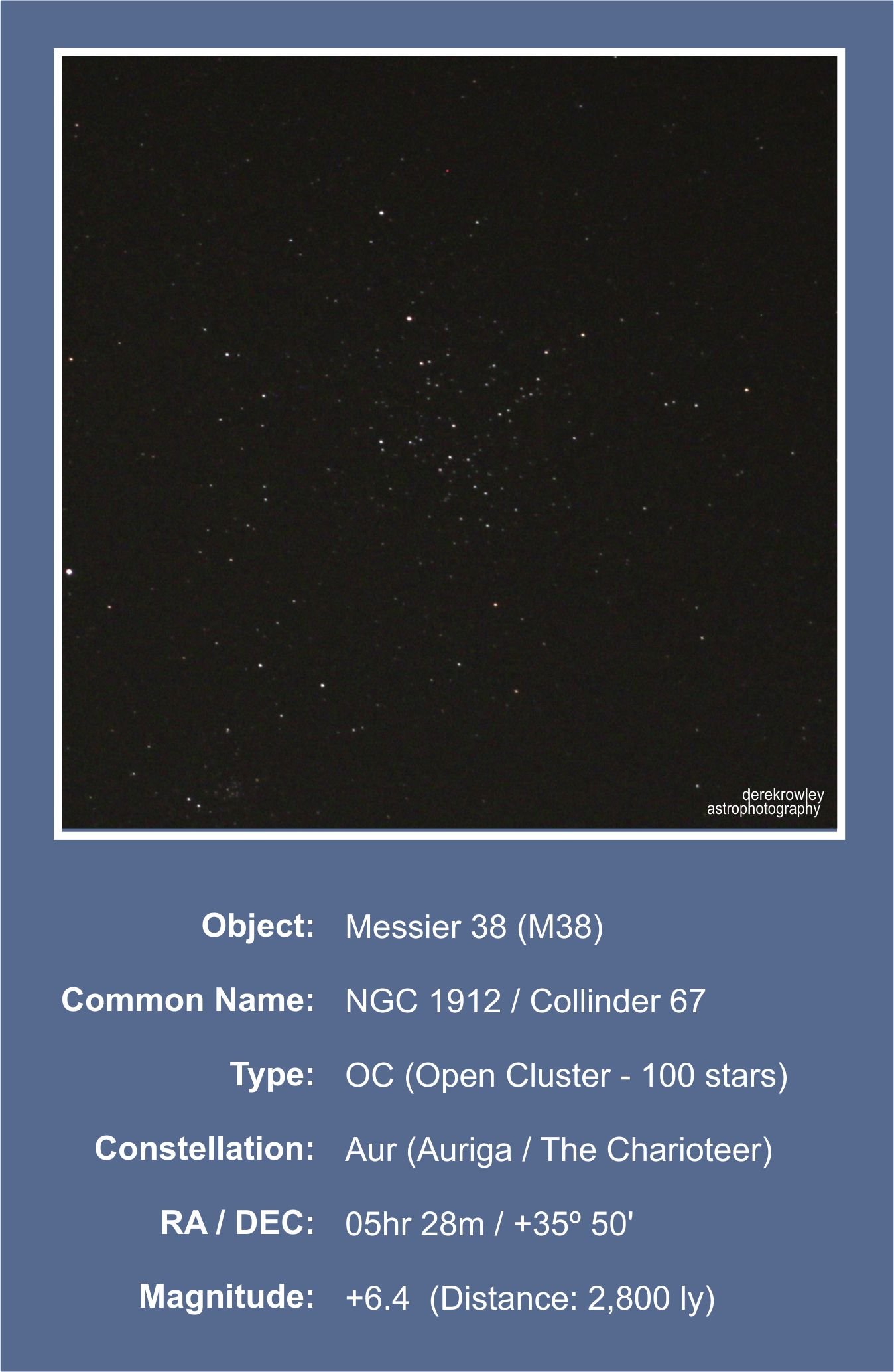
- Messier 95
Features a prominent central bar surrounded by a bright inner ring where new stars are forming at a high rate. Its well-defined spiral arms contain gas, dust, and young star clusters, while the central bulge is dominated by older stars.
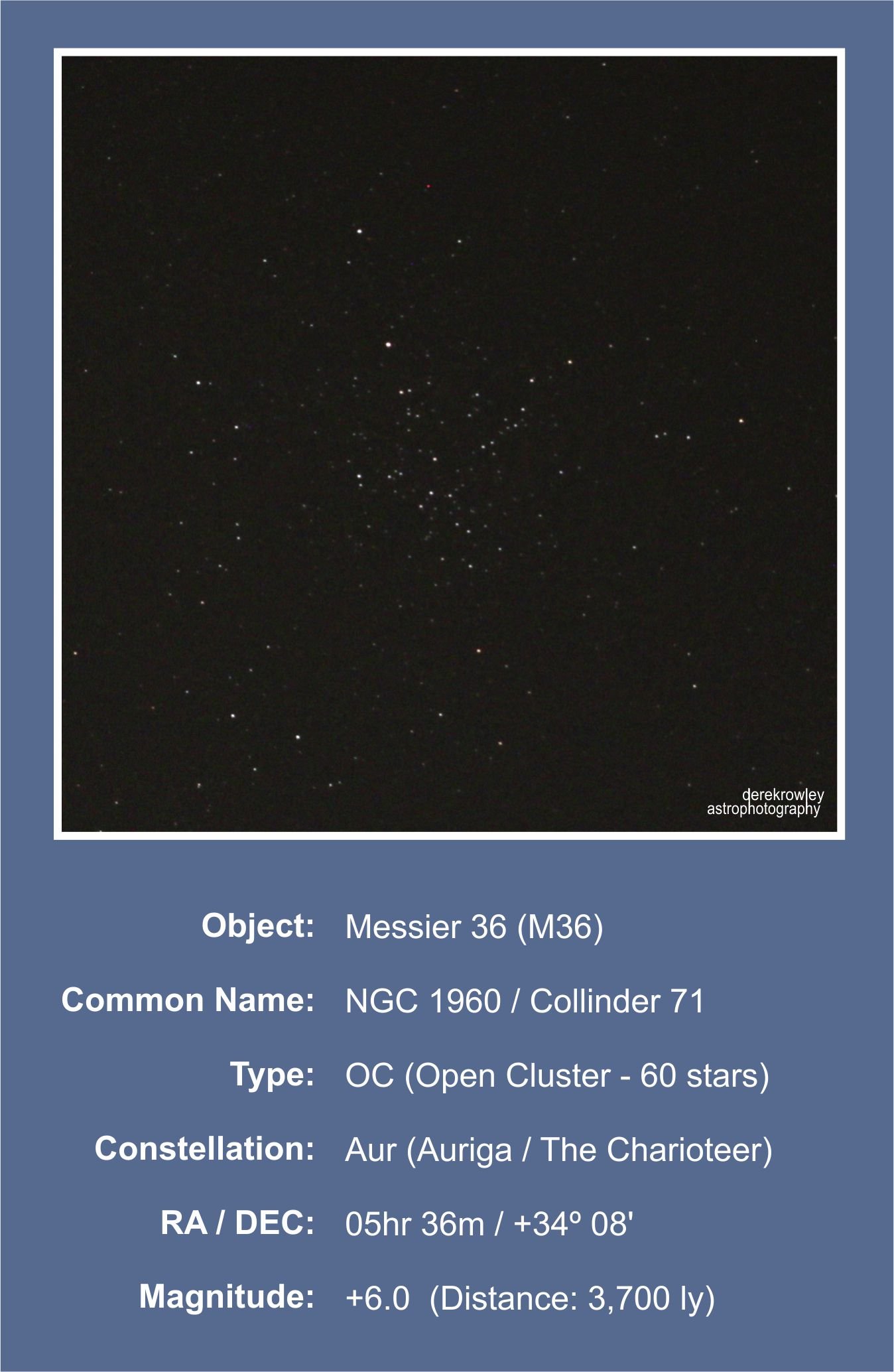
- Messier 96
a bright central bulge and well-defined spiral arms containing gas, dust, and young stars. One of its spiral arms appears more pronounced than the others, likely due to past gravitational interactions with neighboring galaxies in the Leo I Group.
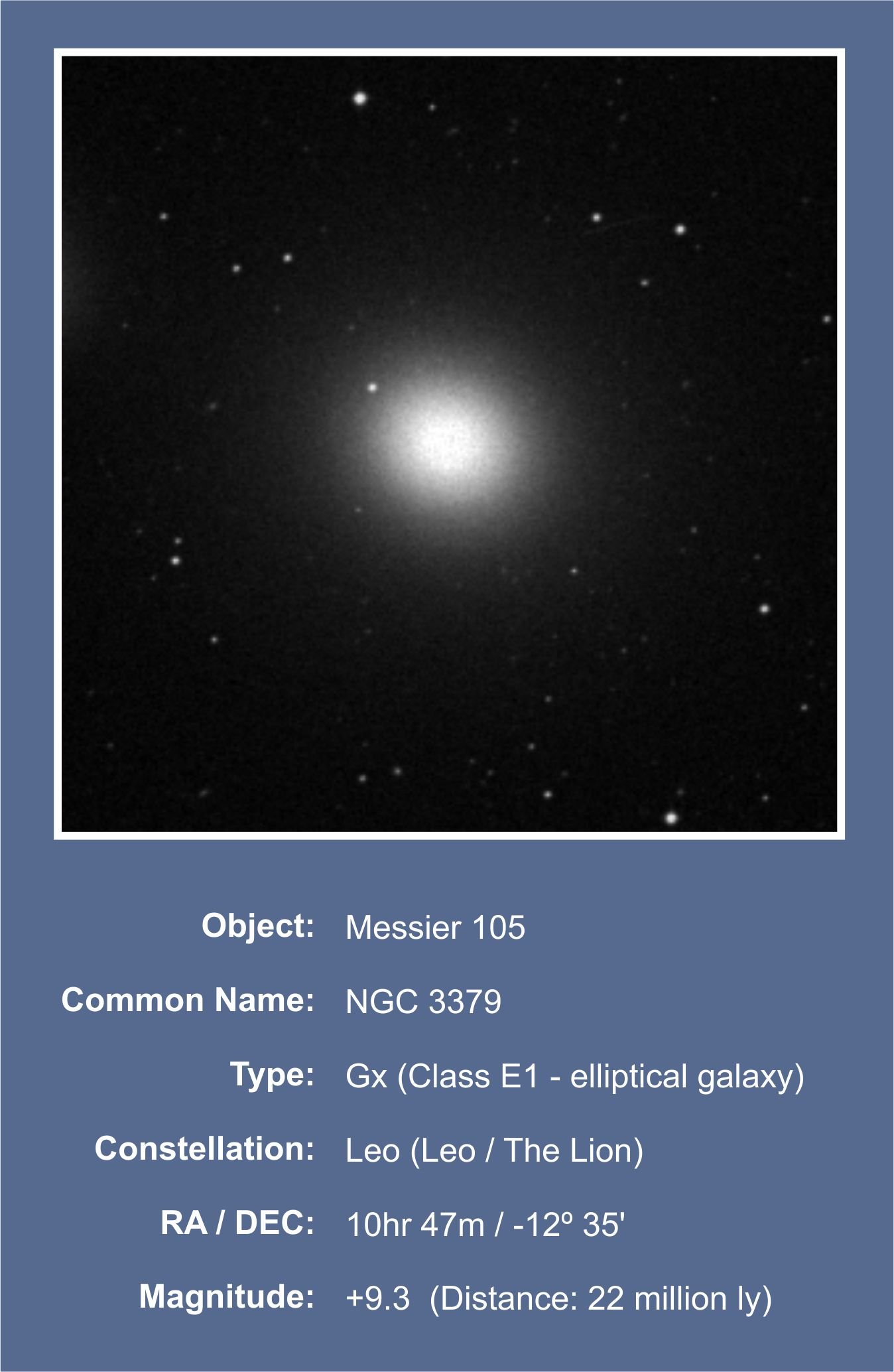
- Messier 105
Asmooth, oval appearance with little gas or dust, typical of elliptical galaxies. It is composed mainly of older, reddish stars and has very little ongoing star formation.
oooo
oooo
More objects in Leo
| Select Catalog | No of Objects |
| Barnard (B) | 0x object |
| Caldwell (C) | 1x object |
| Collinder (Cr) | 0x object |
| New General Catalogue (NGC) | 385x objects |
| Index Catalogue (IC) | 442x objects |
| Sharpless (Sh2) | 0x object |
oooo
Features of Interest
- Leo Triplet – Probably the most interesting member of the Leo Triplet was too faint for Messier to notice.
o - NGC 2903 – Other pretty spiral galaxy in Leo, which Charles Messier missed when compiling his catalog.
OOOO
OOOO
Named Stars
- Regulus (Alpha Leo)
- Denebola (Beta Leo)
- Algieba (Gamma 1 Leo)
- Zosma (Delta Leo)
- Ras Elased Australis (Epsilon Leo)
- Adhafera (Zeta Leo)
- Chort (Theta Leo)
- Al Minliar al Asad (Kappa Leo)
- Alterf (Lambda Leo)
- Ras Elased Borealis (Mu Leo)
- Subra (Omicron Leo)
- more list of stars in Leo
oooo
oooo
Planetarium / Constellation Map
| Live constellation visible from the UK :- Planetarium (Leo) | Best Seen in: April (map) | Seen between: January and June |
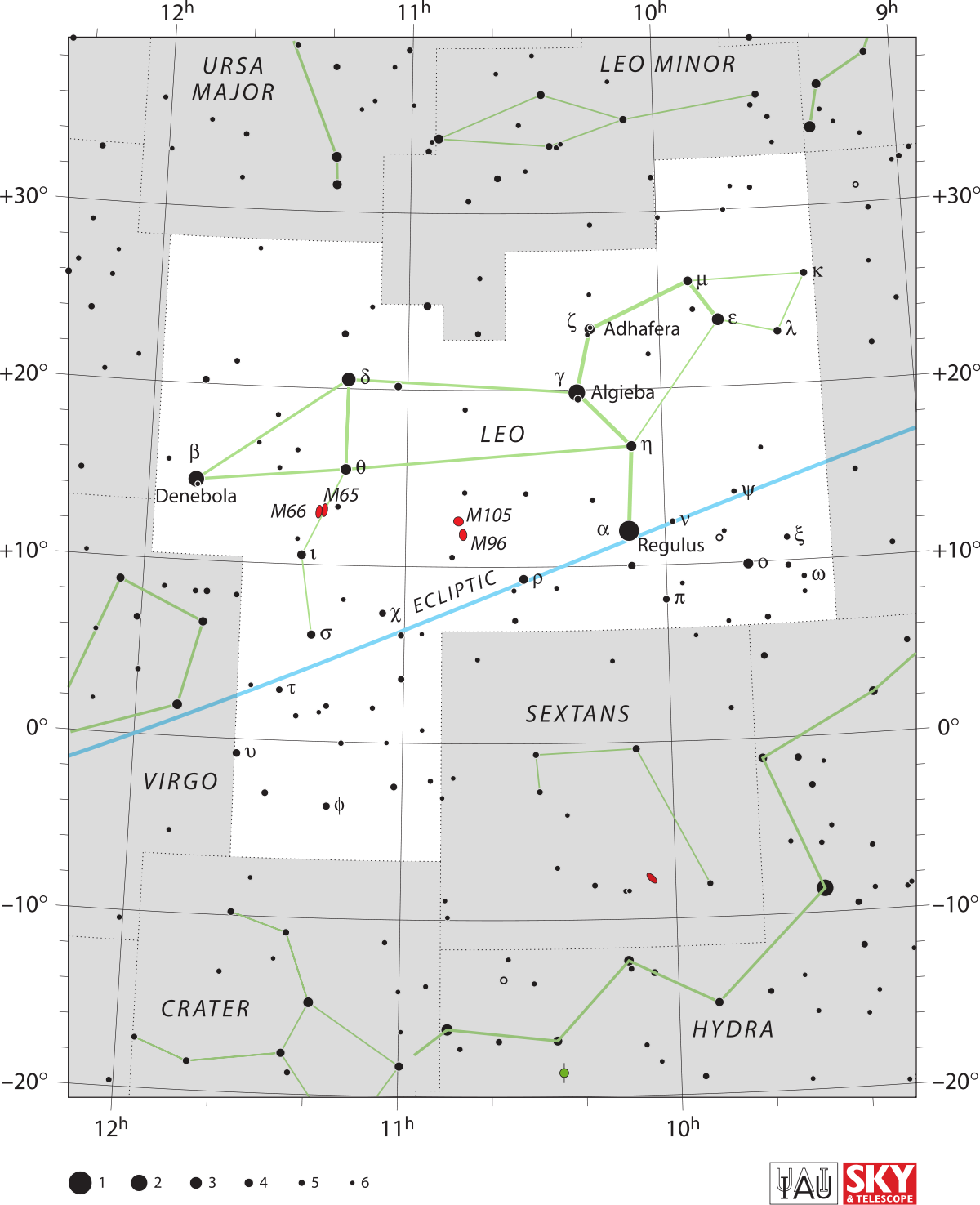
IAU Sky Chart: Leo
OOOO
Constellations – Visible from the UK
OOOO
oooo
Parts visible from the UK
| Antlia | Columba | Eridanus | Fornax | Microscopium | ||
| Piscis Austrinus | Puppis | Pyxis | Sagittarius | Scorpius | ||
| Sculptor |
oooo
oooo
Constellations: Southern Celestial Hemisphere
…..– never seen from the UK
oooo
ooooooo
OOOO