OOOO
| Abbreviation: Mon (Monoceros) |
| English Name: The Unicorn |
| Genitive: Lucida |
| Hemisphere: Northern and Southern Hemisphere. (Bold means the more area in square feet in Southern Hemisphere.) |
| Location: Between the constellations of Canis Minor and Orion. |
| Visible between latitudes: +75 and -85 degrees |
| Best season: Late winter |
| Seen in three seasons: Autumn, Winter and Spring |
| Best seen in: February (map) and March (map) |
| Seen between: February and April |
| Right Ascension (RA): 07 hour |
| Declination (DEC): -05 degrees |
| Area (square degrees): 482 square degrees (35th) |
OOOO
Monoceros (The Unicorn)
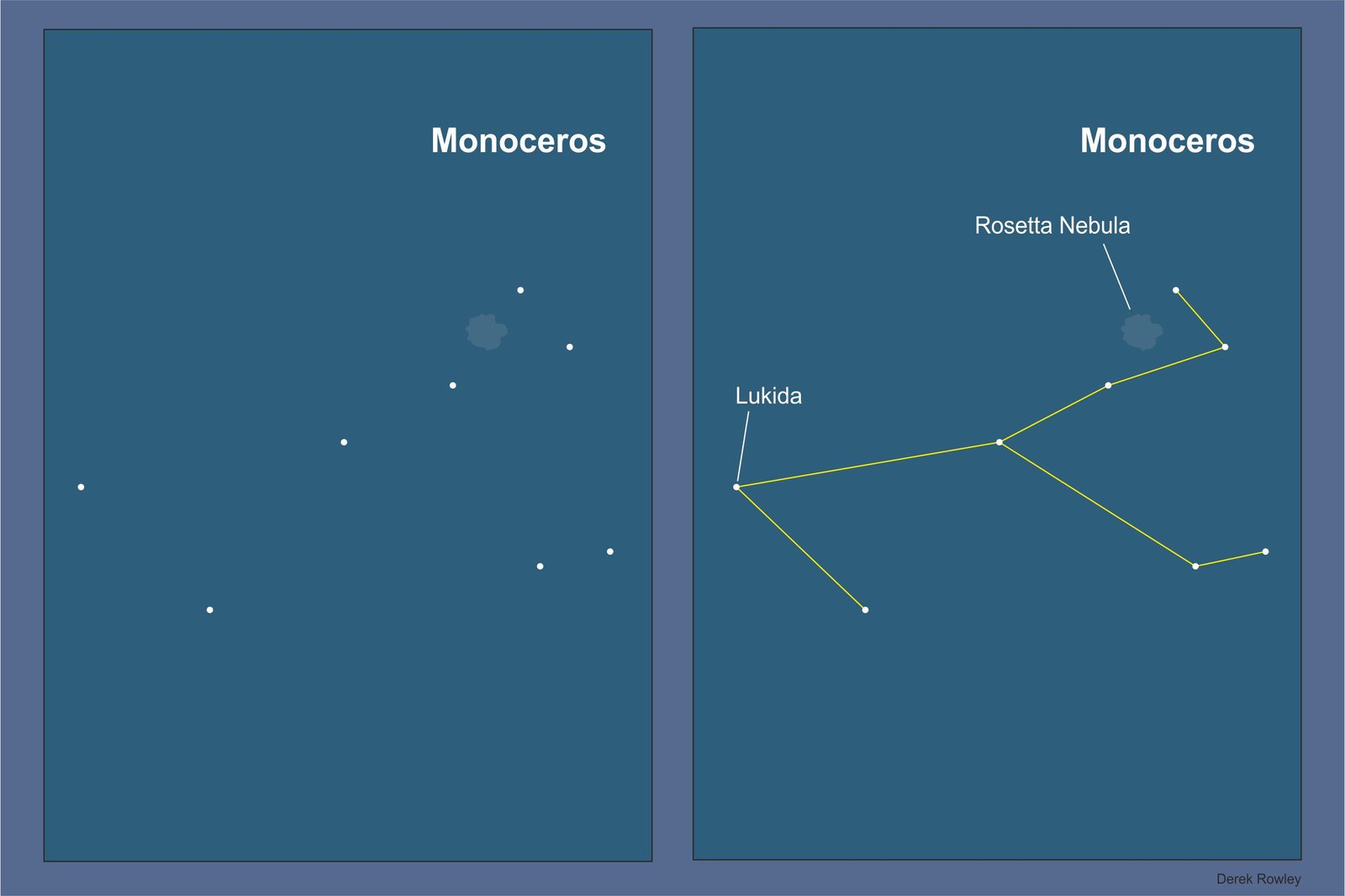
- Monoceros is not very easily seen with the naked-eye, but often overlooked in favour of its glittering neighbouring constellations – specially Orion, but it lies in the Milky-Way.
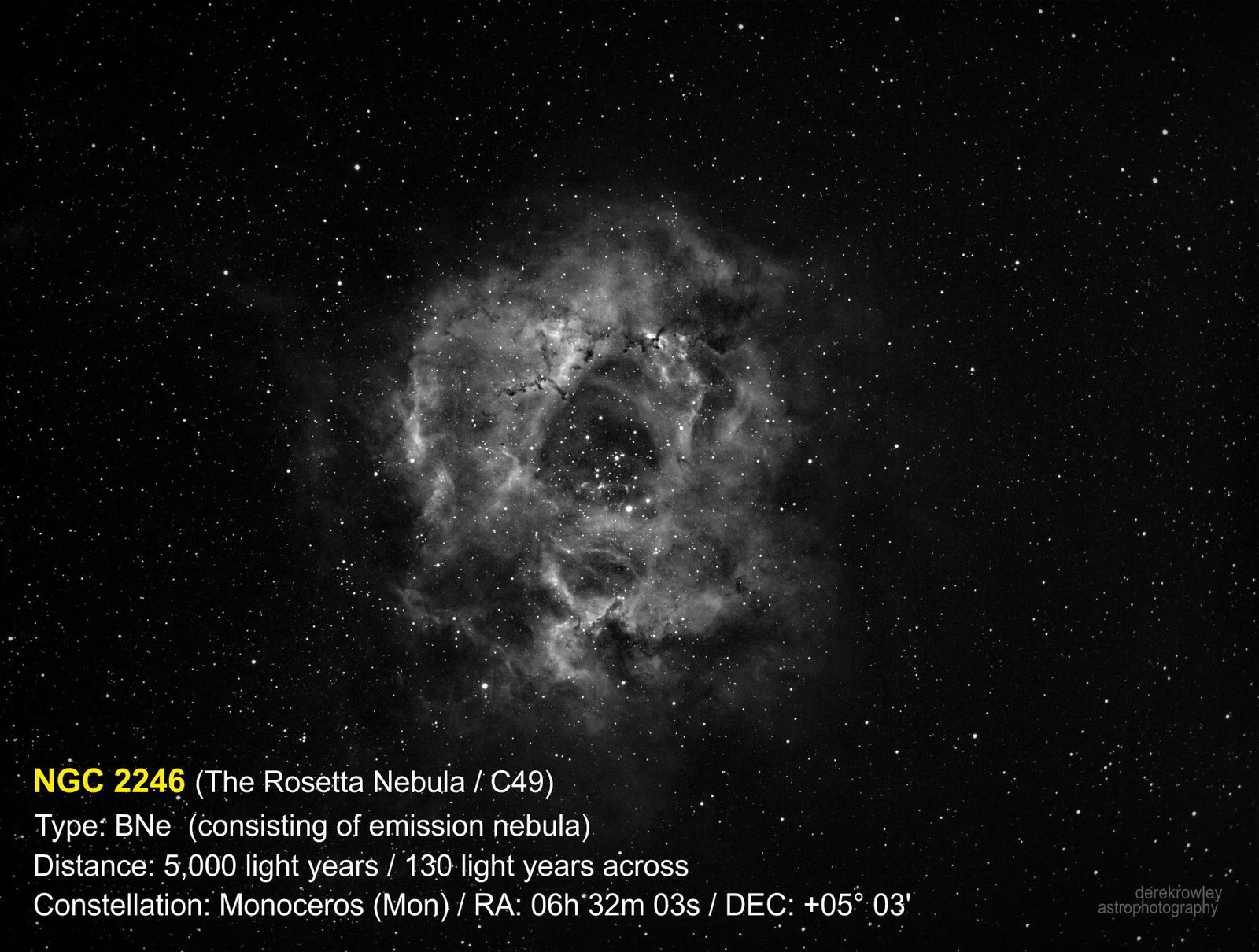
o - It contains some famous clusters and nebulae – Rosette Nebula, also the Open Cluster – Messier 50 (M50).
o - Also the massive binary known as Plaskett’s Star.
o - However, Monoceros does have some interesting features to observe with the aid of a small telescope. Beta Monocerotis is an impressive triple star system, the three stars forming a triangle which seems to be fixed.
OOOO
OOOO
Messier Objects in Monoceros
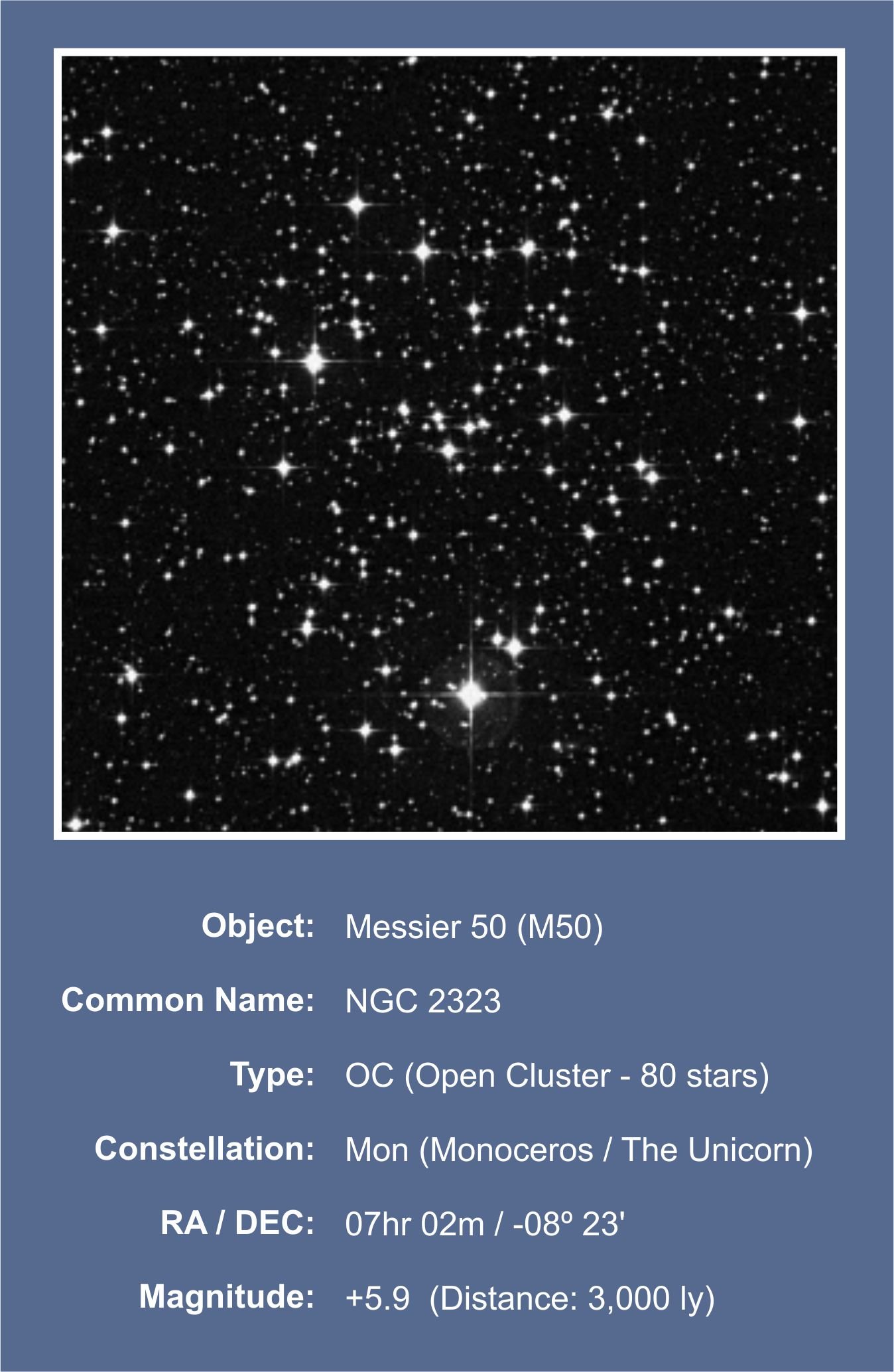
- Messier 50
Open Cluster; remarkable objects – about half the apparent size of the Full Moon and easily visible in binoculars.
oooo
oooo
Other Objects in Monoceros
| Select Catalog | No of Objects |
| Barnard (B) | 0x object |
| Caldwell (C) | 4x objects |
| Collinder (Cr) | 39x objects |
| New General Catalogue (NGC) | 58x objects |
| Index Catalogue (IC) | 9x objects |
| Sharpless (Sh2) | 14x objects |
oooo
Features of Interest
- NGC 2244 – The stars of Open Cluster (at the centre of this picture) are enveloped in the Rosette Nebula. The Open Cluster is easily visible through binoculars – however, excellent skies are needed to trace the outline of the surrounding Rosette Nebula which is four times larger to show up well only on photographs.
o - NGC 2264 – Open Cluster; viewed through a small telescope it appears triangular in shape; also known as Christmas Tree Cluster or Cone Nebula.
OOOO
OOOO
Named Stars
- Alpha Monocerotis (Lucida)
- more list of stars in Monoceros.
oooo
oooo
Planetarium / Constellation Map
| Live constellation visible from the UK :- Planetarium (Monoceros) | Best Seen in: February (map) and March (map) | Seen between: February and April |
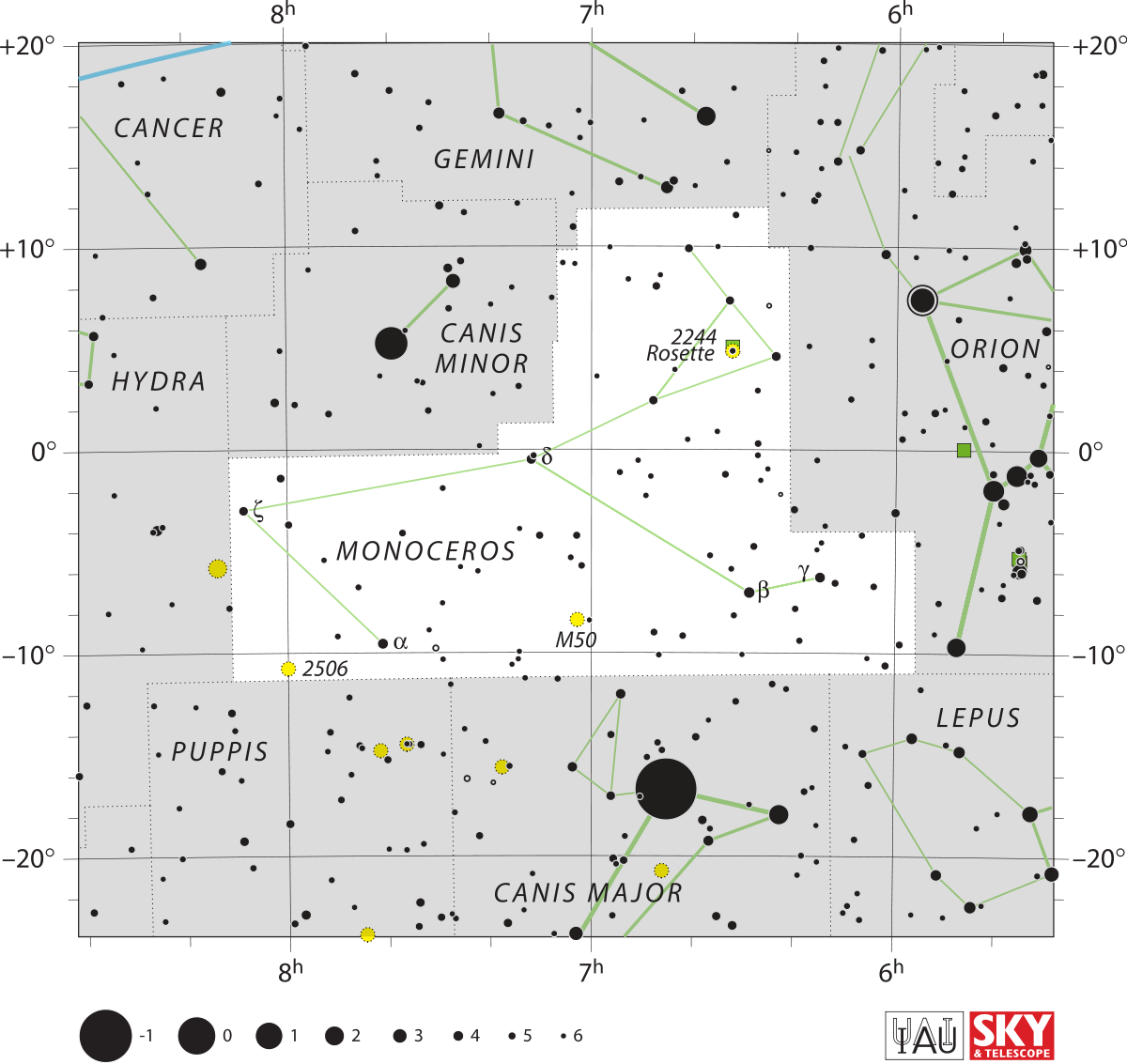
IAU Sky Chart: Monoceros
oooo
Constellations – Visible from the UK
OOOO
oooo
Parts visible from the UK
| Antlia | Columba | Eridanus | Fornax | Microscopium | ||
| Piscis Austrinus | Puppis | Pyxis | Sagittarius | Scorpius | ||
| Sculptor |
oooo
oooo
Constellations: Southern Celestial Hemisphere
…..– never seen from the UK
oooo
oooooooo
OOOO
OOOO