




Monday 20th April 2026

  • Best viewing
    – Start looking between 30 minutes and 45 minutes before sunrise.
    – Just before sunrise, looking toward the eastern horizon with a very clear, unobstructed view.
    – Face East and find a low, clear horizon free of buildings or trees.
    o
  • Binoculars help with Mercury, which will be low and faint.
    o
  • Mercury also has a close conjunction with Saturn in the morning twilight.
    o
  • Mercury will still be quite low and faint in bright twilight, so binoculars greatly improve chances of spotting it.
    o
  • Mercury (magnitude: -0.6) will be brighter than Mars (magnitude: +1.2) and Saturn (magnitude: +0.9) but still low on the horizon in early morning twilight.
    o

Posted in Homepage (Posts) | Comments Off on Monday 20th April 2026

Sunday 19th April 2026

  • Look about 30–60 minutes after sunset when the sky is a bit darker but the horizon still bright enough to catch Venus and the thin crescent.
    o
  • Face west with an unobstructed horizon.
    o
  • Binoculars will help you pick out the Pleiades cluster more easily once the sky darkens.
    o

Posted in Homepage (Posts) | Comments Off on Sunday 19th April 2026

Sunday 19th April 2026

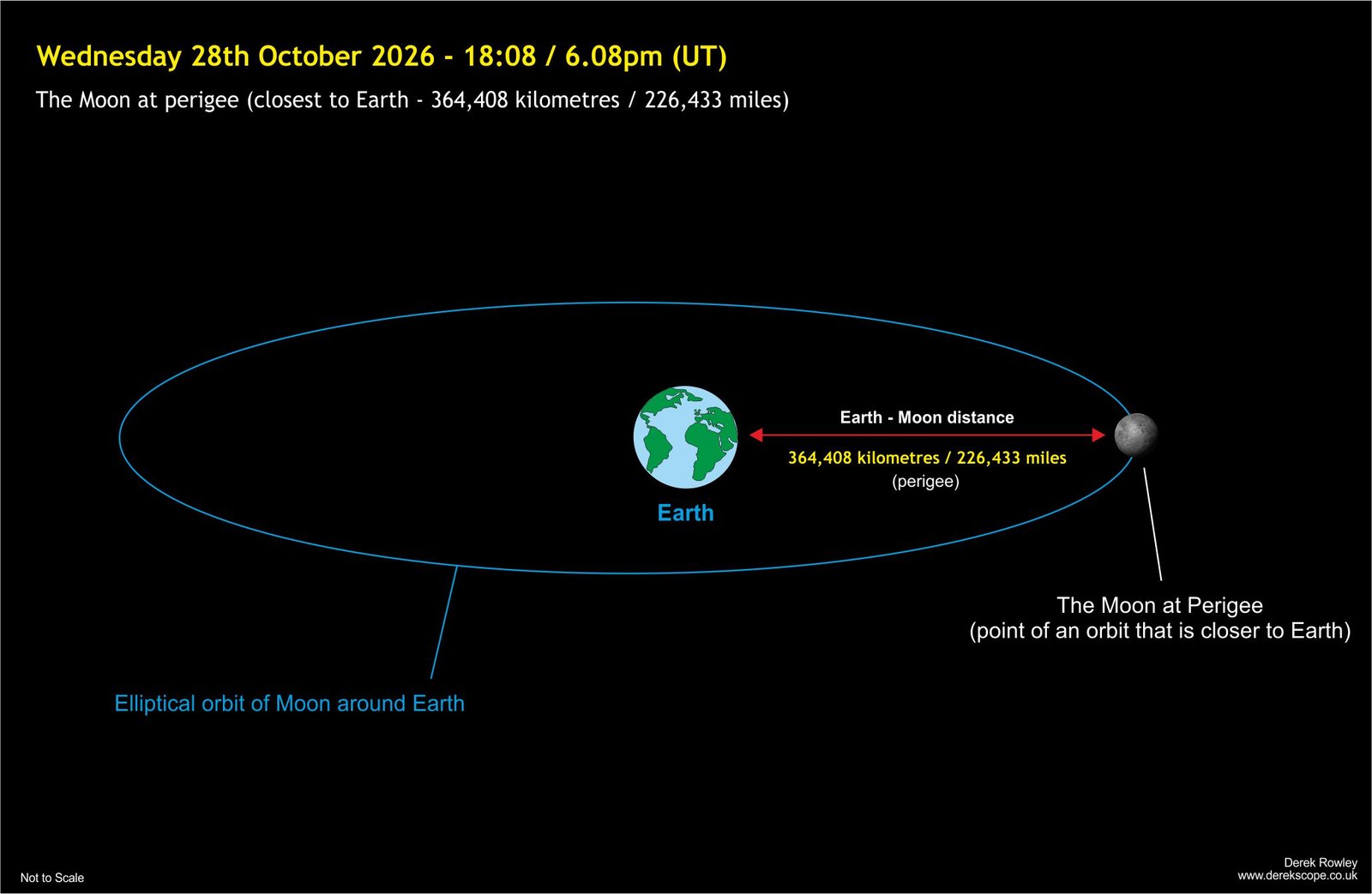
  • The Moon will reach perigee, its closest point to Earth, at 8:54am today, sits in the constellation Taurus (The Bull).
    o

2026 Apogee Dates
(Moon Furthest from Earth)

  • Tuesday 13th January
  • Tuesday 10th February
  • Tuesday 10th March
  • Tuesday 7th April
  • Monday 4th May
  • Monday 1st June
  • Thursday 28th June
  • Saturday 25th July
  • Saturday 22nd August
  • Saturday 19th September
  • Friday 16th October
  • Thursday 13th November
  • Friday 11th December

2026 Perigee Dates
(Moon Closest to Earth)

  • Thursday 1st January
  • Thursday 29th January
  • Monday 24th February
  • Saturday 22nd March
  • Sunday 30th March
  • Sunday 19th April
  • Sunday 17th May
  • Monday 15th June
  • Monday 13th July
  • Monday 10th August
  • Sunday 6th September
  • Thursday 1st October
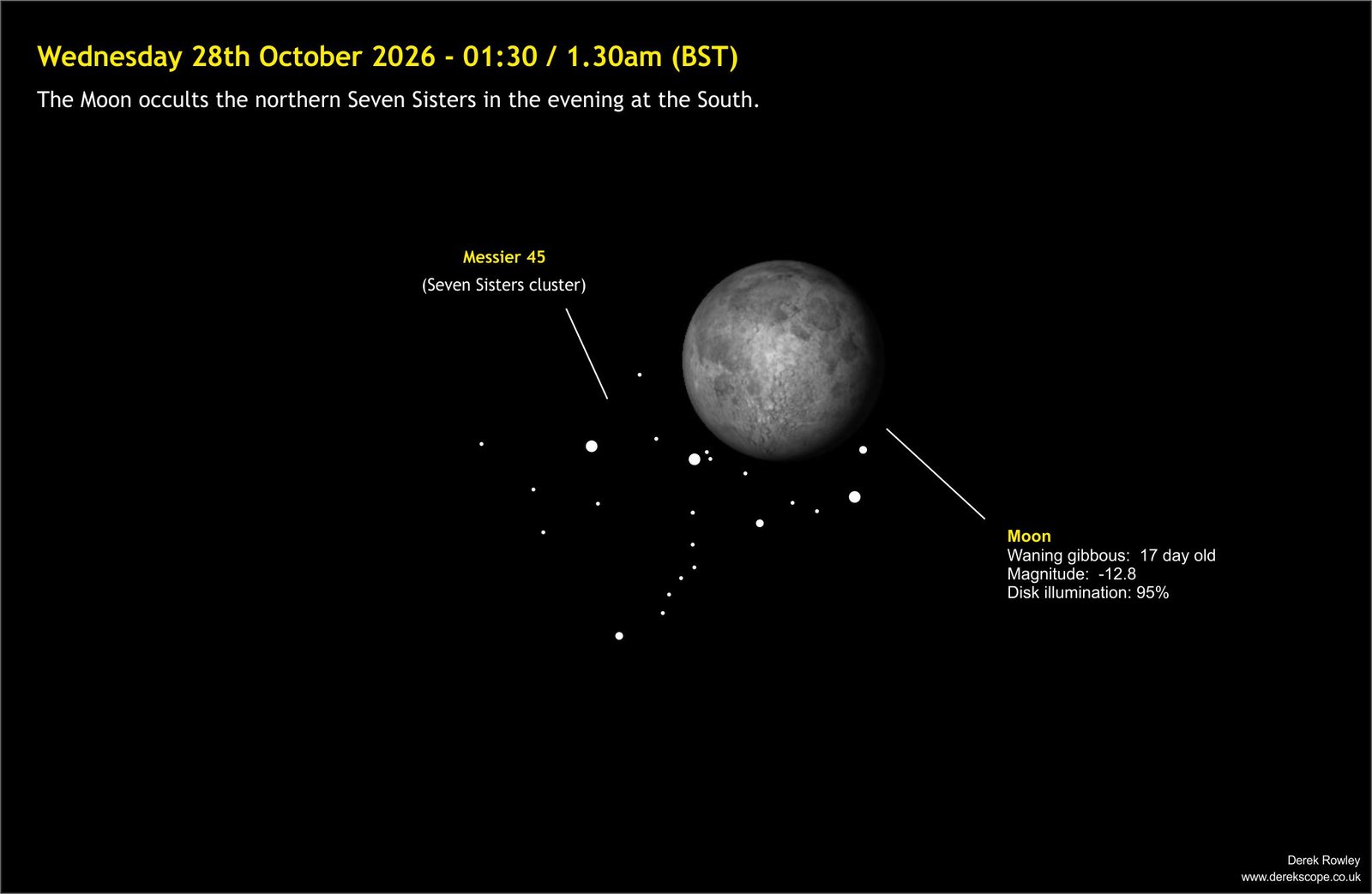
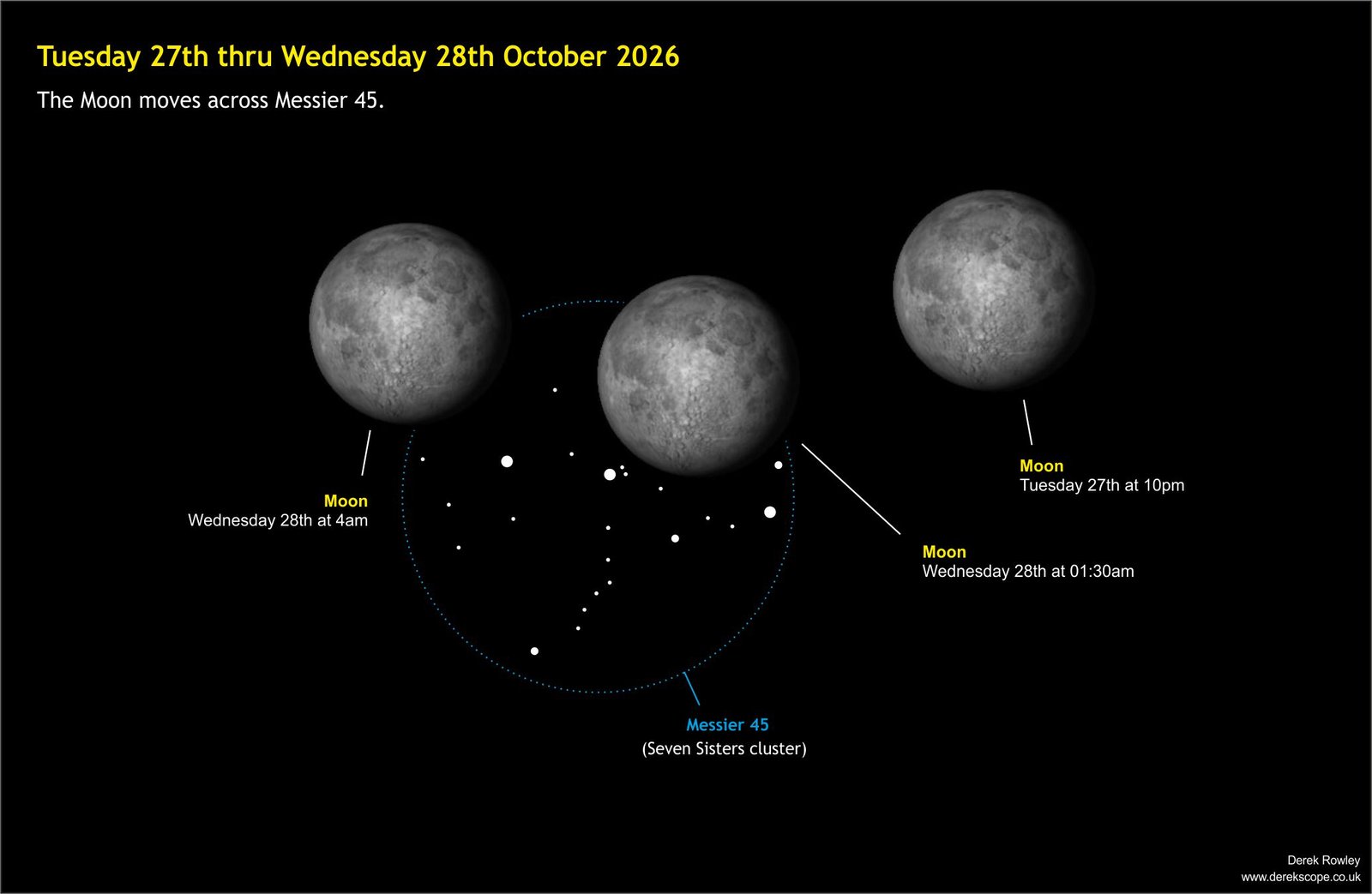
  • Wednesday 28th October
  • Wednesday 25th November
  • Thursday 24th December
    oooo

Posted in Homepage (Posts) | Comments Off on Sunday 19th April 2026

Thursday 16th April 2026

  • The Moon will rise in the east-southeast sky.
    o
  • There are three planets near the Moon might disappear quickly as the sky brightens;

    Mercury (very small and tricky to spot!)
    Mars (looks like a tiny reddish dot.)
    Saturn (looks like a steady pale light ~ you need a telescope to see its rings.)
    o

Posted in Homepage (Posts) | Comments Off on Thursday 16th April 2026

Artemis II is HOME!

Mission communication from Derek
A Q&A for Deaf members about the Artemis landing.
(With signWOW iPads,
our video calls open a clear visual path,
giving Deaf members full sign‑language

access wherever they are.)
oooo

Artemis II is COMPLETE!

  • Orion splashed down safely in the Pacific.
    o
  • The crew are healthy and smiling.
    o
  • This is the first human return from the Moon’s neighbourhood since Apollo.

    oooo

What next now?

  • A big step toward humans walking on the Moon again ~ the next human Moon walk is currently targeted for Artemis IV, not Artemis III.
    o
  • Artemis III is now an Earth‑orbit test mission
    – Full Orion spacecraft checkout.
    – Life‑support and long‑duration crew systems.
    – Docking tests.
    – Mission‑duration rehearsal for lunar operations.
    – Possibly testing interfaces needed for future Starship docking.
    – 4 crew astronauts will spend roughly 30 days in space, validating everything needed for Artemis IV.
    o
  • Next Moon walk: planned for 2028 ~ Artemis IV will take two astronauts to the Moon’s South Pole.
    oooo
    oooo

Posted in Homepage (Posts) | Comments Off on Artemis II is HOME!

Friday 10th April 2026

  • The Moon reaches its exact Last Quarter phase at 05:51am in the constellation Sagittarius.
    o
  • Moonrise at 03:44am on 10th April, Transit at 07:23am (South 180º) and moonset at 11:02am.
    o

Posted in Homepage (Posts) | Comments Off on Friday 10th April 2026

Tuesday 7th April 2026

  • The Moon reaches apogee ~ the farthest point in its orbit from Earth.
    o
  • The Moon appears slightly smaller and dimmer in the sky compared to perigee.
    o

2026 Apogee Dates
(Moon Furthest from Earth)

  • Tuesday 13th January
  • Tuesday 10th February
  • Tuesday 10th March
  • Tuesday 7th April
  • Monday 4th May
  • Monday 1st June
  • Thursday 28th June
  • Saturday 25th July
  • Saturday 22nd August
  • Saturday 19th September
  • Friday 16th October
  • Thursday 13th November
  • Friday 11th December

2026 Perigee Dates
(Moon Closest to Earth)

  • Thursday 1st January
  • Thursday 29th January
  • Monday 24th February
  • Saturday 22nd March
  • Sunday 30th March
  • Sunday 19th April
  • Sunday 17th May
  • Monday 15th June
  • Monday 13th July
  • Monday 10th August
  • Sunday 6th September
  • Thursday 1st October
  • Wednesday 28th October
  • Wednesday 25th November
  • Thursday 24th December
    oooo

Posted in Homepage (Posts) | Comments Off on Tuesday 7th April 2026

Friday 3rd April

  • Mercury reaches its greatest eastern elongation – that’s meaning it will be difficult visible in the early morning sky, so at these times.
    o
  • Mercury will be at its farthest apparent distance from the Sun as viewed from Earth.
    o

Posted in Homepage (Posts) | Comments Off on Friday 3rd April

Thursday 2nd April 2026

  • Spica will be visible close to the Moon ~ easy to spot.
    o
  • The Moon is at full phase (Full Moon), binoculars may help you spot Spica more easily next to the Moon.
    o

Posted in Homepage (Posts) | Comments Off on Thursday 2nd April 2026

Thursday 2nd April 2026

  • It will be in the constellation Virgo and is traditionally called the Pink Moon* for the US or Egg Moon* for the UK , it’s not about the Moon turning pink ~ it’s about spring arriving.
    o
  • Best spectacle
    – Moonrise on Wednesday 1st April or moonset on Thursday 2nd April, when the Moon appears oversized due to the Moon illusion.
    o
  • Traditional Full Moon Names and their Meanings
    – Full Moon names reflect seasonal changes and natural rhythms observed by early cultures, particularly those influenced by UK colonial traditions and Native American heritage.
    o
    – Learn more about traditional Full Moon Names and their Meanings ~ Read more*.
    o


Posted in Homepage (Posts) | Comments Off on Thursday 2nd April 2026